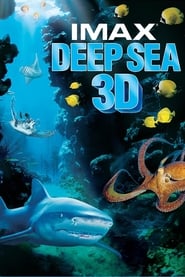
Deep Sea 3D
Scarica il sottotitolo English
Informazioni sulla release
Tag
Anteprima dei sottotitoli in English
Le prime 144 righe.
These are not visitors from an alien planet.
Nor are they science fiction.
They are real.
Creatures of our own world.
And their destiny ...
is linked to ours.
Coral mountains rise more than half a mile from the floor of the Caribbean Sea.
They were built, inch by inch, over centuries ...
by billions of coral animals.
But the animals didn't do it alone.
Tiny plants living inside the coral ...
capture energy from the sun to make its food.
Neither plant nor coral ...
can survive without the other.
And that's the key:
The whole reef community is built on relationships.
Little fish live here.
And big fish eat little fish.
He's a 100-pound black grouper.
And he's always hungry.
But for the community to remain in balance ...
the prey needs a fair chance at survival too.
And nature provides some ingenious ways to even the odds.
Take the frogfish.
He hides from predators by looking like a sponge.
In his disguise ...
the frogfish can sit back and attract lunch ...
with a fishing pole mounted on his forehead.
Glassy minnows.
Like quicksilver.
That black grouper on the ledge is hoping to catch one.
The shimmering school dances for good reason.
It's very hard for the grouper to isolate a single minnow.
And he often fails.
There's more diversity here than anywhere else on Earth.
And every single citizen, from the tiniest fish ...
to the ferocious tiger shark, must depend upon others to survive.
The balance between predator and prey is always shifting.
But the community stays healthy and whole ...
because there are so many different relationships between so many species.
Sometimes ...
even the coral itself is prey.
The crown-of-thorns sea star.
He eats coral.
Too many of these could wipe out an entire reef.
The triton trumpet snail hunts sea stars.
Although the snail is almost blind ...
it can smell the sea star's trail.
Those nasty thorns are full of venom.
But the snail is immune.
- What's that? - It's called a proboscis.
And he'll use it to drill through the stars leathery hide.
Then he'll inject a venom ...
that will dissolve the sea star from the inside out.
So the triton trumpet snail helps save the coral.
And that helps keep the reef's eco system in balance.
Even different species you'd think would be enemies ...
often help each other.
This is a cleaning station.
A sort of a dermatology clinic.
The spotted coney is the patient.
The little cleaner gobies move over his skin ...
removing and eating parasites.
Both species benefit.
It's called symbiosis.
Another cleaning station.
Away from this spot ...
the barracuda might swallow the little Spanish hogfish whole.
When he's being cleaned, the barracuda seems to call a truce.
The cleaning station is a sanctuary.
Green sea turtles love coming to this reef near the island of Hawaii.
It's sort of an undersea spa.
Amazingly, it's only the size of a living room.
But even coming from miles away ...
they somehow manage to find this special spot.
When algae accumulates on their shells, it can really slow them down.
But the reef fish give them a good scrub.
In exchange, the turtles give the reef fish a healthy vegetarian feast.
Some don't even wait their turn.
They swoop in close to other turtles to steal away the school.
With her shell beautifully polished ...
she now returns to her migrations ...
which may take her thousands of miles away ...
through the trackless open sea ...
where jellyfish drift through liquid skies.
That pulsing is how it swims.
Each pulse also forces tiny animals inward ...
where they are stunned and consumed.
Thousands of different species of jellyfish ride the currents ...
like sailors in a gale.
Most are solitary travelers.
But moon jellies sometimes swarm together in astonishing numbers.
They know not what lies in wait below.
A monster jellyfish ensnares them in a venomous web ...
that can stretch more than 30 feet across.
The stinging filaments slowly drag them in toward the translucent bell ...
where they will be dissolved and digested.
For some mysterious reason ...
it's called the "fried egg" jellyfish.
Ocean currents can sweep entire kelp forests ...
away from California's Channel Islands and out into the open sea.
The drifting kelp rafts are a favorite gathering place ...
for one of the strangest creatures in the ocean.
It's called a Mola mola.
This one's about 5 feet across.
But he can grow to more than 4,000 pounds ...
mostly on a gossamer diet of jellyfish.
But Molas don't come here for food.
They come here to be cleaned by halfmoon perch.
It's a cleaning station in the open sea.
Looks like this time, the entire family came along.
Currents are as vital to life under- water as rain is to life on land.
Along the North Pacific Coast ...
they sweep nutrients up from the depths to nourish a dense growth of plankton.
The basket star has sensed the current ...
and opens serpentine arms to snare passing tidbits.
Barnacles are feasting too.
They stick out their furry little legs to catch food.
The translucent creatures clinging to the kelp ...
are called nudibranchs.
They come in a thousand varieties.
They're close relatives of the common garden slug ...
but much more beautiful.
These are hooded nudibranchs.
They use their hoods to scoop in water ...
then slowly squeeze out all but the food.
The hairy arms of feather stars are great for combing out food.
But in a pinch ...
they're even better for escaping from marauders.
The marauder is a sun star ...
and it will eat a feather star if it can catch one.
But it much prefers to dine on juicy shellfish ...
especially sea scallops.
Did that one bite back?
What an intriguing landscape.
It's home to one of the oddest relationships ever between a predator and its prey.
It's actually a forest of animals known as tube anemones.
They protect themselves with stinging cells hidden in their tentacles.
But there's a predator who covets those stingers.
It's a rainbow nudibranch.
And he's a thief.
He eats tube anemone tentacles.
But he doesn't digest the stinging cells.
Instead, he'll pass them on into the feathery gills on his back ...
Deep Sea 3D subtitles in other languages
More English subtitles for Deep Sea 3D
- Deep Sea [Blu-ray] (2006) English · 72 downloads · 2019-04-04
- IMAX Deep Sea 2006 1080p BluRay x264-DON · 47 downloads · 2018-05-25
- IMAX Deep Sea 3D 2006 Blu-ray · 54 downloads · 2016-06-30
- Deep Sea 3D BDRip by Rotten · 39 downloads · 2011-03-01
- Imax Deep Sea DVDRip XviD LKRG · 48 downloads · 2010-07-10
- IMAX Deep Sea 2006 Blu-ray 720p AC3 HDBRiSe · 41 downloads · 2009-08-07
- Deep Sea 3D 2006 LiMiTED PROPER DVDRip XviD-LPD · 41 downloads · 2007-08-06
Commenti
No comments yet. Be the first to leave one.