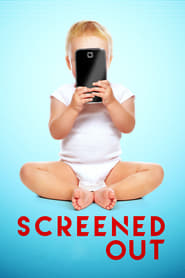
Screened Out
Scarica il sottotitolo English
Informazioni sulla release
Tag
Anteprima dei sottotitoli in English
Le prime 200 righe.
These are changing human relationships,
family relationships, with enormous consequences.
Technology companies have been very, very opportunistic
about hiring very smart behavioral psychologists
to brain-hack and to make these devices
purposely compulsing.
What company can say they have billions of subscribers?
Billions of users?
With a B.
We know what the problems are.
We're living them in our house.
We don't hear about solutions from big tech companies.
We don't hear about solutions from our schools.
And if Mom or Dad is staring at their phone,
then the kid is gonna say,
"That's the way I'm expected to behave in the world."
Well, it's very close to an actual drug addiction.
MRI scans, which really show the scan
of a cocaine addict who's high.
It's an emerging public health crisis
of internet addiction.
Yup, that was me.
I was never good at sports.
That's probably why I became a filmmaker.
Although I always enjoyed being active outside
and having playtime with my family and friends,
building lasting memories with real people.
That guy with the dad bod right there?
That's me now.
I still like being outside,
but nowadays, I can have most of my interactions
conveniently located in my pocket, on a smartphone.
And, gee, do I love my phone.
However, I think we may all share the same problem.
I look at it all the time.
It's the first thing I check in the morning.
My entertainment while traveling to work.
My conversations with people at lunch.
And it's the last thing I see before bed,
while watching an even larger screen in front of me.
Just like me, my wife also checks her phone
far too often during the day.
Being a stay-at-home mom,
it's how she keeps in touch with the outside world
while taking care of our three busy boys.
We often chat about our phone use
and if we are addicted to our smartphones.
People say, "Oh, I'm so addicted to my phone."
Do you think you're addicted to your phone?
Yeah.
It's like smoking a cigarette.
When there's a lull in the conversation,
it used to be like, you would be like,
"Oh, I'm gonna go have a cigarette,"
and that would be like something
to get you out of that lull.
Whereas now, if there's a lull, you just check your phone.
How annoying is it when, 'cause there's so much stuff
to do around the house and I'm looking at my phone?
Very annoying. (LAUGHS)
And, boy, am I distracted by my smartphone.
It pulls me away from my work,
my children, and my relationships
by feeding me constant updates and notifications,
usually unimportant,
but it's something I feel I'm compelled to check.
So what am I looking at?
Like most of you, I'm checking emails, news,
but mostly social media.
And we may be looking too much.
According to research, 70% of adults
spend almost three to five hours per day online.
Some may be hitting seven hours.
80% of those hours logged are on a mobile device.
And a recent study shows
that this can add up to seven years of our lives
spent using a smartphone, liking, tweeting,
and taking pictures of our food and children.
And my problems focusing may have long-term effects
because of the smartphone.
A study done by Microsoft
revealed the average attention span
dropped from 12 seconds to eight
since the mobile revolution began,
which makes our attention span second below a goldfish,
which is only nine.
And what about our kids?
While my boys are very active,
adventurous, fun little guys,
the screen devices are a hot commodity around here.
They seem mesmerized, like I seem to be when using them,
and taking them away is difficult.
The tone and the behavior, as soon as the screen goes on
and has to be turned off, is dramatic.
Ahh, he's doing all that?
- I hate my life. - I hate you.
Why are you making me get off the screen?
According to Common Sense Media, children up to age eight
are spending up to three hours a day consuming screen media,
children eight to 12 spend closer to five hours,
and teenagers can be more than six
and even up to nine hours.
What exactly are these devices doing
to their long-term mental and social well-being?
And our kids get to watch us all day long
being drawn back into our screens.
What do our behaviors teach them?
We may not be paying attention to them when they need us to.
So I decided to hit the road and get some answers
about what these devices are doing to us
and how they're impacting the younger generation
who's growing up in a fully connected, wired world.
Most people I talked to said they were, quote,
"addicted" to their smartphone
and could not live without it.
So is this real addiction?
And what is an addiction anyway?
I would say addiction is a loss of control
around a particular behavior,
whether it's ingesting substances or alcohol
or engaging in a particular behavior.
So it's a loss of control
and it's a pattern of having a loss of control
that's negatively impacting your life.
So what about looking at our phones
150 times a day?
Is this an addiction?
Are we screen-addicted?
To us, it really is addictive-compulsive behavior.
Just go to a meeting or go to a restaurant
or go to an airport and look at the people,
and see them glued to their screens
as opposed to paying attention to the people around them.
It affects our personal relationships.
It affects our love lives.
It affects our ability to concentrate and our personalities
and how we work and, really, who we are.
And I think that makes it one
of the most pervasive addictions
and potentially dangerous ones.
Ultimately, people have free will.
They have the ability to put down their phones.
But I think these companies are doing everything they can
to short-circuit free will and, in a way,
to make us forget that we ever had it in the first place.
When we think of addiction, we think of substances,
something that you put in your body
and that changes the way you experience the world.
That's been true of addiction for centuries,
millennia, forever, basically.
But things have changed, so now addiction can also apply
to things that are behavioral where there is no substance.
And that's what I'm interested in:
a behavior that is so well designed,
an experience that is so well engineered
that you can effectively become addicted to that experience
in the absence of any drug.
That's really where screens come in, because most of those,
the vast majority of those experiences that are addictive
happen on screens.
I think we're actually being too cautious
in recognizing this is a problem.
Think about it very simply.
All of the aspects of gambling addiction are present.
In fact, those are the exact mechanisms
that are being built in.
And this is why checking our smartphones all day
may not be our fault.
In fact, it may not even be the devices, but what's on it.
Most apps we use have been designed
to monetize our attention
and keep us logging on as much as possible.
And what these app companies have learned,
like gambling and slot machines before them,
is that we are not addicted to the tech,
but we are, in fact, addicted to getting rewards.
Intermittent rewards, to be exact.
And what the heck
are intermittent rewards anyway?
Slot machines.
What keeps people playing them for hours and hours?
Why don't we stop playing after a win, big or small?
Well, this is because of what psychologists call
the most powerful motivator on the planet:
intermittent rewards.
Now, you might imagine intuitively
that you want rewards all the time.
You know, you go do something, you get a reward,
you do it again, you get a reward,
and so on until the end of time.
That's actually not that interesting to humans
or any animals, really.
What we like is unpredictability.
We like randomness.
Many years ago,
influential American psychologist, Professor B.F. Skinner,
ran experiments to help us all
better understand our behaviors.
He used animal subjects,
in this case, a pigeon,
More English subtitles for Screened Out
- Screened Out 2020 NORDiC WEB-DL XviD AC3-FGT · 29 downloads · 2021-01-21
Commenti
No comments yet. Be the first to leave one.