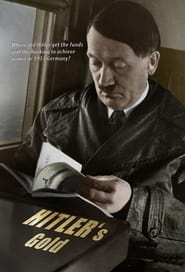
Hitler's Gold
Scarica il sottotitolo English
Informazioni sulla release
Tag
Download English Subtitle Files for Mobile (4)
Anteprima dei sottotitoli in English
Le prime 200 righe.
Germany. September the 12th, 1919.
At the Sterneckerbrau restaurant
located in the heart of Munich's Old Town,
history is about to be changed by a single man.
He was basically a loser.
I mean, his chosen profession, to be an artist,
it was a failure.
He barely earned a living.
There was nothing that would mark him out for greatness.
For the past few months,
a new political movement known as the German Workers' Party
has been holding regular meetings
at the Leiberzimmer on the first floor.
He had attended a lecture
in which a professor had advocated
a various splitting off from the rest of Germany.
He got up to rebut this professor
and he launched into a tirade.
And when he stopped speaking, he looked around
and he could see people with their mouths hanging open.
That stranger's rant
would impress Anton Drexler,
the founder of the German workers movement,
who would invite him to join the party.
Drexler would later write to a friend.
An absurd little man
has become number seven in our party.
13 years later on January the 30th, 1933,
and that absurd little man would be saluted
and acclaimed by thousands on the packed streets of Berlin
as the new chancellor of Germany.
We read that a funny little man called Hitler
had come into power in Germany.
The Nazi Party became a huge organization,
and when we see the propaganda tactics that they did,
it becomes obvious how much money was needed.
But how was that even possible
when Germany had been on her knees economically
since the end of World War I?
Who paid for the massive propaganda machine
that helped Hitler become a media sensation,
tour the country in a private airplane,
and even build his own private army?
He's backed by these petitions
signed by prominent far-right politicians
and industrialists and bankers.
You've got a lot of powerful people supporting Hitler.
Was Hitler being manipulated
by the shadowy financiers and industrialists
who were funding his irresistible rise to power?
Or was Hitler the one doing the manipulating?
All along when they started to say
that he was a puppet of big business,
Hitler said, "Come and have a look
at the accounts of the Nazi Party,
and you'll see that all of our money
comes from membership fees."
August, 1936.
The height of the Nazis' glory and power.
Hitler was the supreme fuhrer of a resurgent German Reich.
Its growing economy was admired and envied
by leaders from around the world,
who flocked to the epic opening ceremony
of the Berlin Olympics.
Not even the triumphs of America's new track and field star
could spoil Hitler's opportunity
to show off on the world stage.
A few months later, in a note in his diary,
Hitler's propaganda minister Joseph Goebbels
couldn't help but reflect on the meteoric rise of the Nazis
since their chaotic attempt to stage a coup and seize power
in the aborted Munich Beer Hall Putsch of 1923.
How poor we were then.
The fuhrer tells how he wanted to shoot himself once
because the bill debt grew over his head.
Goebbels was writing about a time
when the very idea of Hitler as fuhrer of Germany
would have been laughable.
When the man who would become Germany's supreme leader
was fresh out of prison
for his failed Beer Hall Putsch of 1923,
banned from speaking in public
and struggling to keep his party against internal divisions
and soaring financial debt.
This was the third devastating blow
Hitler had suffered in his life
after losing his beloved mother
to breast cancer when he was just 18.
And then, the humiliation of defeat
at the hands of Britain, France, and America
in the First World War.
Back then, Hitler was a mere army corporal.
Though Austrian by birth,
he had proved his loyalty to Germany
and her Prussian ideals by his bravery in the trenches.
There was nothing that would mark him out for greatness
except that he had won the Iron Cross.
When he joined the German army in World War I,
they put a rifle in his hand, they gave him self-discipline,
they taught him how to kill,
and he was a completely different character
coming out of that war.
After the German capitulation,
Hitler feared for his future in the army,
the only place where he had so far found
the purpose and recognition that he was looking for,
but the impoverished and increasingly desperate
Weimar Republic would be fertile hunting ground
for his extremist ideas.
And of course, we have these sort of famous images
of people taking wheelbarrows full of money
to buy one loaf of bread and a bit of ham.
It is absolutely chaotic.
You know, the country is in a mess,
so that creates a lot of resentment,
and what you get emerging in Germany
is increasing political fanaticism.
So what you've got is a country
becoming more and more poor, more and more fanatical.
It's the perfect breeding ground
for a fanatic like Adolf Hitler.
During his military service,
Hitler had shown he had the gift of gab
and a knack with public speaking,
with which he had openly voiced
his strong nationalist beliefs.
This was something the new German army,
the Reichswehr, could make good use of.
At the end of the war, he would be drafted
into the army's new education and propaganda division.
He kept on an army salary and his job
was to talk to the troops before they were demobilized
and keep them loyal to Germany and the army,
keep them from going over to communism.
And his commander was a Captain Mayer
who spotted his talent early.
Captain Karl Mayer
was a young ambitious officer
with a talent for picking the right agents
and choosing the right missions.
These skills earned him the commanding post
of the education and propaganda department in Munich,
and he would be the man who,
with the help of the army's secret slush fund,
would kickstart the Hitler money trail.
In 1919, the Treaty of Versailles
had dictated that the German army
should be limited to only 100,000 men.
To tackle these terms, the commanding officers
created a special money reserve
that would be kept under the noses
of the allied supervising commission
and finance a secret army reserve
named the Black Reichswehr.
This was mostly formed
by nationalist private paramilitary organizations
made up of demobilized soldiers from the Great War
and known as the Freikorps,
who would be used to fight and contain
the growing number of communist uprisings in the streets.
There's no doubt that some of these paramilitary groups
were being financed by the army
because the army had the intention of suppressing socialism.
In a way, the army in Germany
was a kind of state within a state.
It was sort of saying, look, we call the shots here.
We want to have a big say in who rules Germany.
So that's why the army was getting involved.
Black Reichswehr funds would also be used
to infiltrate newly emerging political organizations
and disrupt those who could pose
a potential threat to the army
or support those who were sympathetic to their aims,
such as the German Workers' Party.
They get Hitler to go along to a meeting
of this Deutsche Workers' Party led by Anton Drexler,
and he goes along.
He's supposed to actually be eavesdropping on them
to take information.
And that's how Adolf Hitler would be invited
to join the German Workers' Party, the DAP,
which would eventually become the Nazi Party.
Karl Mayer trusted his agent's capacity
and would give him an extra 20 gold marks a week
on top of his salary for the young corporal to help
in the fledgling party's expansion.
Mayer's investment paid off.
In just a few weeks,
Hitler would organize his first public speech
on October the 16th, 1919,
before an audience of 111 people.
On February the 20th of the following year,
more than 2000 would listen to the presentation
of the 25-point party program at the Hofbrauhaus in Munich.
Hitler would soon become the party's star speaker,
mesmerizing audiences hungry for someone
who could show them new direction.
In 1921, Hitler would be elected
the leader of the now-rebranded
National Socialist German Workers' Party,
Commenti
No comments yet. Be the first to leave one.