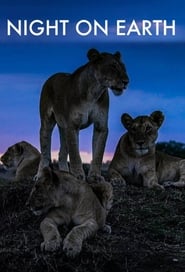
Night on Earth
English 字幕をダウンロード
リリース情報
タグ
English字幕のプレビュー
最初の200行です。
Night on Earth takes us around the globe
to showcase incredible wildlife stories
that take place after dark.
From tropical rain forests
to the urban jungle...
...arctic ice
to African plains...
...crews worked the night shift...
...and used an array of cutting-edge camera technology.
And then there was light.
Look at that.
Some used ultrasensitive cameras
that can shoot in full color
with just the faint light of the Moon.
Others filmed animals with thermal imaging gear
designed for the battlefield.
- Oh! - With groundbreaking technology
came groundbreaking science.
We're using drones technology to count flamingos nesting.
Biologists provided their expertise
on newfound animal behaviors.
There they are. The cubs are calling.
But even they were amazed at what our cameras revealed.
That's incredible.
Is that what I think it is?
Shooting from the air...
the land...
and under the water.
Enduring freezing cold...
...and tropical heat.
Whatever it took to capture Night on Earth.
Moonlight-sensitive cameras were first put to the test
on Mexico's Caribbean coast.
The crew's mission:
to record the nocturnal behavior of flamingos...
on a remote lagoon on the Yucatan Peninsula.
The flamingos nest in a protected reserve...
only accessible with the help of biologist Alexander Dzib.
It should be a beautiful tonight. There are a few clouds, but, um...
not where the moon is coming.
His expertise will be vital in getting our crew close.
Even so, getting into position isn't easy.
So the flamingo colony is out on a little island, uh,
which offers it some protection from predators.
Which means for us, we've gotta cross this water to get there.
It's not that deep, but...
we've gotta run the gauntlet of crocodiles.
Both American and Morelet's crocodiles lurk here,
preying on flamingo chicks that stray from the flock.
We've loaded all our kit up into a boat.
It's pretty heavy, so we're gonna have to walk alongside the boat.
If anything happens, jump in the boat.
So we just have to walk up to this tower,
and from there, I'll get into my hide...
and slowly inch along.
Get as close as I can without scaring them off the nests.
Now Ralph just has to wait for nightfall
to put the low-light camera through its paces.
Specialist camera tech also plays a role in Alexander's studies.
At the moment, we're using drones technology
in order to count flamingos nesting.
And we count one by one.
Imagine counting 20,000 birds.
It takes at least close to a week to finish that work.
Once hunted by people,
the number of birds here was in decline.
But with protection, the flock is growing again.
This year, we have 21,900 nests.
So, that means close to 44,000 flamingos,
so there is increase of 7,000 more flamingos on the last years.
Over nearly two decades of flamingo research,
one thing Alexander hasn't been able to do
is record what happens after dark.
But Ralph is going to change that.
I can't see. I can't see anything with my eyes.
I have to only look through the camera.
It's hard to believe the light of the moon is enough
for such color and detail.
The camera is doing a fantastic job.
I've got this beautiful pink line of flamingos
all standing there looking fantastic in this light.
I can see stars in the skies.
I'm really impressed with the images.
The super-sensitive camera proved its worth,
showing us a familiar animal in a completely new light.
The next step...
was to use it and other cutting-edge cameras
to reveal behaviors never seen before.
One crew follow the lead
to one of Africa's most famous reserves:
Kenya's Maasai Mara.
To film alongside wildlife after dark,
they mount the moonlight camera onto a four-wheel drive.
To make all of that camera system work outside,
we have to have a lot of equipment in here.
It looks like wires going everywhere, but everything has its place,
going out... out the window to the gimbal system,
going to the front to the cameraman,
sound, uh, GPS...
It's all got a use, but it's, uh, quite crazy in here.
Setup complete, cameraman Jamie McPherson
sits up front with his viewfinder and control deck.
It's a short drive to the gates of the reserve...
where they pick up Dr. Femke Broekhuis,
director of the Mara Cheetah Project.
She's studied cheetahs for over a decade.
This is the first time I've been in a vehicle like this with a film crew,
and we're hoping to capture the cheetahs and see what they get up to at night.
So we've just gotten information
that cheetahs have been seen, so we're just on our way to try and find them.
Data from GPS tracking collars has shown Femke
that, against expectations,
these cats are very active after dark.
Now, she'll get to see for herself.
Headlights would disturb the wildlife,
so Baz uses night vision goggles.
To drive during the night is very difficult,
'cause you cannot see any distance,
or sometimes you have to just predict where you're driving.
You cannot tell if there is a ditch or there is a hole,
so it's quite dangerous.
You have to be very careful.
With Baz at the wheel,
the crew just about keep up with the cheetahs.
And the moonlight-sensitive camera is showing its power.
That's incredible.
It's honestly like it's daytime.
I mean, the image is so clear.
I never thought I'd see any cheetah,
but especially these cheetahs, like this at night.
I think this is absolutely incredible.
As Femke's data suggested, these cheetahs are on the move.
The team will stick close and keep their camera trained,
hoping to catch more moonlight activity.
Half a world away...
without the light of a full moon...
another crew used a different night vision camera.
On Peru's southern desert coast...
...they're looking for something sinister.
Field biologist Marco Cardeña
leads the long hike to the sea caves
where their targets are found.
For safety, they trek down the cliff paths in daylight,
along trails strewn with millions of seabird feathers.
It's like someone's had a massive pillow fight here, but it's really stinky.
It's full of dust,
so it's not the best place.
The dust gets everywhere...
and its source becomes clear.
Four hundred thousand nesting cormorants.
Gotta be very careful we don't scare them into the air,
'cause if we do, then all the predators like seagulls will come in,
take away the chicks or the eggs.
So we keep a low profile as well, so we don't break the horizon too much.
'Cause as soon as we do that, we become very conspicuous.
We'll wait a couple of minutes.
The locals have the right of way.
Just waiting for some penguins... like you do.
But birds are not what Marco has led them down here for.
These caverns house a colony of bats.
To peer into the pitch-dark interior,
Luke uses a thermal imaging camera...
which detects heat instead of seeing light.
I look up here, it's just black, but on the camera...
- Oh. Ahh. - Yeah. There they are.
- That's amazing. - Yeah.
And these bats are vampires.
Marco, I've got one question.
When they come out, are they gonna try and bite me?
I... I'm not sure of the neck.
I think... Normally, try to... the hands.
- Then, eh, try to cover... - Okay.
A few nights at the vampire roost
gets Luke some great shots.
Arteries intact, the next mission
is to film the bats where they feed:
a nearby colony of fur seals.
Luke will use this crane arm to get sweeping shots across the beach.
So the whole fur seal colony has come out of the water to rest.
And they're all just chilling out for the evening.
All the cubs are feeding with their mothers.
The vampire bats are gonna come out of the darkness at some point.
Their arrival puts Luke on edge.
It's quite a spooky place to be at night, because... I can only see this screen.
Everything else around me is black.
I mean, the sounds are echoing off the cliff behind me.
I've had a rat run up me in the night that I thought was a vampire bat.
And I'm just hoping the bats don't like the taste of me.
Luke's still on high alert, when suddenly...
...the beach is thrown into disarray.
We've got a huge male sea lion that's come up the beach.
He's full of testosterone and anger,
and he just wants to grab hold of the pups and kill them.
Let's hope they get away.
Something we weren't expecting.
We came to see vampire bats,
and I see this guy terrorizes this beach at night.
All the pups dash up the cliff.
And while they're up there,
the vampire bats are coming in and feeding on them, so...
Night on Earth subtitles in other languages
More English subtitles for Night on Earth
- S01 - NF WEB-DL - NTG / GHOSTS / CiELOS / ION10 · 17 downloads · 2020-01-29
- S01 - NF WEB-DL - NTG / GHOSTS / CiELOS / ION10 · 15 downloads · 2020-01-29
- Night on Earth S00E01 Shot in the Dark 2020 NF WEB-DL DD5 1 x264-NTG · 23 downloads · 2020-01-29
- Night on Earth S01 WEBRip x264-ION10 · 21 downloads · 2020-01-29
- Night on Earth S01 WEBRip x264-ION10 · 17 downloads · 2020-01-29
コメント
No comments yet. Be the first to leave one.