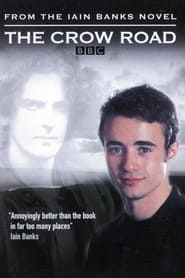
The Crow Road
English 자막 다운로드
Download English Subtitle Files for Mobile (5)
English 자막 미리보기
처음 179줄입니다.
Iain, at what stage did you start writing seriously? What age were you?
I started trying to write seriously when I was about 14.
And, um... I tried to write this very much Alistair McLean influenced spy story.
It didn't really work. it wasn't even the Wright length.
I thought it seemed about the Wright number of words,
but when I counted them up, it was about 25,000-30,000.
I thought I'd finished an entire novel, but it turned out it wasn't quite that length.
- Is this when you were at school? - Yes.
What were your favourite subjects at school?
Well, English, oddly enough, cos it was easy.
And I quite liked physics and chemistry, but only sort of the practical side of it.
I wasn't very good at maths,
and obviously the more deeply you go into both physics and chemistry,
you started to have stuff with equations and...
What subjects did you do at university?
English, philosophy and psychology. I actually got better marks in philosophy,
because you can waffle more in psychology, frankly.
English you have to have... They expected you to have read the books.
But, philosophy, yeah, I got better marks in that,
and I'd done the same amount of course work.
Why did you choose those subjects?
I mean, English, obviously, but why psychology, why philosophy?
It's a little embarrassing, actually. I wanted to be a writer, so I thought "Well...
- Already? - Oh, yes.
This is quite seriously from the age of about 16 or whatever.
So, I thought "I want to be a writer, what do you do to be a writer?"
You've got to do English literature, because it's the obvious thing.
"Books have to have a meaning"
So, I thought "Philosophy, I'll be able to philosophise the novels"
And you've got to have convincing characters, therefore, obviously, psychology.
So they were very deliberately chosen?
Absolutely, chosen in remorseless cold-bloodedness.
Did it work?
I don't think so, no, but I enjoyed doing it.
I loved doing philosophy and I quite enjoyed a lot of the psychology,
apart from the statistics, which meant back to equations and formulae again.
It worked in a sense I think any sort of university course works
If it's relatively benign in its effects on your life in terms of time.
There was one... semester in particular,
when I was at Stirling, I was doing the above mentioned subjects,
and I had about five hours or six hours of dedicated teaching time in my whole week,
and I was talking to people who I knew were doing physics and chemistry
at Strathclyde or Glasgow and they had a working week - 36, 37, 38 hours a week.
I thought "Um, gulp" I think if you've got that amount of free time,
which, obviously, one's supposed to be reading the approved texts,
you could also be working your own stuff, whatever.
I think that kind of helps - just the general atmosphere of being at university.
What was the career plan after university then?
Because you can't apply for a job as a writer.
No, I thought you could.
After that I was just going to keep on writing books.
I'd written two proper full-size novels - in fact one beyond proper full-size by that time.
I just wanted to keep on writing, keep on sending stuff away.
But in the meantime, how were you going to feed yourself?
With lots of wee daft jobs, which back in the mid to late 70s, I had quite a few of.
Such as?
Oh, well, the one that I did, the one I like to drag out
is when I worked for six months for IBM in Greenock.
I was an expediter/analyser.
What is that?
- You wanted me to ask. - Yes. It's IBM for clerk, actually.
Do you see any relationship, any direct relationship
between the kind of life experiences you've had in these jobs, or indeed in any other area,
and the fiction that you write?
I hope not, no. Well, not directly, no.
An awful lot of the stuff that I'm writing about, there's quite a lot of conflict
There's some warfare involved and I haven't had any experience of that sort of thing at all
I started out doing that
The book that was like the second attempt at the first novel...
Which is after Alistair McLean?
It's still influenced by Alistair McLean - it was Alistair McLean with lots of sex.
I was 16 and you know, fizzing with hormones, dear.
And it was absolutely full of sex and violence,
which at the age of 16, neither of which I knew very much about,
and to this day, still not sex.
So, um, it was like...
My course was set even then,
when I was writing all these things full of machine-gun fire and rampant rumpy-pumpy,
when I was 16, and that's hardly changed.
One of the things I find really interesting about your books
is that although they are, for want of a better word, very much mainstream fiction,
they're like Hollywood movies in a sense -
they're addressed at the biggest possible readership that you can get,
but you're quite distint from, I would say, probably the majority of other Scottish writers,
who tend to write in a much more direct, familiar, recognisable way about Scotland,
about themselves, about the common experiences that we all have.
I'm thinking of people like William McIlvanney, Janice Galloway and so on.
Now, what I was wondering was how do you character wise,
or do you character wise your fiction as different from that?
Do you say "I'm not that kind of writer, I'm some other kind of writer"
and what is that other kind of writer?
I see what you mean.
The distinction is obviously there.
It's...
There's a casualness to the whole thing though.
It's not something that I've set out to do.
It's just me trying to write books, trying to tells stories,
and these happen to be the sort of stories I'm interested in writing.
Who's your ideal writer in that case?
Well, me! I'm trying to write what I want to read.
It's as simple as that I'm trying to write exactly what, if I wasn't a writer,
If I had a proper job out there, you know, in book-buying land,
I'd be my biggest fan, you know.
I'd be "God, that Banks guy's great! That's what I'd like to write if I could."
That's what George Lucas said about Star Wars.
Yeah, I know. I read a book about.. what was it? Empire Building about Lucas,
and I thought "Yeah, I'm a bit that way as well, except not nearly as rich of course."
Yeah, I think there is a kind of...
I think it also perhaps involves not growing up properly.
Why do you say that?
Because you still want to slightly shock,
but also, you want to amuse and you want to go for the big effects,
and I think there's a real distinction between serious literature,
which is supposed to only really appeal to the intellect, Wright,
- and stuff which... - No.
Well, I don't think it should, but this is often the way it's taken, Wright,
and I think this is why there can be a sort of selecting process,
that keeps... people like me out of the Booker Prize, I suppose,
even out of the list
I thought I might've got in by now, just as local colour, not to win it.
Well, for staying the course.
Well, yes, exactly. I want my long-service medal.
The Booker Prize for persistence.
So, I think because I'm writing stuff that, I do, I get a physical effect out of people.
I want them to laugh out loud at my books, on trains. I want them to cry or whatever.
I don't particularly into writing pornography,
but if I was, I'd want them to get sexually aroused.
I think there's a strand of particularly Oxbridge culture that finds that very suspicious.
Only the mind should be...
The highs from literature should affect only the mind, the body should remain -
the heart should not pump, the glands should not secrete.
That's because there's now the distinction between the so-called literary novel
and the entertainment it's that kind of thing, isn't it?
Dickens, that would have been absolutely...
The distinction you're drawing there would have made no sense to Dickens.
I know, yes, that's why it's only come about in the last century or so.
In fact, during this century really. it's the same thing I guess, now.
And it's the groves of academe...
...they're enforcing this, in a sense,
in terms of the effect that academic criticism can have on literature.
I think there's a lot of people writing books designed to be criticised.
To go back to what you were saying
- about you being your own ideal reader. - Yes.
How has that ideal reader changed over the years?
Because presumably the person you were writing for when you wrote The Wasp Factory,
which was probably written many years before it was published in 1984...
About two/three years before, yeah.
How does the reader of The Wasp Factory, or the ideal reader of The Wasp Factory
differ from the ideal reader today?
Um, probably, disappointingly not very much I think. Not much has changed.
I think I probably appreciate the precise way that words are put together,
or sentences are put together better.
I have a slightly better appreciation of the way that the book as an entire entity works,
but there's probably been relatively little real development
Maybe if I had been involved in an academic literary course or something,
I might develop more.
Is there a sense in which one of the things that you want to do,
that you expect from a book is to learn something from it?
I've always felt that one of the reasons that we have this huge appetite for fiction
is that we can't experience all the kinds of things that are on offer,
and so reading, particularly in adolescence, but continuing into later life,
reading in adolescence is very much a way of finding out things about the world
that you can't find out directly - is that something that's going on in your books?
Again, not subconsciously.
It must be there but it's not something I'm deliberately setting out to do.
It may come about to a degree because I'm trying to do different things each time,
or attempting not to write the same book every year, or whatever,
or even every second year, given every second year is science fiction.
That might lead to me going further afield as it were.
What have been the most successful of your books,
either financially or in terms of reader response?
Do you get a lot of response? Do people write letters to you?
Yes, I think still The Wasp Factory, it's been out there the longest
I think it's sold to the most foreign territories or whatever, so...
I think The Crow Road, having been on television, that makes a big difference as well
What was that experience like watching it - just sitting watching it?
Nerve-racking, initially, until I realised it was actually rather good.
After that, it was OK, but I was very nervous initially.
I was very sort of... just worried that they might make a mess of it,
댓글
No comments yet. Be the first to leave one.