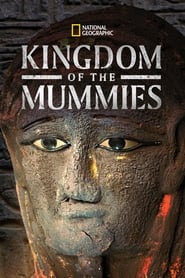
Kingdom of the Mummies
English 자막 다운로드
릴리스 정보
태그
English 자막 미리보기
처음 200줄입니다.
100 ft beneath the Egyptian desert, a team of archaeologists
is carefully dismantling an ancient stone wall.
We are expecting the unexpected.
They're searching for evidence of a burial chamber,
hidden for the past 2,500 years.
The work is risky.
Is it safe to remove the wall? Or not safe?
But the potential reward is a discovery that could help unlock
the secrets of life and death in ancient Egypt.
Oh, there's stuff in there.
Ramadan, there's stuff in there.
Let me see.
No way.
We thought it's going to be big, but this is huge.
I think I am a very lucky egyptologist.
Saqqara, Egypt.
In the shadow of the world's oldest pyramid, renowned egyptologist,
doctor Ramadan Hussein and his team of archaeologists
are investigating a ground breaking new site.
This is one of the most beautiful mummies I have ever seen in my life.
A 2,500 year old funeral home where ancient Egyptians, rich and poor,
were mummified and buried deep underground.
What makes the site so special is that nothing remotely like it has ever been found before.
Personally, I never thought I would be making discoveries like this,
we were always collecting information about ancient Egyptians.
But discovering this magnitude is absolutely
unprecedented in Egyptian archaeology.
The first clue that this is no ordinary
site is a deep pit carved from solid limestone.
We made a big discovery in the form of an intact shaft,
it's about 13 meters deep.
At this point I've realised this shaft is an embalmers cache,
a hiding place that the ancient Egyptian embalmers used to collect all the tools
and the vessels they used during mummification.
The team has also found other deep shafts.
Now it's using the latest laser scanning technology
to take its investigations to the next level.
We use a laser scanner to get the big picture of the whole site.
We're doing the two scans, put them over there.
To reconstruct the whole site with all context,
with all objects in high resolution.
By stitching dozens of scans together,
the team is mapping the complex both above ground and below.
The scans reveal a network of shafts and passageways stretching nearly 100ft down
and leading to a set of burial chambers untouched for thousands of years.
From the style of pottery found in the shaft,
the chambers have all been dated to around 600 BC
when the practice of mummification was at its peak.
It's Ramadan’s mission to decode this sprawling site and re-write the book
on mummification and burial in ancient Egypt.
To reach the burial chambers, the team has had to clear over 450 tons of sand
from a vertical shaft known as K.
This is a fabulous shaft, this one's been cut through limestone
of varying qualities.
You can see that the ancient Egyptians have shored it up a bit to make sure
that things don't come collapsing down.
And it's extraordinarily deep, it's 30 meters.
At the bottom of K, 100ft is a hallway with five adjoining chambers;
two to the west, two to the north and one to the east.
Inside these rooms, Ramadan and his team are uncovering an incredible range
of treasurers, including the first silver mummy mask
found in Egypt for nearly a century.
It's very rare, you don't find it every day.
Grave goods to provide the dead
with everything they needed in the afterlife,
plus dozens of embalming cups containing traces
of the actual oils used during mummification.
And Ramadan suspects that the complex has even more secrets to share.
Today we're very interested to explore this area right here.
Where we standing on the first hallway, we have one burial chamber on the west,
but on the east we have this wall, the Egyptians were always consistent,
I think there might be another burial chamber behind this wall.
We're moving one stone so we can get a better look at what's behind.
Oh, there's stuff in there!
Ramadan, there's stuff in there.
- What's in there? - There's this
dark stuff that looks as if it's mummy residue,
resonate substance of some sort.
It's an encouraging start, but not everyone is happy.
Yes, I’m concerned because some of these rocks are cracked,
so cracking means that it is overloaded.
Now what we were discussing, is it safe to remove the wall, or not safe?
After weighing up the risk, Ayman gives the okay to continue.
Let me see.
No way.
It does seem to be an opening of some sort that keeps on going.
This is the surprise we're looking for.
Oh my god.
This is the hole that keeps giving.
Oh wow, this is unbelievable.
This looks bigger than everything we've seen here.
This is unreal.
Ah!
We're just happy because we thought it's going to be big, but this is huge.
Discovering the tomb is just the start.
Now Ramadan must investigate the new chamber to see if it can shed
any new light on the ancient practice of mummification.
A nine year old me came from a really humble background,
it's a lot of work.
Everything I went through is worth it.
I came into this field, a lot of passion and love but I don't think a lot of people
have my luck and this is what's so emotional about it.
100ft beneath the desert, egyptologist doctor Ramadan Hussein
and his team are opening the newly discovered burial chamber.
For Ramadan, its contents are a golden opportunity
to learn more about the mysterious practice of mummification.
We can just have a peak at a really big room with a number of wooden coffins,
so we have multiple burials in there.
And I could see already a wooden box with a calcite canopic jar
that I'm seeing right there.
Canopic jars like this were used to store the organs of the dead
as a way of guaranteeing eternal life.
And on one of them, Ramadan, an expert in hieroglyphics, spots a name.
Now we have a photograph of the canopic jars and I could see
the name we have here is Didi Bastet so it's good to find a mummy,
it's good to find a coffin, it's good to find a canopic jar.
It's much better to be able to put the name on this.
The name, Didi Bastet is also significant for another reason.
Across the hallway on the sarcophagus of a priest
called Tjanimit is a painted inscription.
It describes not only his titles but also the name of his mother,
one Didi Bastet
it makes you happy as a family reunion here,
you get the son and the mother in the same place
and you don't find this very often in archaeology.
Armed with this crucial new information,
the team gets ready to enter Didi Bastet's chamber for the first time.
We're setting up some light in here,
'cause the room is quite dark.
2,500 years of heat and humidity have taken their toll
and the room's contents are extremely fragile.
So the first job is to create a carbon copy.
We have seen all the wood inside the chamber, as soon as someone touches it,
it will just fall apart and it will fall into dust.
So the only possibility to preserve it is to have a digital 3D model.
The team is using a digital imaging technique called photogrammetry.
It involves stitching together hundreds of overlapping photographs
to create a 3D model.
It's always exciting, it's always, always exciting to get
inside a burial chamber and be the first to explore it.
The project is using technology like this,
to document every inch of the site and the scans are revealing
that it was much more than just a handful of tombs.
In their quest for eternal life, customers like Didi Bastet
weren't only buried here, they were also mummified.
One of the key parts of having a good afterlife is to preserve
your body because the Egyptians believe
that if your body is preserved and recognisable,
your spirit essence can go into it and reanimate it.
And mummification was key to that because that made your body well preserved.
From written records, we know that Egyptian embalmers
could take as long as 70 days to produce a finished mummy.
Much less though is known about where mummification took place.
Just to the north of K is another shaft leading to an empty chamber.
In it, Ramadan has found intriguing evidence that it was used for mummification.
Hey. Hi, great to meet you.
- Good to meet you. - And you, and you.
To test his findings, Ramadan has invited along mummification expert,
doctor Stephen Buckley.
We're gonna put a climbing harness on for you,
so it's just like putting on a pair of pants really,
one foot in each leg loop, there we go.
Until now, the only archaeological evidence for mummification
has been above ground.
The reality of mummifying a body is quite a challenging one
as you need not only the right materials but the right environment to achieve that.
If Ramadan is right about the chamber then it would be the first proof
that mummification was also performed underground.
Don't worry, we're here.
Almost there,
- good, good, good, good. - Yeah, it's good.
- Good? - Yeah.
- Okay, so, yeah. - Okay.
Compared to the glaring heat above, the atmosphere in the chamber
couldn't be more different.
That's what you notice straight away,
that it's a lot cooler and that airflow as well,
very different to up there.
This corridor, this is what brings fresh air
and keeps the air moving all the time inside this place.
That's exactly what you need for successful mummification.
Bodies can start to decompose relatively quickly, so their special space with airflow
would've been the perfect place for mummification.
Ans there's another clue that this air conditioned chamber
might have been used for mummification.
The interesting thing that I've noticed here is that large vessel.
First it's in the corner, second there is a wall that is built around it.
Third is traces of charcoal burning on the side right here.
I can see that, yeah.
So I’m thinking this is a large incense burner.
I agree with you completely, you need a cool ventilated space
for mummification, that's vital.
But you've still then got the biggest killer
for mummification which are insects.
So the way to actually deal with them is to burn incense, so the coolness,
the ventilation combined with this as an incense burner would mean
that it would be the perfect environment.
I have one last thing to show you, that this ledge cut in the bedrock,
it's occupying the entire space of the eastern wall, but the back of it,
there's a small channel that runs on the side right here
Kingdom of the Mummies subtitles in other languages
More English subtitles for Kingdom of the Mummies
- Kingdom of the Mummies S01 NORDiC 1080p WEB-DL DDP5 1 H 264-GRANiTEN · 16 downloads · 2022-12-29
- Kingdom of the Mummies S01E04 Servants of the Serpent Goddess 720p WEBRip x264-CAFFEiNE · 26 downloads · 2020-06-06
- kingdom of the mummies s01e03 the broken seal 720p WEBRip x264-CAFFEiNE · 17 downloads · 2020-05-29
- Kingdom of the Mummies S01E02 The Lone Coffin WEBRip x264-CAFFEiNE · 24 downloads · 2020-05-29
댓글
No comments yet. Be the first to leave one.