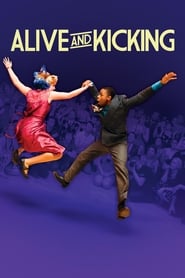
Alive and Kicking
English 자막 다운로드
릴리스 정보
태그
English 자막 미리보기
처음 200줄입니다.
The first time I saw Lindy Hop, I was 18 years old,
I was a freshman at the University of Texas at Austin,
and it was to Duke Ellington's "Rockin' in Rhythm."
And it was four couples onstage,
and they were throwing aerials, and it was so incredible
and playful and fun and magical,
and I saw this, and I was like...
"I have to do that. I have to do that."
I'm a swing dancer, 'cause I fell in love with it.
Most importantly, it's the music
that keeps me coming back,
so I'll always dance.
Lindy Hop is so free. It's so fun.
You know? And anything goes.
It's so hard to explain to nondancers this obsession.
They--I don't think they really get it.
To dance with another person
and to find the connection, it is like--
like having sex when you are on amphetamine or something.
Swing dancing is the pursuit of happiness.
I think the way that our society is built right now,
a lot of people, they're so isolated,
They really, really live lives of quiet desperation.
They get up in the morning, they go to work,
they come home, they sit home by themselves and watch TV,
maybe they go to the mall, go to bed,
get up the next day, and the same thing repeats, repeats.
We're just becoming more isolated.
I like to think that I'm the last generation
that grew up outside. We'd go outside and ride our bikes.
There was interaction. You went to school.
You had recess. You played games.
You know, now it's video games,
it's isolation, and it's hard for people to relate.
I don't think people have the skills
at personal interaction anymore.
The world is becoming kind of a spectator sport.
It used to be you'd go to a concert,
and everyone was singing along and getting into the moment.
Now you go to a concert,
and people are like this...
with their phones.
It's all about Facebook, texting,
I.M.ing, e-mails, cell phones.
I mean, people prefer to text over even talk to each other.
And thank God for dancing.
Thank God for Lindy Hop,
because that is the balance to this.
I am a dancer.
I've been dancing for 29--
28 years of my life.
It's like a purpose and a calling.
I remember the first time that I got paid to dance,
and I was like, "Really?"
And I was just blown away by the fact
that it was possible to get paid for doing something you loved.
Let's give it up for Michael and Evita!
I'm not doing it for the contest.
I'm not doing it to win. I'm doing it just to dance.
Well, first by yourself,
everybody with your right foot, go...
7, 8.
1, 2, 3, 4, 5.
As a full-time professional dancer,
I make the majority of my money from teaching.
You don't win a lot of money from competitions.
It is not at all like the ballroom circuit.
5, 6,
5, 6, 7--
And 1, 3, 5, 7, 8,
2, 4, 5, 7,
up! 2, 3.
This is not big-money business at all.
The people who do this full-time,
they barely scrape by with a living.
If they wanted big money,
they would, like, work, you know,
sort of making coffee.
The better money is made
when I go internationally.
There, I'm considered a novelty.
I'm considered a special guest from New York City,
and so I get a larger amount of money in one weekend from my work.
You develop this family of dancers that's on the circuit,
and they become like really good friends,
and you look forward to seeing them.
If you take it seriously
and you realize that these aren't paid vacations.
I'm being flown somewhere and paid
to create this experience for the students,
for the audience.
And if I can't do that, they'll get somebody else.
So I work for a 24-hour emergency service construction company,
so I have to crawl under houses a lot,
go into attics, run into spiders and rats
and sewage, poo water, all the fun stuff.
It's an interesting job, you know?
Every day is a little bit different.
I'm on call pretty much all the time,
so I dance when I can,
and sometimes I'm at a dance, and I have to leave.
Me and Chanzie, my dance partner,
we try and get together when we can,
but she works, too.
My full name is Chandrae Roettig.
That's been a disaster my whole life.
Steve's a blast to work with,
and we're always laughing. Give a quote.
Has she got everything?!
I coulda been a contenda.
I coulda been somebody.
Your son,
fuck-head that he is,
left his I.D. in a dead man's hands.
That's all I got.
Steve and I are not a couple,
and it's kind of nice,
'cause the other aspect never gets in the way.
I always wanted to move to L.A. because of dancing.
They called it Hollywood style.
You know, it's just a lot smoother of a dance,
uh, cool, everyone dressed up vintage.
And then I saw the Camp Hollywood tapes,
and I was like, "That's where I want to be."
Camp Hollywood is a huge event.
How myself and so many other people learned
was watching the competition videos,
and now to, you know, be competing in it...
Yes, we are nervous. Yeah.
Uhh.
Most people don't even realize
that swing dancing competitions aren't choreographed.
It's all improvised.
You can practice with your partner
long before competition,
but when you get there,
you have no idea what music they're going to play,
you don't know how fast it's going to be,
and you have no idea when you're gonna get called out either.
If you do something badass in a contest,
all of the other Lindy Hoppers in the world
are watching that on YouTube,
and if they liked that stuff you did,
they're gonna bring you to their city,
and then you're gonna get hired for a teaching gig,
and that's how Lindy Hop instructors
sort of make their living.
We're a new partnership, so--
Been together for, like, half a year.
Of course we want to represent real well, you know.
Hopefully this will help us to teach.
We want to try-- try to go somewhere with it.
So the history, kind of, of this swing bubble that we live in.
Here's the swing bubble, Oh, Jo's got it. Swing bubble.
Got the swing bubble. Inside the swing bubble, we've got Lindy Hop,
we've got East Coast Swing,
West Coast Swing, Collegiate Shog--
Shag! Carolina Shag,
Balboa, St. Louis Shag...
D.C. Hand Dancing... D.C. Hand Dancing.
We've got Cajun Zydeco Dancing.
We've got Boogie-Woogie.
We've got Rock n Roll.
We've got Bugg, Swedish Bugg,
and we got Double Bug,
and it just goes on and on from there.
They're all in part of-
encased in the swing jazz era genre of dancing.
Lindy Hop is the original American swing dance,
and from this dance, we've had so many branches
come off of this amazing, beautiful, wonderful tree.
And even a lot of the moves that you see
in hip-hop and other dances today
are coming from this exact same spot.
When you Lindy Hopping, you're swinging, honey.
I mean, you swinging, baby.
The swing-out is the Holy Grail of Lindy Hop.
It's the one move that you can never do enough.
You have this syncopation and this stretch
and this pull in of energy,
and it whips around and slingshots your partner away from you.
She goes out so fast, you're thinking she's never gonna stop,
but there's this lifeline
of the leader holding on,
and brings the follow right back into their arms
and continues and does it again.
Every dance has its own mood,
and so I think that tango is very dramatic,
and West Coast Swing can be sultry,
and Salsa is sexy,
but Lindy Hop is silly. It's ridiculous.
Have you seen these kinds of moves in, like, ballroom?
In ballroom dancing, you have rules.
Your hand must be here.
Your head must be here.
You can't pass rules on swing.
There is no clean, perfect, technical position
a lot of times in Lindy Hop,
and so you have the freedom to go for it,
to just, like, throw your arms up, you know?
Alive and Kicking subtitles in other languages
댓글
No comments yet. Be the first to leave one.