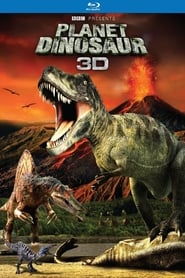
Planet Dinosaur: Ultimate Killers
English 자막 다운로드
릴리스 정보
태그
English 자막 미리보기
처음 173줄입니다.
We are living through a dinosaur revolution.
We have pushed the boundaries of our knowledge further than ever before.
We have a completely new understanding
of the greatest killers ever to walk the Earth.
One killer,
first discovered in Egypt,
has become the icon of these new predators.
A giant dinosaur
with two-metre-long spines rising over its back.
It was unlike anything seen before.
It was only in 2005, when a complete upper jaw was found,
that we could accurately reconstruct this bizarre creature.
With a skull almost two metres long,
this dinosaur was a colossal 17 metres from nose to tail.
Four metres longer than T Rex.
The reign of the dinosaurs
began almost 250 million years ago.
But this killer didn't appear until a time known as the Mid-Cretaceous.
95 million years ago, its home in North Africa
was a desert surrounding a vast system of rivers and swamps.
The swamps are refuges for many large dinosaurs,
like the duck-billed Ouranosaurus.
They're also the hunting grounds for a killer.
Spinosaurus.
The biggest killer ever to walk the Earth.
An 11-tonne colossus.
However, for the time being, these Ouranosaurs
are off this killer's menu.
Spinosaurus is part of a relatively newly-discovered family of dinosaurs.
They've been found in South America with Irritator,
in Europe, there is Baryonyx
and Asia, Siamosaurus.
But the last and biggest of all came from North Africa.
Spinosaurus itself.
And studies of their bones and teeth revealed something amazing.
Spinosaurus is a predator.
But one that hunts in water.
Spinosaurus is unique.
With long, narrow jaws and nostrils set high on its head.
Its teeth were straight and conical.
And had a curious pattern of holes in its snout.
Which give us a clue to how it hunted.
These are Onchopristis.
Eight-metre-long giant sawfish.
In 2008, a Spinosaurus' skull was put through a CT scanner.
It revealed that the holes and sinuses in the snout
looked just like those of crocodiles.
It's thought these contained pressure sensors.
Sensors that, like a crocodile,
can detect the movement of prey.
It can strike without even seeing its victim.
Anywhere else this eight-metre Rugops might be the top carnivore.
But here, it is dwarfed by Spinosaurus.
A predator that adapted to exploit an environment so successfully,
it evolved into a 17-metre giant.
Spinosaurus is the biggest dinosaur predator ever discovered.
But it wasn't the first giant killer.
The first giant killer dinosaurs appeared much earlier.
They lived in the Jurassic period, 150 million years ago.
One of the most iconic is Allosaurus,
from the Morrison Formation in North America.
Yet it's only recently that we've been able to work out,
how these predators hunted.
Allosaurus is the most common killer in these lands.
Nine metres long, with a battery of saw blade-like teeth
Allosaurus is a formidable hunter.
A lone Camptosaurus should be an easy kill.
Allosaurus teeth were serrated front and back,
perfectly evolved for tearing through flesh.
However, recent research has indicated
that Allosaurus' bite was surprisingly weak.
Calculations suggested its bite was less powerful than a lion's.
So, just how did this Jurassic monster hunt and kill?
Camptosaurus relies on its keen senses
to avoid predators.
Allosaurus on the other hand, is a fast and powerful ambush hunter.
Despite the apparent weakness of its bite,
Allosaurus did in fact have a deadly killing method.
Its skull could withstand a force
more than 15 times as great as its bite.
This meant that Allosaurus used its head like an axe.
Its strong neck muscles driving its top jaw into its prey.
With every impact, the serrated teeth
would tear through its prey's flesh.
The victim dying, through a combination of shock and blood loss.
Saurophaganax.
At 12 metres, it is the biggest carnivore in the region.
One of the advantages of being so big
is that stealing another's kill is that much easier.
With rise of giant predators
and their spread throughout the Jurassic world
smaller dinosaurs needed new strategies
if they were to survive.
In recent years, China has been the focus
of some remarkable fossil discoveries.
One extraordinary fossil hints
how some may have avoided these killer dinosaurs.
It lived in the Jurassic forest of China
a 154 million years ago.
Hiding in these lush forests is Epidexipteryx.
This forest is home to many predators
and being small makes it vulnerable.
This is Sinraptor.
A small dinosaur like Epidexipteryx
would be of no interest to a seven-metre adult.
But this is a juvenile.
Being small does have its advantages.
Everything we know about Epidexipteryx
comes from an incredible fossil,
first revealed in 2008.
It showed an animal with a small skull and large eye sockets,
and unusually long teeth.
With toes suited to gripping branches
and very long arms and hands,
it suggests that this was a dinosaur well suited to living in the trees.
The extraordinary, elongated third finger
is another distinctive feature of the group.
With this and its projecting front teeth,
Epidexipteryx has the perfect tools to hunt for insects.
Prey like this, which is difficult to catch, is quite a prize.
A prize that can attract unwanted attention.
Here it's another, larger, Epidexipteryx.
There is more to this extraordinary creature than first meets the eye.
The fossil has also revealed
that it was covered in short, simple feathers.
Feathers that were likely to have evolved for just one reason:
to keep it warm.
But there is one last striking feature:
four long feathers on its tail.
These feathers aren't like those of modern birds.
These are long and ribbon-like.
Almost certainly, only for show.
They're the earliest record of ornamental feathers.
In fact, the very name Epidexipteryx means "display feather".
And they're among the most bird-like of any dinosaur.
Only in the trees can you be safe
from the large predators like Sinraptor.
Moving into the trees
opened up an entirely new world for dinosaurs.
And it wasn't long before killers followed.
The most dramatic, found in 2000,
lived in Northeast China around a 120 million years ago,
at the beginning of the Cretaceous period.
A dinosaur that took tree-living to a whole new level.
This is Xianglong.
With prey like this, predators were sure to follow.
Microraptor.
Microraptor is small, and well adapted
to chasing prey in the canopy.
Xianglong, however, has a trick.
This is a flying lizard.
And the exquisite fossils of Microraptor
revealed a surprise.
The feathers of this dinosaur
aren't for keeping warm or for show.
Their structure is plainly visible from the fossils.
They are very long, veined and most importantly,
their shape creates a perfect aerodynamic surface.
And they aren't confined to its forearms.
Its legs, too, had long feathers.
These feathers are designed for one thing only:
Flight.
Microraptor is a four-winged dinosaur,
that took to the skies.
But Microraptor isn't the only flying monster here.
Sinornithosaurus more than capable of stealing prey.
But it has bigger prize in mind.
And Sinornithosaurus has a deadly secret.
In 2009, a study of Sinornithosaurus
found distinctive grooves along the length of its teeth.
They resembled those of the venomous Gila monster.
The grooves of its teeth used to deliver venom into its victim.
The team even identified what they thought was the location
Planet Dinosaur: Ultimate Killers subtitles in other languages
More English subtitles for Planet Dinosaur: Ultimate Killers
- Planet Dinosaur Ultimate Killers 2012 720p-EbP · 43 downloads · 2012-09-28
- Planet Dinosaur Ultimate Killers 2012 · 37 downloads · 2012-09-25
댓글
No comments yet. Be the first to leave one.