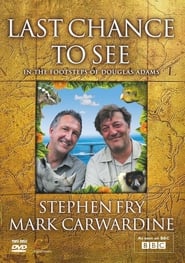
Last Chance to See
Muat Turun Sari Kata English
Download English Subtitle Files for Mobile (6)
Pratonton sari kata English
200 baris pertama.
20 years ago, my good friend Douglas Adams spent a year tracking down endangered animals
together with the zoologist Mark Carwardine.
Now it's my turn.
Mark and I are heading off to find out exactly
what happened to those species that he'd seen
dangling on the edge of extinction two decades ago.
It promises to be exhausting, exhilarating and exasperating.
But I wouldn't miss it for the world.
Mark Carwardine, how are you?
How very good to see you. How are you?
Thanks for waiting. I paid extra to go business so that my luggage would be out last.
A little privilege you get. I see you've come dressed for the jungle.Well, not exactly, no.
Welcome to Manaus at last. Thank you.
My travelling companion is to be Mark Carwardine,
an internationally-renowned zoologist and photographer.
In the pursuit of the weird and the wild,
he's travelled to almost every country in the world,
encountering pretty much every conceivable creature,
and several of the inconceivable ones.
We're starting our adventures in the Amazon,
the biggest river system in the world.
We've arranged to set out from Manaus, on the banks of the Rio Negro,
where Mark has a fast boat waiting to take us up river.
That's not the Amazon. No, that's the Rio Negro.
Goodness me. There we go.
Two things, I think the most important bit of kit, binoculars...
Oh, thank you. Sorry they're not wrapped.
No, no that's wonderful, that's wonderful.And a hat.
Oh, they're good. Oh!
We're hunting for the lugubrious Amazonian manatee,
a large seal-like mammal that once swam these waters in vast herds.
What are our chances of seeing a manatee?
Pretty slim, to be honest. They're here, we're going to go to the right areas where they occur,
but the fact that it's murky water
and the fact that when they rise to the surface to breathe,
they have two little nostrils at the top of the snout,
and all that breaks the surface is just enough for the nostrils to blow out,
take a breath, and they disappear below again.
So not only are they rare, you could be on top of one and you still might not see it.
They were confused with mermaids in the early days, weren't they?
Yeah, although you had to be quite drunk as a sailor.
I think the reason they were called mermaids is cos the females
have mammary glands in the same position as female humans,
and I think that's how the term originally came about.
In fact the name "manatee" is taken from the word in Carib,
one of the old Brazilian tribal languages, meaning "breast".
Though not noticeably breasted to the casual observer,
the manatee is a large, fully aquatic mammal, sometimes known as a sea cow.
Manatees are spectacular only in their single-minded devotion
to doing everything as slowly as possible.
Unfortunately, when escaping from hunters,
they have also been inclined to do it rather slowly
and the species is now classified as vulnerable to extinction.
'To begin the hunt, Mark has brought us to a lodge
'aimed at fulfilling the every need of the 21st century jungle tourist.'
You've taken me to the middle of the jungle, and we're sitting on golf carts.
I'm sorry about that.
So they've got electricity for charging them. I notice a phone signal.
I know, it's like an out of body experience. Oh, dear.How unusual.
'Whilst I admit to being a fan of the 21st century's little luxuries,
'I must admit that this isn't entirely what I'd expected of the Amazon.'
See the macaws?
Hello. Thank you.
Oh. Thank you very much, very kind.
The Lodge is comprised of seven towers,
linked by a five-mile network of walkways.
Mark first came here exactly 20 years ago together with author Douglas Adams.
I became friends with Douglas in the early '80s and we decided we wanted
to do something for wildlife and travel together as well,
and we came up with this idea of Last Chance To See.
We got a world map and Douglas stuck pins in where he'd like to go,
and I stuck pins in where the endangered animals are and we came to a compromise,
and strangely enough, the first place we came to was here.
We started off in the towers here and went off into the jungle looking for the Amazonian manatee.
By 1988, Douglas Adams was the celebrated author
of The Hitchhiker's Guide To The Galaxy, and a personal friend.
While he trotted the globe with Mark,
I lived in his house, fielding requests for lenses and guidebooks
to be sent to exotic locations,
and I came to know jealousy on an inter-stellar scale.
Douglas, as we know, died very sadly almost what, five-and-a-half years ago now,
and I never spoke to him about this, but did he express a desire to go back and look 20 years on?
He became really passionate about conservation. He'd done a lot of good work
for conservation after Last Chance to See,
and we were both very keen to go back and see what had happened in the years in-between,
and, very sadly, I was talking to him about that very thing the night before he died,
and we were planning the next trip and planning to go back
around the world and review all those projects,
so, very sadly, he missed out on that.
After Douglas died, Mark asked me if I would be interested
in accompanying him on the journeys they'd been planning.
Though Mark and I have never travelled so far as to the corner shop together,
for better or for worse, our fate is sealed.
I have to confess I'm quite nervous about this whole enterprise.
I like my creature comforts rather more than I like my creatures.
I must say, standing next to him, he's so tall as well. He's so brown
and so bright and knowledgeable,
it makes me feel really short and white and stupid, to be honest.
I'm quite nervous of Mark. I don't know him that well. I've met him before,
but he's such an all-round expert on all living things
and I shall feel very foolish if I say, "What's that?"
and he gives me a long, burning look as if he cannot believe
there is a sentient being on the planet who is unaware of what a capybara is.
Mark has been telling me of a local legend in which the Amazonian manatee
is guarded by a most peculiar bright, pink dolphin,
known locally as the boto.
It is said that if you want to find manatees,
then you must first make your peace with the dolphin.
Unlike the manatee it shares its waters with,
the boto is a fast-moving predator, living on fish and small crustaceans.
The boto is typically eight feet long, becoming pinker as it becomes more excited.
It should be noted that the boto is only found
in the Amazon basin and is recognised as an endangered species in its own right.
It should also be noted that dolphins are Mark's most favourite thing in the whole wide world.
We're going to see a lot of animals on our adventures,
but you're particularly excited about today. Why is that?
You know how some people need a cigarette or a drink
every so often to survive normal daily life?
I have to see a whale or a dolphin at least once every couple of weeks to survive.
I lay awake last night thinking about today. I know it's sad. How wonderful!
I love it. It's fantastic.
I had heard that there was a legend that at night,
the pink river dolphin turned into a gentlemen with a black top hat -
it's very specific -
and an Edwardian waistcoat,
and ravished the local women, and it was explained to me
that this was probably missionaries
justifying the arrival of rather surprising pink babies in Indian tribes.
One of the things I want to try and do today is to get some underwater shots of them
because they're so hard to approach normally and the visibility is so bad.
There are very few pictures of them underwater.
My dream is by the end of the day at least have one great underwater shot.
'In an attempt to increase visitors' chances of glimpsing the rare dolphin,
'staff of the lodge have been feeding the boto from a floating platform in the river.'
Thank you.Did you have a pee before you left, by the way?
No, I didn't. I could get into the water, I'm sure it's big enough to accommodate my urine.
You mustn't pee in the river.
There's a fish here called a candiru fish. Have you heard of that?
That's an urban myth, isn't it? No, no, it's true.
It's about this long and if you pee in the water,
which I'm serious that you mustn't do, it swims up your urine and into your willy.
Basically, it's designed to go into the gills of a fish,
so it gets into the gills and the spines come out, it lodges itself in there,
drinks the blood and then when it's full, it lets go and drops to the bottom and digests it.
But if you get one up there it's apparently unbelievably painful, and you have two choices,
you chop your willy off or you have to get to a hospital,
and given that we're nowhere near a hospital, there's only that first choice.
I've got a couple pieces of string, actually, so if you just tie a knot in it.
Please!I've done mine.
Don't be...
Which size do you need?Oh...
Sorry! Wicked. But the fish does exist?
No, no, the string's a joke. But the fish is real.
Then I'll be extra careful with my family package. Gracious.
'Having been distracted by Mark's "hilarious" joke,
'we fail to notice that while we haven't found the dolphins, the dolphins have found us.'
Oh, look at that. Fantastic, it came right out of the water.
Yay!Oh, they're fantastic.
Aren't they beautiful?
They're so lovely.
You notice when they're swimming around,
they can do sort of handbrake turns. Most dolphins, all the neck vertebrae
are fused, and it's designed for swimming fast
so when they turn they don't break their necks.
But these dolphins are designed for swimming in the flooded forest
and weaving in between all the trees and roots,
so when you watch, they can turn on a sixpence
and they can bend their necks and they're very different to marine dolphins.
Really interesting. Yeah. Yes!
Astonishing.
Very beautiful, and unmistakeably dolphinous.
That obviously isn't a word, but you know what I mean.
'As a creature more at home on the land than in the water,
'I am more than a little uncertain about joining Mark in the river to get his shot.'
I would be a lot more uncertain if I knew what Mark told me later.
Not only is this water home to the candiru fish,
it's also popular with piranha fish
and frequented by passing bull sharks,
the most deadly shark in the world.
The sediment in the water means that one simply has no idea what, if anything, is down there.
And suddenly out of the murky darkness, the unmistakable shape of a dolphin appears just inches away.
Oh, they're very soft.
They feel like an old vinyl Lilo.
One of those little paddling pools or something you used to blow up.
They've got that sort of vinyl feel.
Sorry.
The lodge has provided everything we had hoped for,
with one noticeable exception - a manatee.
Amazing.
We decide to leave the tourist trail
and fly in search of a man who spends his life tracking manatees,
if only the rain would ever stop.
My God, I'm glad we didn't take off in this!
Whether or not we get to take off depends on the only man with the skill,
and the plane, to get us there.
Captain Wilson, a Christian missionary pilot.
But even with God on his side, he's taking no chances with the elements.
So if you get caught in this when you're flying, do you just have to land somewhere and wait?
Yes, on a river. Isn't that dangerous?
Not with experience, you still.. You can't be sloppy.
Komen
No comments yet. Be the first to leave one.