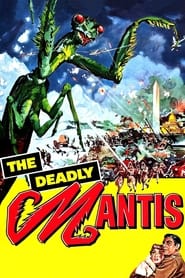
The Deadly Mantis
Muat Turun Sari Kata English
Maklumat siaran
Tag
Download English Subtitle Files for Mobile (2)
Pratonton sari kata English
195 baris pertama.
Narrator: For every action,
there is an equal and opposite reaction.
Radar.
Designed to defend us against attack.
Radar stations on mountaintops, in deserts,
deep in untracked forests.
In a thousand secret and isolated places.
Over both oceans, there are radar equipped picket planes.
In both oceans, manmade radar islands
to guard our flanks.
There are the inshore pickets
and several hundred miles beyond them
are the offshore pickets.
Another radar fence stretches across the long,
unfortified border between the United States and Canada.
The Pine Tree Radar Fence.
And beyond that, still another network
of electronic eyes.
The Mid-Canada Radar Fence.
Even farther north in the very shadow
of the North Pole, this fence,
the distant early warning system known as the DEW Line,
ready to transmit the first warning signal
of a sneak attack across the polar regions.
To build the DEW Line, an armada
of ships was assembled in the largest
and most secretly planned operation
since the Normandy invasion.
Grinding through treacherous polar ice fields
in a desperate gamble against time and weather
to land a mountain of supplies,
machines, tractors, and men upon the ice.
First things first.
Level landing strips for heavy cargo planes.
Then shelters for the men, for the planes,
and for operations.
And while some hands are busy laying long pipelines
to transport fuel, others build tanks to store it.
The work continues day and night
around the clock, seven days a week.
At long last, the ships are gone.
The summer is gone but the job is finished.
Red Eagle One, sentinel of the Arctic,
nerve center of the DEW Line is operational.
Male: Colonel Parkman arriving, dispatch jeep.
Soldier: Colonel Parkman.
Glad to have you with us.
Narrator: Across the roof of the continent,
still farther north, an outpost of the DEW Line.
Hey Mike.
Hey Mike, get a look at this.
Mike: I don't see anything.
Hey, wait a minute.
Listen.
It's almost on top of us!
Kane: This is Kane, Picket 7327, calling Red Eagle One.
Come in, Red Eagle One.
This is Kane, Picket 7327, calling Red Eagle One.
Come in, Red Eagle One.
Hello, Picket 7327, it's Red Eagle One, I read you, over.
Kane: Put the old man on the horn, will you, Pete?
Roger.
I've got Lieutenant Kane, sir.
Colonel Parkman, Walter.
What's up?
Kane: We're over Weather Four, sir.
The building's been damaged.
Looks like the roof's caved in.
If there's anyone inside, they could be hurt or worse.
I tried to contact them but there was no answer, over.
We'll get right on it.
Over and out.
When did Weather Four report in last?
At 0800, sir, right on the button.
See if you can contact them again.
Alright.
Red Eagle One calling Weather Four.
Red Eagle One calling Weather Four, come in, Weather Four.
No answer, sir.
Keep trying.
Red Eagle One calling Weather Four,
Red Eagle One calling Weather Four.
Come in, Weather Four.
Operations.
Colonel Parkman here.
Get my plane ready.
Oh, and alert Lieutenant Pizar.
Red Eagle One calling Weather Four,
Red Eagle One calling Weather Four.
Come in, Weather Four.
Two men don't just vanish.
These did.
I don't get it.
Everything was under control when they checked in 0800.
Well, nothing unusual has been reported since then.
No storms.
It wasn't a gale that wrecked this shack.
Besides, they're caved out as though something
crashed into the roof.
Well, if it was a plane that hit it...
Maybe there's a very ordinary explanation for what happened.
Maybe the men are on their way back to the base right now.
On foot?
There would be footprints in the snow.
Did you see any?
Take a look here.
What do you got?
I don't know.
Plane?
No plane ever made that short a run.
Helicopter?
No, a helicopter couldn't make a furl like that.
There is an ordinary explanation as to what happened but...
I wouldn't take any bets.
So the only recent contact you had with the weather shack
was when the helicopter dropped supplies there five days ago?
Yes, sir.
You checked Weather One?
Yes, sir.
Weather Four made contact with them at 0813.
Everything was jake.
I'm picking up something, Colonel, but it doesn't make sense.
I never saw a blip like that before.
It's there, then it's gone.
Hey, there it is again.
What do you make of it?
I'm not taking any chances.
Sound the red alert.
Male: Vector 360, climb to angels three,
bogey, 90 miles.
Pilot: Red Leader to Control.
Nothing here.
Give us a new vector.
Male: Bogey has disappeared.
Return to Home Plate.
Charlie.
Pilot: Sugar Pine to Red Eagle One.
Come in, Red Eagle One.
Sugar Pine to Red Eagle One.
Come in, Red Eagle One.
Hello Sugar Pine. This is Red Eagle One, go ahead.
Pilot: Red Eagle One, we're over the wreckage of the C-47.
They found it, Colonel.
- Colonel Parkman: Get his position. - Radio Operator: Yes, sir.
- Alert Lieutenant Pizar. - Yes, sir.
Colonel!
Looks just like the weather shack.
Colonel Parkman: Yeah.
Where are they? Where are the bodies?
Easy.
Male: Look out!
What in the world?
What is it?
I don't know.
Looks like it had been broken off of something.
That point's as sharp as a needle.
I give up, you got me.
Well, where do we go from here?
We'll have to let CONAD worry about that.
Narrator: This is CONAD.
The Continental Air Defense Command at Colorado Springs.
The focal point of the supersonic shield
that guards the North American continent.
A shield that could mean the difference
between life and death for millions of Americans.
These are hot phones.
Using them, it takes only 15 seconds to talk to Alaska.
Ten seconds to alert Newfoundland.
Five seconds to contact DEW.
Three seconds to reach the Pentagon Command Post.
General Ford speaking.
Yes.
I see.
Good, I'll take a plane right out.
The Arctic Command has delivered the package.
Good afternoon, gentlemen.
I'm General Ford.
Oh no, no, please sit down.
Gentlemen, I realize that the Air Force
hasn't given you much time in which to make your tests
and that a definitive job may
have been out of the question of the short time you've had.
But the Department of Defense hopes
that during these two days of concentrated efforts,
you've come to some conclusion about this.
Professor Gunther, I believe you're in charge.
All of us are agreed to accept one thing.
This appendage comes from some living creature
but as to what creature it was once a part of,
we... we are completely in the dark.
Our anatomist, Dr. Arnold Burton,
has been unable to identify this object.
Professor Harvey Pierce is certain
from his exploration that the hook
cannot belong to the neurological system.
The Deadly Mantis subtitles in other languages
More English subtitles for The Deadly Mantis
- The Deadly Mantis (1957) 1:18:35 · 64 downloads · 2019-12-30
- The Deadly Mantis 1957 720p BluRay x264-PSYCHD · 45 downloads · 2019-05-23
- The Deadly Mantis 1957 720p BluRay x264-PSYCHD · 78 downloads · 2019-05-23
Komen
No comments yet. Be the first to leave one.