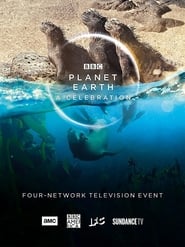
Planet Earth: A Celebration
Muat Turun Sari Kata English
Maklumat siaran
Tag
Pratonton sari kata English
184 baris pertama.
We are living in extraordinary times.
The pandemic has changed all our lives.
But while WE are restricted...
...wildlife is free.
In moments of crisis,
the natural world can be a source of both inspiration and escape.
So we are taking you on an adventure...
...to some of the wildest places on Earth...
...bringing together spectacular stories from Planet Earth II...
...and Blue Planet II.
And accompanying this special journey,
there's a new score created by Hans Zimmer and Jacob Shea,
who composed the music for the original series...
...performed by the BBC Concert Orchestra,
and featuring, on piano, the award-winning artist, Dave.
Working remotely on opposite sides of the Atlantic,
they've come together to create a visual and a musical feast.
Our adventure will take us
to some of the most extreme environments on Earth.
From the hottest deserts...
...to the freezing poles...
...and from highest mountains...
...to mysterious kingdoms under water...
...where, against all odds, life flourishes...
...giving us all a message of hope for the future.
This is Planet Earth: A Celebration
The Atlantic.
Off the coast of South Africa,
it collides with the warm waters of the Indian Ocean.
Spectacular winter storms create colossal waves.
But one species turns these turbulent seas into a playground.
Bottlenose dolphins.
They are extremely intelligent...
...and with this intelligence comes playfulness.
They surf...
...and as far as we can tell,
they do so for the sheer joy of it.
The coastal waters of South Africa teem with life.
And below the surface...
...one of the greatest of all kelp forests...
...which is home to some truly extraordinary creatures...
...including one smart individual
who's found rather ingenious ways to survive.
Barely visible except for the pulsating siphon
through which it breathes,
a common octopus waiting for prey to pass by.
A crab will do.
The octopus sets off in pursuit.
And then, lurks...
...with the patience of an ambush hunter.
But the octopus shares the Cape waters
with a great concentration of other predators.
Fur seals...
...and sharks.
They all eat octopus...
...if they can find one.
And pyjama sharks are experts...
...at hunting in the undergrowth.
Time to disappear.
But these tough-skinned little sharks are small enough
to reach deep into crevices.
But the octopus is far from finished.
She slips her tentacles in to the shark's gills.
That prevents the shark from breathing.
When caught out in the open, and vulnerable,
this octopus does something truly extraordinary...
...and never recorded before.
She disguises herself...
...with a protective armour of shells.
The shark can sense its prey.
But the shells confuse it.
In a forest full of hungry mouths,
superior wits allow this octopus to stay alive.
Surviving in this submarine jungle can be a challenge.
But above the waves,
over 700 miles to the north...
...lies a world with challenges of a different kind.
The Namib Desert.
It's the oldest desert on the planet...
...believed to have been dry since dinosaurs walked the Earth.
Life here for a hunter is as hard as it gets.
A pride of lions.
One of the very few that endures this desert's scorching temperatures
and lack of water.
A herd of oryx.
The only prey within 20 miles.
Out here, there is no cover for an ambush.
It will have to be a straight chase.
They have failed.
And each failed hunt brings the lions closer to starvation.
To find enough to eat,
the pride continually searches an area the size of Switzerland.
Three days and 100 miles later,
and still no kill.
These are desperate times.
A dry riverbed on the edge of their territory.
The only animals here are giraffe,
but these one-tonne giants could kill a lion with a single kick.
Lions seldom tackle such formidable prey...
...but this pride can't go on much longer without food.
The whole pride must work together as a team if they're to succeed.
Two lionesses lead the chase,
others race to cut off possible escape routes.
The giraffe has the speed and stamina to outrun the pride...
...but it's being chased into a trap.
Up ahead, the lead female waits.
It's now up to her.
Most lion hunts end in failure...
...but no lions fail more often than those that live in the desert.
And yet, for generations,
despite overwhelming adversity,
they have managed to endure.
Dawn breaks in the Andes.
Here, high altitudes bring their own set of trials.
Wildlife faces scorching days and perishing nights.
Mountain viscacha are up early
to claim the best places to catch the sun's first rays.
For others up here,
the sunrise is even more welcome.
At over 4,000 metres,
this is the highest flamingo colony in the world.
At night, it gets so cold that even this salty water freezes over...
...and now the flamingos are trapped in the ice.
Eventually, the sun thins the ice,
but it's still a struggle for the flamingos to break free.
Walking on thin ice is always risky.
And it's hard to retain one's dignity...
...especially when you're wearing stilts.
At these altitudes,
the sun's power can quickly turn from salvation...
...to threat.
The atmosphere is so thin,
there is very little protection from ultraviolet radiation.
By mid-morning, it's risky to linger out in the open.
Out on the lake, there is nowhere to hide.
The white crust of the soda lake reflects the sun's glare
and increases the impact of its ultraviolet rays.
By midday, uncovered human skin will burn in four minutes.
But this doesn't seem to bother the flamingos...
...in fact, they are on parade.
During the breeding season,
the flamingos perform these peculiar courtship dances,
even through the hottest time of the day.
They're so eager, they don't even pause to feed.
The rules are something of a mystery.
But after a month of dancing,
all the birds will have paired off and will be getting ready to mate.
Up here, there are few other creatures to bother the flamingos,
but then few other creatures could even tolerate these conditions.
Wildlife has colonised almost every corner of our planet...
...even the slopes of its highest mountains.
AWE-INSPIRING MUSIC PLAYS
The Himalayas.
Lethally cold...
...scarred by gales and blizzards...
...these mountains are among the most hostile places on Earth...
...yet a few special animals manage to live here.
The snow leopard.
Seldom seen,
the detail of their lives has long been a mystery.
But now, at last, helped by the latest remote camera technology,
we are getting closer to them than ever before.
They're very rare,
only about four of them in 40 square miles.
There is simply not enough prey to sustain more.
They live solitary lives.
Nonetheless, they are well aware of the presence
and the movements of their neighbours,
because they leave messages in a few special places.
They rub particular rocks with their cheeks...
...and then spray them with urine.
The two perfumes create a unique signature.
Any other leopard can know which of its neighbours passed this way
without ever making direct contact.
But there are times when snow leopards must come together,
and the event is often violent.
An adult female and her daughter.
She has devoted the last two years to raising her cub
and very soon it will be weaned.
For now, the cub is still entirely dependent on its mother.
But staying together as long as this could cause problems.
The female is now in heat again,
and any male that smells her signature will know that.
From this moment on, her cub's life is at risk.
Planet Earth: A Celebration subtitles in other languages
More English subtitles for Planet Earth: A Celebration
- Planet Earth A Celebration 2020 HDTV x264-DARKFLiX · 29 downloads · 2021-04-25
- BBC Planet Earth A Celebration 1080p HDTV x265 AAC MVGroup org · 36 downloads · 2020-09-02
Komen
No comments yet. Be the first to leave one.