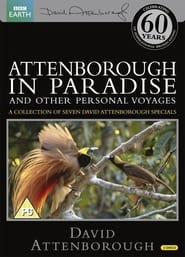
Attenborough in Paradise
Muat Turun Sari Kata English
Maklumat siaran
Tag
Pratonton sari kata English
200 baris pertama.
This strange figure appeared in a New York auction room some ten years ago.
They said it came from Easter Island
but they gave it a value far lower than that of a genuine old Easter Island piece.
Maybe they thought it was carved for tourists
or perhaps they weren't even sure how genuine it was.
But I thought it had a strange, almost hypnotic power, and I bought it.
But who had made it? And where? And when?
And what did it represent?
In trying to find the answer to those questions,
I set off on a long trail of detection which took me back to the 18th century,
to the great days of the European exploration of the Pacific,
to the ancient beliefs of the Polynesians,
and eventually to one of the great wonders of the world, Easter Island.
Two and a half million years ago,
the waters in the middle of the eastern Pacific began to boil.
Lava spewed up from the ocean floor.
As the eruptions continued over centuries, an island grew.
Today, it measures only 14 miles by seven.
It's one of the most isolated fragments of land in all the oceans of the world.
South America lies 2,500 miles away to the east,
Tahiti, in the centre of the Pacific 3,000 miles to the west.
It's a barren, rocky place,
hardly a tree to be seen.
There are still three huge volcanic craters on the island, all now inactive.
The one on the western corner has pools of fresh water lying all over its floor.
The island's flanks descend so steeply into the ocean
that no fringing coral reefs have been able to grow,
and the Pacific breakers crash directly onto its narrow beaches.
Landing is extremely difficult, and at some times, impossible.
Nonetheless, about 1,500 years ago,
human beings did manage to reach it,
and here, in isolation they developed an extraordinary culture.
They carved gigantic figures of stone.
Today, these statues are among the most famous images in the world,
immediately recognisable everywhere,
and used in advertisements and cartoons
as the symbol of all that is most remote and exotic.
Europeans didn't discover the island until a Dutchman, Jacob Roggeveen,
arrived on Easter Day, 1722.
He made a brief note of the huge statues in his journal,
but he didn't stay long, for soon after he landed, a fight broke out.
A dozen of the islanders were shot dead and Roggeveen sailed away.
52 years later, Captain Cook arrived,
and made the first detailed survey of the island.
14 years after him, a Frenchman, La Perouse, landed there
and wonderingly measured the statues.
His artists confronted with such strange images,
couldn't record them objectively,
and perhaps unconsciously gave them European features.
Some stood 30 feet tall and weighed 60 tons.
But who would carve them? How had they been transported and erected?
The islanders met by the visiting Europeans
seemed to have none of the necessary skills.
So began the mystery of Easter Island.
Later visitors invented their own explanations.
One claimed that such colossal statues
could only have been put up by a race of giants, now extinct,
who stood 12 feet tall, and were endowed with superhuman strength.
By the 19th century, European artists who had never been to the island
were portraying the people as degenerate savages,
who conducted unspeakable rites before the stone idols.
In 1947
Thor Heyerdahl left the west coast of South America on his raft, the Kon-Tiki
and sailed toward the island to prove his theory
that the islanders had come from Peru
bringing with them the Incas' famous skills in working stone.
In more recent times some writers have seriously suggested
that the only possible explanation
was that the statues had been raised by people arriving from outer space.
But the islanders also carved small wooden figures like mine.
What could be the connection between the great stone monoliths
and these relatively tiny carvings?
Today they still carve wooden figures for sale to visitors.
It seems that they've been doing this for 150 years or more.
Some of them are fairly crude,
some less so.
But it seemed to me that mine was much more powerful
and certainly older than any of these.
But was it?
One of the best collections of early figures
still untainted by the demands of tourism is in London.
So off I went with my figure, to the Museum of Mankind
the ethnographic department of the British Museum.
In its hall stands one of the very few stone figures to have left the island,
collected by a British warship in 1868.
But it was the wooden figures that I had come to see.
This is some kind of grotesque monster,
half reptile, half human.
Its head appears to be like a lizard's,
and yet it has what seem to be wings,
a fattish body, human buttocks and legs,
but then a long tail that projects beyond the legs.
This, on the other hand does seem to be a human being.
It's got a very human face.
But it's a human being wearing a bird costume of some kind
because he's got a mask with a bird's beak on his head
and instead of arms what appear to be wings,
but then again, very human-looking legs.
And then there are much more naturalistic human figures.
This is a female.
Her flat body but overall human proportions, fairly naturalistic.
Most common of all are the figures of men.
This is a particularly fine one.
We know from museum records that it was collected in 1820.
It's the body of a normally proportioned man,
but one who's half starved
for his ribs are very prominent.
He has a more or less naturalistic face
with a goatee beard, a smile showing the teeth, but very long ears,
and legs of normal proportion.
But none of these seem to me
to have the characteristics that set my figure apart.
They don't have the goggling eyes, the crest,
the toothless smile stretching from ear to ear,
and this enormously elongated body,
with elongated arms, and fingers that are also equally elongated.
I looked not only here
but in catalogues of museums around the world.
There was only one place in the world where I could find an equivalent figure.
To see that, I'd have to go to Russia.
St Petersburg, the old capital of Russia, once the home of the czars
and still today one of the country's great cultural centres,
rich in art galleries and museums.
I was heading for one of the oldest museums, the Kunstkammer
founded by Peter the Great, and now the main anthropological museum.
Here are gathered the art and the artefacts
that have been brought back by Russian travellers and explorers
from all parts of the globe.
Their Pacific collections are not huge
but I had seen from the museum's catalogue
that they included two strange wooden figures from Easter Island,
one of which has an exceedingly long, thin body.
And they had them out ready for me.
And here it is.
So how close is the resemblance between this and my figure?
Museum regulations here require you to put on gloves
before you touch any of their objects,
so of course I did.
Well, the resemblance is astonishingly close.
It has the same goggle eyes - spheres surrounded by a single ring.
There are three ridges above the eyes,
a mouth which stretches from ear to ear in a toothless smile.
The same rod-like arms
the same elongated body.
It's surely impossible to believe
that whoever carved one was unaware of the features of the other.
The museum's other figure is of less relevance.
But it's nonetheless very remarkable.
It's a bird-man a bit like the one in the British Museum.
So where did these two Russian figures come from?
Well, the museum records show that they were transferred here
from the Maritime Museum of the Admiralty Department in 1824.
So they must have been collected by Russian explorers before that date.
They both belong to a group numbered 736.
There were only two Russian explorers, before then who went to Easter Island
neither of them stayed for any length of time,
and there's no record of either trading for figures.
So all I can say as a consequence of finding the similarity between these two,
is that my figure therefore is probably early 19th century,
and no more than that.
So to some extent, this identification is something of a disappointment.
I must admit I had hoped that it might prove to be somewhat earlier in date.
I'd run out of clues.
My investigations seemed to have come to a dead-end.
It seemed that the origin and identity of my figure
would have to remain a mystery.
But then, a stroke of luck.
A couple of years after I bought my figure,
some drawings held by the State Library in Sydney were published.
They had belonged to Captain Cook himself.
After his death they passed to his widow,
who in turn gave them to a naval officer who looked after her in her old age.
I had to go to Australia anyway, so I went to have a look at them.
This is a scene in New Zealand
by the expedition's official artist, William Hodges.
And this too is by Hodges,
a moving portrait of a Maori.
And here is a picture of HMS Resolution, Cook's ship.
And this was drawn not by Hodges,
but by Able Seaman Roberts,
who was the draughtsman on the voyage.
This sketch of the ship was done, one imagines, for his own pleasure,
but his actual job was recording profiles of coasts,
making charts, as has been done here.
These were profiles that were of use
to any ship that might try to follow in Cook's wake.
And as well as those he also drew records
of some of the objects that were collected on the expedition.
Here is a club
and here an axe or an adze
and a spear.
And here is a drawing by Roberts
which, when I first saw it made my heart miss a beat.
Because here, correct in every detail,
is a drawing of that enigmatic, mysterious, bird-headed man figure
that's in St Petersburg.
Correct even down to the number of ribs on the chest.
And next to it, even more exciting from my point of view,
here is a drawing of that female stick figure,
again correct in every detail,
Attenborough in Paradise subtitles in other languages
More English subtitles for Attenborough in Paradise
- 7of7 Amber Time Machine xvid ac3 www mvgroup org ENG · 16 downloads · 2007-10-04
- 6of7 Life On Air xvid ac3 www mvgroup org ENG · 18 downloads · 2007-10-04
- 5of7 The Song Of The Earth xvid ac3 www mvgroup org ENG · 12 downloads · 2007-10-04
- 4of7 Bowerbirds The Art Of Seduction xvid ac3 www mvgroup org ENG · 12 downloads · 2007-10-04
- 2of7 A Blank On The Map xvid ac3 www mvgroup org ENG · 16 downloads · 2007-10-04
- 1of7 In Paradise xvid ac3 www mvgroup org ENG · 13 downloads · 2007-10-04
- -=COMPLETE=- xvid ac3 www mvgroup org ENG · 35 downloads · 2007-10-04
Komen
No comments yet. Be the first to leave one.