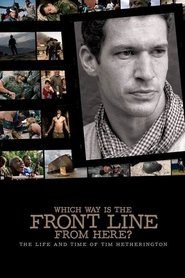
Which Way Is The Front Line From Here? The Life and Time of Tim Hetherington
Muat Turun Sari Kata English
Maklumat siaran
Tag
Pratonton sari kata English
189 baris pertama.
You know, what's interesting
about war is that there's
lots of generalizations made up about it.
But in going to these extremities, that what's
interesting is that you see
that even in these terrible
times, in these terrible moments,
in these terrible extremities,
that people are still human.
I think that that for me is
like the redeeming factor
of the human experience.
No, that sounds too fucking bullshit.
Well, I think it was good.
I think we're almost there.
You know, there's a lot of people who make
kind of generic--
No, I don't want to say,
"There's a lot of people, you know.
I think the important thing for me is
to make work that is connected to people,
you know.
Uh, I like to--Oh, shit. Sorry, man.
Ha ha ha!
Blah, blah, blah, blah, blah.
Start over. Yeah.
How can I get it--I just kind of, like, bloop!
Ah...
I think the important thing for me is
to connect with real people, you know,
to document them in these extreme
circumstances, you know,
where there aren't any kind of neat
solutions or where you can't put
any kind of neat guidelines
and say, "This is what it's about..."
or, "This is what it's about..."
It's not.
I hope that my work kind of shows that.
Yeah, that was strong.
Yeah?
Yeah.
[Radio playing American pop music]
So which way is the-- which way is the front line
from here?
That way.
Jesus, Guillermo.
You got to stay down.
Fuck. Look at that, nice little shooter.
If we got shot at, just jump on it.
[Shouting commands in foreign language]
Good.
Crazy.
Yes, it's crazy.
[Men talking and shouting in foreign language]
[Men talking and shouting in foreign language]
TIM, VOICE-OVER: I risk my life
for a lot of different things.
As a documentary photographer,
I probe this idea the whole time,
of what am I doing and why am I doing it.
You know, a single photo isn't necessarily a story,
so you have to ask yourself the question, "Why do you
put yourself in that position?"
And I do it for lots of different reasons.
I do it also for personal reasons, you know,
as much as I do it for the objective truth.
In war, you see so many crazy things happening.
You see all sorts of different human emotions
crystallized.
Reporting on these things that are very complex
and political gives you
an insight into human behavior that imbues
your reporting with a sense of meaning and significance.
It's addictive in that way, yeah.
TIM, VOICE-OVER: As a photographer, you need
to develop a way of working that suits your personality
but also allows you to bring out
the sort of subject matter that you think is important.
[Kids talking in foreign language]
TIM, VOICE-OVER: At the root of my work is
really this kind of whole idea of intimacy.
I become deeply embedded emotionally
in all the work I do.
Wow! She's really a bright character, eh?
How old are you?
9 years old.
9 years old?
What's her favorite time at school?
You seem very intelligent for 9, huh?
Just keep looking in here and don't move.
TIM, VOICE-OVER: It's necessary, I think,
in raising sort of consciousness
of serious political or social events
to create something that works on a more
imaginative level, something that will allow the viewer
to engage creatively with the subject.
[Speaking foreign language]
Can you see me?
Hello, Britad!
OK, we're going to swap now,
and you're going to come and sit here.
TIM, VOICE-OVER: For me, it's all
about personalization.
Often, we see scenes of disaster,
and it's almost like we forget
that the people imaged are individuals,
with individual stories and lives.
You're done, OK, no problem.
Ask him, "Was that painful?"
"Yeah."
It was painful.
Yeah, that's the sad truth about photography.
TIM, VOICE-OVER: I got into photography because I got
into travel.
I lived in 12 different places in Britain;
I never had a community that I lived with.
And what I do now is a reflection of that.
Because of my work, we moved around quite--quite a lot.
I don't say that we were-- the family was gypsies,
but Tim certainly was brought up in a family
that were used to living
in different parts of the country.
He was always very comfortable and confident
with people, and I think that was
one of his great gifts,
that he could communicate at whatever level,
whether it was children or adults,
and in whatever condition.
As an undergraduate at Oxford, Tim had a very wide
and enquiring mind and was intensely interested
in everything that took his attention.
He finished his degree, and he went to India.
After a year, we couldn't get him back.
Had three faxes in over two years from him
from odd places.
He was a person who seldom became a tourist.
His mind and the interest led him
really to immerse himself.
That sort of commonplace impulse was
of the foundation of really the rest of his life.
It kind of occurred to me that we were living
in an image-based world
and that that would be kind of a really
interesting way to communicate with people.
Eventually a friend of mine said,
"You know, if you really want to do this properly,
you should go back to college,"
and there was a course in Cardiff that he pointed out,
and it was about photojournalism.
And he said, "Well, that's
telling stories with pictures," and I thought,
well, that's a pretty--
that's kind of what I want to do.
Well, as I remember Tim in '96, he was a big,
rangy fellow.
Tall, thin, very affable,
and he had a nice laugh
and a relaxed manner
about him, but he was also, obviously, very bright
and he was also warm.
My whole belief--about photography is that it's
about engaging with people, and Tim engaged with people
with knobs on.
I think he was willing to put himself
in difficult situations.
He did a piece about a hospital,
and as it turned out, he had spent sort of 24 hours
at A & E, which most of us wouldn't, you know,
dream of doing at the time.
It's a lot of dedication
to spend 24 hours in that situation.
It was a pointer to the sort of way he worked
and what he did later on.
Tim embraced--
and he was the only student that year
who really got into it-- he embraced multi-media.
I think of him as probably my first genuinely
modern student.
He saw right from the word go
that the future wasn't going to be just about print.
The future is about learning to work across many
different platforms, for many different audiences,
in many different ways.
It's about having a subject matter that you've immersed
yourself in completely.
And he had a way of being able to do that
that was remarkable, and not many people
have been able to do that.
Komen
No comments yet. Be the first to leave one.