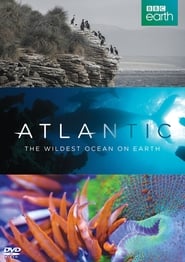
Atlantic: The Wildest Ocean on Earth
Muat Turun Sari Kata English
Maklumat siaran
Tag
Pratonton sari kata English
200 baris pertama.
There's an ocean where giants gather to feast...
..where people battle the planet's roughest seas.
EXPLODING
It stretches nearly 10,000 miles...
from Arctic to Antarctic.
PENGUINS HONK
THEY BARK
From tropical shallows...
..to mysterious depths...
..it's an ocean of extremes.
A engine room for storms 1,000 miles across...
..yet also a sanctuary for the vulnerable.
People and animals brave this unpredictable ocean...
..risking it all for rich rewards.
This is the Atlantic...
..the wildest ocean on Earth.
WAVES CRASH
Travel away from land into the centre of the Atlantic
and you enter a vast, blue desert.
No sea floor, or plants, or coral might grow.
No animals, no sign of life.
Or so it appears.
Blue jack mackerel.
They have shoaled here by their thousands to breed.
But their gathering has attracted attention.
DOLPHI N CLICKS
A group of common dolphins.
Close behind...spotted dolphins.
DOLPHINS CLICK
The two species collaborate to herd the fish into a ball.
There's no escape.
The bait ball is pinned against the surface,
under attack from every direction.
From above...
sheer waters.
The bait ball gets broken into smaller fragments.
Few mackerel will survive.
But the fish consumed,
the predators depart.
This fleeting gathering took place far out in the open ocean
because of something that happens deep beneath the surface.
Our vast geological forces throw up huge undersea mountains
and stir the ocean into life.
60 million years ago
an immense rift tore open the planet's surface.
Magma poured out
pushing America apart from Europe,
opening up the world's youngest ocean...
..the Atlantic.
DEEP RUMBLING
The crack in the earth's crust is still visible today.
This is the Silfra Gap in Iceland -
a strange no-man's land between two continents.
On the left side, America,
and on the right, Europe.
Over millions of years this crack spread,
opening up the Atlantic as it went.
And beneath the new ocean, that colossal upheaval threw up
the world's longest mountain range.
The Mid-Atlantic Ridge runs along the sea floor,
down the centre of the ocean, for 10,000 miles.
This undersea mountain range is vital for life in the ocean.
1,000 miles west of Portugal,
two brave explorers are preparing to drop into the abyss.
OK, let's go on our journey.
This mission is to uncover the secrets of life on
the Mid-Atlantic Ridge.
Husband and wife team Kirsten and Joachim Jakobsen
built this submarine themselves.
They rely on communication with the ship above in order to find
the ridge.
Are you right on top of us?
'We are northwest...
'maybe 300 metres to get to it.'
OK, thank you.
200 metres down is beyond the reach of sunlight.
And beyond 600 metres is a world as little-known
as outer space.
736 metres.
In everywhere you dive, you discover new things,
so a journey into the deep is a journey to another planet.
After nearly an hour, they reach the ocean floor -
over half a mile down and a few hundred metres
from the Mid-Atlantic Ridge.
The sea floor is just a vast, empty plain of mud.
But as the explorers pilot towards the ridge, life begins to appear.
The first foothills of the Mid-Atlantic Ridge.
I think we feel like discoverers, somehow.
We go to locations where no-one has ever been before.
Here at the bottom of the ocean, gardens have sprung to life.
Fields of sea fans, sponges and soft corals.
Over the past 20 years, Kirsten and Joachim
have discovered species that were completely new to science.
The deep-sea wonderland supports a rich food chain.
An angler fish breaks camouflage to ambush passing prey.
A squid dismembers another fish with its sharp beak.
An octopus overwhelms its prey.
Here, there's even enough food for giants.
At five metres long, these sixgill sharks have remained
virtually unchanged for more than 200 million years.
These predators move slowly to conserve energy.
They feed on whale carcasses falling from above.
Nice. Yes!
To protect themselves,
some animals have adopted ingenious defence measures.
These decorator crabs rarely venture far without an umbrella.
This isn't a form of camouflage -
these crabs live their lives in pitch blackness.
Researchers think the crabs choose corals and sponges with stings,
using them as a living shield to repel predators.
So, what has turned these undersea mountains
into such a rich oasis of life?
The answer lies with the nutrient-rich current,
which flows through the deep.
It's travelled thousands of miles across the sea floor
from the Arctic and here, it collides with the ridge.
These nutrients in the current
feed the foundations of a remarkable pyramid of life.
And here in the deep, it's only the start.
Bye-bye, deep sea, until the next time.
The submarine follows the current
as it's deflected up towards the surface.
As they rise, they encounter other creatures of the deep,
sustained by the rich, upwelling current.
Comb jellies can grow to more than a metre across.
Thousands of hairs catch the submarine's light,
beating to propel it through the water.
Next come clouds of krill -
tiny shrimp, the food of giant blue whales.
What's this?
Strange.
Oh, there's a histio.
Yes, histioteuthis. Yes!
Oh, we have to be very careful now.
At the edge of where sunlight can penetrate,
the bizarre strawberry squid.
It has two different-sized eyes for hunting in this unusual world.
The large eye points upwards
to scan for silhouettes in the twilight.
And a smaller one scans for bioluminescent prey
glowing in the depths.
At last, the submarine returns to sunlit water.
The nutrients welling up from below combine with the sunlight
to create an oasis of life in the heart of the Atlantic.
From small fish like blue jack mackerel
to voracious predators like these barracuda...
..many animals journey thousands of miles to feast here
in the peak summer season.
These mobula rays, over three metres across,
have travelled from the coast of Africa.
A blue shark - another wonder of the ocean desert.
And these - sperm whales, the largest toothed animal on earth.
They feed 1,000 metres down
on deep-sea squid and even deep-sea sharks.
The abundant life here supports
a population of hundreds of these whales.
The Mid-Atlantic Ridge has transformed the open ocean
into an oasis for life.
In some parts of the Atlantic,
the volcanic forces that created the ridge are
so powerful that the mountains are driven right up to the surface.
One million years ago, the tip of a volcano broke the surface
just south of the equator to create the island of Ascension.
It is one of the newest and most lonely islands
in the South Atlantic...
..and home to a very strange ecosystem.
The shallow waters around the island are dominated by one animal -
the black triggerfish.
Few competitors have yet made it
across the vast stretches of open ocean.
Triggerfish will eat almost anything.
And they are here in such numbers that little coral or seaweed
can gain a foothold.
Seabird chicks that fall in the water are soon snapped up.
Sick or injured triggerfish don't last long, either.
Above the waves, barren volcanic rocks bake
in more than 30 degrees Celsius under the equatorial sun.
This truly is a desert island.
The diary of a Dutch sailor was found here centuries ago.
He survived just six months in this waterless place,
drinking the blood of sea turtles to survive.
But some castaways have made Ascension their permanent home.
Ascension land crabs, the size of a man's fist,
are the largest native animals on the island.
Their larvae drifted here on ocean currents
and the adults survived by foraging on the lava fields.
To escape the searing equatorial heat,
the crabs live high up,
where it's cooler and there's moisture from the clouds,
but they still have to lay their eggs in seawater.
So, every year, the female crabs face an epic journey to the ocean.
To escape the heat of the day, they travel mostly at night.
Almost all the crabs head for just a few beaches -
perhaps the ones where they first came ashore as youngsters.
For some, that means travelling halfway across the island -
the equivalent of a person walking 100 miles.
They drink from occasional pools of condensation on the rocks.
They don't drink with their mouths -
they absorb water through their rear legs.
Dawn brings an end to their week-long trek.
Atlantic: The Wildest Ocean on Earth subtitles in other languages
More English subtitles for Atlantic: The Wildest Ocean on Earth
- BBC Atlantic The Wildest Ocean on Earth 3of3 From Heaven to Hell 720p HDTV x264 AAC MVGroup org · 17 downloads · 2025-10-28
- BBC Atlantic The Wildest Ocean on Earth 1of3 Life Stream 720p HDTV x264 AAC MVGroup org · 21 downloads · 2025-10-28
- BBC Atlantic The Wildest Ocean on Earth 3of3 From Heaven to Hell 720p HDTV x264 AAC MVGroup org eng · 47 downloads · 2020-03-14
- BBC Atlantic The Wildest Ocean on Earth 2of3 Mountains of the Deep 720p HDTV x264 AAC MVGroup org eng · 40 downloads · 2020-03-14
- BBC Atlantic The Wildest Ocean on Earth 1of3 Life Stream 720p HDTV x264 AAC MVGroup org eng · 44 downloads · 2020-03-14
Komen
No comments yet. Be the first to leave one.