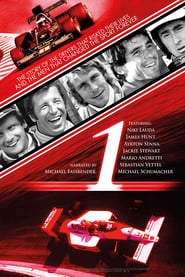
1
Download English ondertitel
Release informatie
Tags
Voorbeeld van English ondertiteling
De eerste 200 regels.
Everybody thought I was dead.
I didn't have a bruise on my body.
I didn't have anything at all.
I looked up, and I saw a red flag.
That's lucky-- they've stopped the race.
Back then, we had the restarts, and...
also we had spare cars,
so your mind goes, "Get in the spare car."
And new ear plugs! - Yes, okay.
And new gl-- and new gloves!
And so, you can't start until you've seen Professor Watkins.
"Where's Sid? Anybody know where Sid is?"
I ran towards him like crazy.
I got there, and he said, "I can see you're okay.
I've just watched you run 300 meters. What's the date?"
I said, "It's the 10th of March."
He said, "Yeah, then you're fine. Get in the car."
There is no doubt about it--
a few years before, I would have been a dead man.
We want to see something exceptional,
breathtaking, that we think we can't do.
We want to see gladiators, warriors.
And let's face it, we do like to see a bit of a shunt.
But we don't want to see deaths.
Miracle of miracles! This is well-nigh unbelievable!
Martin Brundle gets out of the car,
and he's seemingly all right.
It is incredible how this changed,
and how suddenly it became unacceptable to die in the name of sport.
Grand Prix is like the Olympics of motor sports,
with the cars in all national colors:
blue for the French, green for the British,
red for Italy, and white for the Germans,
until Mercedes stopped using paint on those silver arrows...
Michael Schumacher wins,
and becomes the most successful Grand Prix driver of all time!
...The silver cars that are the pride of Hitler Germany.
Alfa Romeo wins, driven by the fabulous Nouvalri.
What a feeling for Fernando Alonzo.
He wins the Italian Grand Prix at Monza.
As the French announce their search for the fastest man
in a new world championship series to be entitled Formula One,
with the inaugural race to be held at Silverstone.
Enzo Ferrari for one is not impressed
with the new wave of British motor racers.
Il Commendatore has labeled the new independent designers
garagistes, 'the men who cannot build engines'.
Fangio is beaten in Buenos Aires
by former teammate and fastest rival Stirling Moss,
in a Cooper funny car, no less.
What courage by these men,
to push these cars and themselves
to their very limits. But that is Formula One.
Formula One was born in a bygone time...
When boys' heroes reigned in the sky.
When you're young, you wanted to be a Formula One driver.
You wanted to be an astronaut,
you wanted to be a fighter pilot.
After the second world war,
the mindset of going off
and doing something courageous in a vehicle,
this just naturally flowed into what became Formula One.
When you see photographs and film of that era,
the seriousness of them is awe-inspiring.
I grew up in that world.
My dad was world champion '62, and I was 2.
They all had this genuineness about them.
They all were the real article.
I certainly had respect to those that went before me.
Some of them were my contemporaries.
I met one time probably in my view
the greatest Grand Prix driver ever,
and that includes people like Michael Schumacher and Ayrton Senna.
Fangio. Fangio.
Fangio. Fangio.
Fangio.
Juan Manuel Fangio.
The first big name in Formula One
may have been the best driver ever.
Fangio would win five world titles,
a record that stood for 40 years,
surpassed only by Michael Schumacher.
Whenever you drive those cars that Fangio had to race in,
it's very scary.
You have to hold yourself on the steering wheel.
No safety belts.
The helmet was just like a hat.
Goggles. And you had to be brave.
The most celebrated driver in a dangerous time
survived.
The year Fangio retired, 1958, the formula changed.
The sport's governing body announced from Paris
that Formula One would crown two world champions each season--
one title for the fastest driver,
and another for the manufacturer of the fastest machine.
This was the evolution, you know?
Each team has to take engines,
take chassis and technology to the absolute limit.
In this new competition,
the British began to challenge the old world continental powers.
All the English teams were considered to be
the garagistes by... by Ferrari and the other racing teams.
One Englishman would set the pace of progress,
in racing and the entire automotive world.
We basically go racing 'cause I like it.
I like the competitiveness of it,
I like the comradeship of it.
And I also like the technical fallout that comes from it.
Colin Chapman was a great character,
if at times a bit cavalier.
Oh, I don't know about that.
Colin Chapman was an engineer who learned to fly,
an entrepreneur who made lightweight sports cars for the public,
as well as for Grand Prix, under the name Lotus.
In those days, Lotus was an out-and-out racing car.
My father, he was always pushing the envelope.
Good engineering means you've designed something to its limit.
Colin was the maverick of all time.
He was a genius.
He was the team owner that you want to drive for.
By 1963, Chapman had designed
the fastest machine in Formula One...
And he had the fastest man behind the wheel of a Lotus.
Jim Clark was the best racing driver
I ever raced against.
The whole exercise was to be as good as you can get--
on the limit.
And Jimmy drove in such a way
that he was never over the limit.
He was never erratic. He was never spectacular.
He was spectacularly fast, but in an unspectacular fashion.
It was smooth and clean and beautifully handled.
He would win more Formula One championship races
than any driver before him,
finishing in second place only once in his career.
He was a country boy.
He was a farmer from the borders of Scotland,
quiet and almost innocent.
I'd like to get back here much more often.
It's, uh, great relaxation to get back here,
and very much the opposite from racing.
Clark became the face of Formula One,
with another champion, Graham Hill,
playing his affable foil.
Everyone was quite close.
Jim Clark had been to our house,
and I knew Colin Chapman sort of the same way as I knew my dad.
They sounded the same, and they had the same mustache.
Colin was an extreme extrovert,
great fun to be with,
but very different in character to Jimmy, really.
Jimmy was quieter. But they were like brothers.
Together, they were racing on the limit
of manmade speed and ingenuity.
They won four world championships between them,
and a record five British Grand Prix.
But for all their success,
they failed to take the checkered flag
at the most famous motor race of all.
Fast cars and courageous souls from all over the world
have been racing through these streets since 1929.
Monaco is terrifying.
You cannot believe it's possible
to hold a motor race round Monaco.
In the first few laps, you stick your head up to see where it went, 'cause
it's just guardrails that you can't hardly see.
You're millimeters away from barriers.
You either do a lap that you're so proud of--
you're always wondering if you're ever gonna do that again--
or you end up in the wall.
The danger aspect to this
is one of the parts that drives us racing drivers.
It's something we love.
One man mastered these streets
like no other driver in history.
Monaco was a special place for Senna.
He was the best in the world.
His concentration on one lap was just uncanny.
Ayrton Senna won Monaco a record six times,
one more victory than the man with the derring-do mustache.
Graham Hill came to Monaco in 1966
to defend his third straight victory.
It's a tremendous race and a great one to come and watch,
and if anybody's gonna come and see a Grand Prix, this is really the one.
It's such a nice place to be, anyway.
To come to Monaco and talk to men
is a waste of time, so excuse me.
That's when motor racing was really dangerous,
and sex was safe.
Still today, what defines Formula One
is the sense of prestige.
It's an event. Kings want to be there.
For me, it's a thrill to see an expert at work.
Upon meeting Graham Hill, you like him.
Watching him made me become more interested in racing
and what these men were doing.
In those days, Hill's fiercest rivals
were also his closest friends.
The intimacy was incredible,
from the racing drivers to the mechanics
1 subtitles in other languages
More English subtitles for 1
- 1 Life on the Limit 2013 1080p BluRay x264-SPLiTSViLLE · 56 downloads · 2019-08-21
- 1: Life On The Limit (2013) BluRay 1080p 5 1CH x264 Ganool · 38 downloads · 2014-05-26
- 1 Life On The Limit 2013 720p BluRay x264-PublicHD · 72 downloads · 2014-02-21
- 1 2013 720p WEB-DL H264-PublicHD · 37 downloads · 2013-10-13
- 1 2013 720p WEB-DL H264-PublicHD · 56 downloads · 2013-10-13
Opmerkingen
No comments yet. Be the first to leave one.