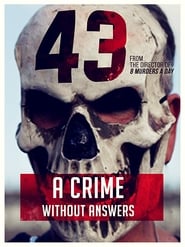
43
Pobierz napisy English
Informacje o wydaniu
Tagi
Podgląd napisów English
Pierwsze 191 wierszy.
- We're in the middle of yet another protest
from the Mexican citizens complaining about
their government, which is nothing new.
This is one of the streets here in downtown Iguala.
We have many, many citizens here, maybe 100 plus,
protesting the federal police.
The federal police, they've taken over this city
after the municipal police were dissolved
after the incident on September the 26th, 2014,
when 43 students went missing from the school Ayotzinapa.
- They took these kids away somewhere.
We don't know where.
No one seems to know where.
- All this blaming each other began,
like in many other cases in Mexico.
As many other stories in our history,
it went deadly wrong, and that's only one
of those stories that we actually know about.
It just went out of control.
As easy as it looks,
that you can't just erase someone from
the face of the Earth in Mexico nowadays,
you cannot do that without facing some consequences.
- It's very, very hot, late June 2015,
and we're gonna get to the school in Ayotzinapa
to talk to the students, the parents,
the administrators to find out
the latest on this huge tragedy.
We can see the entrance of the school Ayotzinapa.
This is an all-male school where they
were studying to become teachers,
people who were trying to make a difference in
the poor state of Guerrero, to make Mexico a better place.
- When millions of Mexicans that we do our part everyday,
we play fairly and we play with love for
the country, and we move that country.
- We are the ones, the good Mexicans
are the ones who move our country
forward, not the powerful crooks.
- This is the actual intersection
where the buses were intercepted.
The students from Ayotzinapa were basically
trapped in this area right here.
In the last seven years, 135,000 Mexican people
have been murdered during this drug war
that's really occurring in the United States.
It's a war on people here in Mexico,
and out of all those deaths, I would say
that this particular incident,
that occurred on September 26, 2014,
has gotten the most attention.
You can see a memorial here that has been set up
to honor these missing students.
- I took this investigation because for me,
these students, really, they are a symbol
of something that is important.
They are people that fight against the injustice.
They are kids that are very poor.
The Isidro Burgos School
and also other teachers' schools,
they have this big meeting to
organize the big protest for the
next October, too, in Mexico City.
They decide that now, in that year, 2014,
was the work of the Isidro Burgos School
get the bosses to be able to go there.
So okay, that's your job, get the bosses.
Others will get money.
Others will get food.
The mission was get 27 buses,
and they have very short time to do it.
How they do it?
How they used to do it?
Many of these kinds of public schools,
how they used to do it, they stole the buses.
They stole them, and they took them
for some days, and then they'd release them.
That's how they work.
This is a school of teachers,
very young people, that came from
the poorest areas in Guerrero.
Really are not common people.
Ayotzinapa, Isidro Burgos choose the students
not because the student is the most smart guy.
It's because the ideology.
This group doesn't accept the violence.
They don't accept be poor for the rest of their lives.
They don't accept the abuse of the power
against their families, against their territory.
- Why these students are radicals?
First, the society, the world
should ask what have we done to them,
what the government done to them
to push them to take that decisions.
You really cannot understand what Ayotzinapa is
if you don't see each story of each boy that is there,
and each story is very sad.
It's a tragedy.
They don't have food to eat.
They don't have clothes to wear.
They see how the army raped their mothers
and their sisters, and it's not justice.
- Those families don't have any proof
that their kids are alive or gone forever.
This cannot be over.
This is not over, and this case cannot be closed.
There's nothing you can say to
a mother that lost her child or
to a family who lost everything.
There's nothing we can say.
I know that in that attack
participate the municipal police,
the police of Guerrero, the government of Guerrero,
the army of the federal government, and the federal police.
Everyone participate in the attack of the students.
- To my left, you can see a huge sign here,
a reward for one million pesos
to help capture whoever was
responsible for the missing 43 students.
- Federal government, really at the beginning,
start to say a lot of things that doesn't have any sense.
So the first sign, the first proof that I got,
really, really important, is from one court in Mexico.
I start investigate and they gave the file,
and for example, the government said,
oh, we arrest to the municipal police.
22 municipal police that participate in the attack,
and they are guilty, and they did it
and they confessed, and I was able to get the file,
and many of them were released.
And the confessions are very different
than the government is saying.
- Is Peña Nieto a murderer?
- I think, as almost any Mexican would tell you,
the biggest problems of the country
are corruption and government impunity,
and even though Mexico's a very vigorous democracy
in which you can criticize the President
in the newspapers, on TV, on the radio,
and public demonstrations, often criticism
and protest marches and demonstrations change nothing.
The structure of the economy and the political system,
which is at the heart of the problem, that is,
the rich getting richer and the poor staying poor.
Historically, Mexico's been kept down because
the United States, its next door neighbor to the north,
is much more powerful in almost
every way, economically, politically.
Mexico essentially supplies cheap labor
for American industry, American fields.
The United States sends hundreds
or thousands of factories to Mexico
and creates industrial production there
but exploits the workers of Mexico.
It's a very one-sided relationship.
- Tell us about the state of Guerrero.
- The state of Guerrero is one, historically,
of tremendous poverty, tremendous social inequality
and endless rebellion and protest against local government
and state government and federal government.
- The most famous city in the state of Guerrero is Acapulco.
This used to be the ultimate tourist destination
for famous movie stars and musicians
until cartel violence hit this
city in the last, about, 10 years,
making it the most dangerous city in Mexico.
- Very corrupt, despotic leadership
controlling a population that's extremely poor.
Rural farmers with very few rights,
and many of them, especially in Guerrero,
their only way to survive is by growing marijuana
or opium poppies to make heroin,
and these are people with few opportunities in life,
little chance to get a proper education or a good job.
They try to send their kids off to college,
high school if they're lucky, really,
but some of them get to college,
such as the students who were murdered at Ayotzinapa.
So Guerrero's produced some of the most radical movements
in Mexico, such as the rebel group in the 1970s of
the Party of the Poor and Lucio Cabañas.
- Iguala is a very historic city in Mexico.
This is where the Mexican flag was born.
It's the third largest city in Guerrero after Acapulco
and Chilpancingo, which is the capital.
This city has over 100,000 residents,
and they're still reeling from that day,
now nine months later as of this filming.
After the mayor and his wife fled after the incident,
a new mayor was brought in, basically a lame duck,
and he'll be replaced this September of 2015.
43 subtitles in other languages
Komentarze
No comments yet. Be the first to leave one.