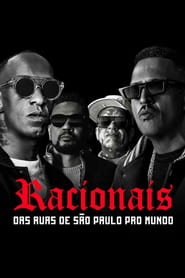
Racionais MC's: From the Streets of São Paulo
Racionais: Das Ruas de São Paulo Pro Mundo
Pobierz napisy English
Informacje o wydaniu
Tagi
Podgląd napisów English
Pierwsze 200 wierszy.
Revolution will come from the bottom, from the roots, from the mud.
One for the love, two for the money Crazy life, Capão
I'm a warrior of faith
One for the love, two for the money Crazy life, Capão
I'm a warrior of faith
If crime is a disease I know the infection
But I still won't ruin anybody's plans
So, one for the love, two for the money
Three for Africa and four for the brothers
Who are at war and not afraid to fail
Say what you will Only God can judge
Film them. Film all these police cars, bro.
We've all watched Dr. Dre's concert.
The dudes walked onto the stage through the screen,
like an image that's…
Three-dimensional.
A three-dimensional image! From outer space.
It's futuristic.
So we watch that, and we get inspired.
"Whoa, that's what's up."
"Let's rap, because that's what's on!"
And then we wake up.
Check this out.
That's our stage.
For you and those who didn't become shark food.
Those who came from the other side of the continent,
who suffered the botched transatlantic transplant.
For the naturally strong.
This is for you.
-Does Racionais do any social work? -Here.
This is our social work.
Music that changes people's attitudes, gets into their minds.
MOUSETRAP IN CAPÃO
The most violent weekend of all time.
A NETFLIX DOCUMENTARY
End racism! Now! Now!
When the police officers approached him, they didn't ask for any explanation.
They just shot him with machine guns.
Murdered in the next bedroom, in his sleep,
23-year-old Wanderley,
whom Ms. Ivanda swears is a working man.
Then I came back bigger.
São Paulo, Brazil.
This is Racionais MC's!
Capão Redondo, São Paulo, Brazil.
The South Side, in the 1970s, was still almost rural.
There were still lots of horses, cattle,
dirt roads, fences, lots of soccer fields, lots of kites, you know?
I was just trying to get by.
I wasn't going anywhere.
The way I was back then, I wouldn't have made it.
Completely empty-minded. Empty.
Ready to become a thief.
I went to an all-white school,
so they made fun of me because of my hair, my lips.
They even had racist nursery rhymes.
When they came at me, I'd react poorly.
I'd get violent. I'd draw blood.
Because my Barrabaz heart For loving too much
Would be tried in absentia It is the law
If they knew what I know They wouldn't love, ha!
Being a recording artist or a singer
felt as distant as Saturn or Jupiter.
I knew we would be heard eventually.
I knew that.
It was more romantic and naive, like,
"I want Black people to hear me."
"I need them to hear me."
"I need to get into their hearts." You know?
I used to live in a war zone.
I lived in the most dangerous area of the South Side.
My street ended in a wooded area.
Every day, there'd be a new corpse there.
But there was a soccer field there.
Our relationship with corpses became natural.
You'd see someone who was hanged, or shot,
and they'd be left there for days.
That's exactly what the 1980s were like.
It's a challenge to make people aware
of what is actually happening.
My mother and Brown's mother were friends.
They both went to Seu Isaac's Candomblé house.
We became family,
even though not by blood, since we were little.
We've been stuck together ever since.
I remember vaguely us living
in the Santa Rita family backyard in the '70s.
Because it was a Candomblé yard,
the family would shelter people.
When Sunday services were over, it all turned into samba.
Sundays were all about samba, cookouts.
So we grew up surrounded by music.
During the '80s, the North Side had many violent neighborhoods.
But they were further back.
Where I used to live in Mazzei,
there was some violence, but not as much.
At the time, most parties were still home affairs.
That was the culture, you know?
So there was always a party to go to.
There's this sense of brotherhood
which dates back 400, 500 years.
We were together in past lives.
My family always liked to party, and it's a large family.
I used to live in Vila Mazzei, and when I was 14, I started going out.
EDI ROCK'S MOTHER
It was formative. I carry it with me to this day.
It's how I got to know music,
the streets, the world, life.
I also met KL Jay in Mazzei.
There was a crowd gathered around, and KL Jay was dancing in the middle.
He even had Ray Parker's hair, like Michael Jackson.
The man was a legend even then.
Through breakdancing We made a pact
Another duo from São Paulo Tried their luck
Through the darkness, yeah And the damp night air
We came up with the cure Which contained venom
I can see it in people's eyes when they're leaving a concert.
Our mission here is to make people feel good and uplifted.
It's powerful, it's a mission.
We're here to accomplish a mission.
Through music.
We rocked at rapping.
Remember the video we went to the white guy's house?
Edi Rock and I are from the North Side.
Brown and Blue, the South Side.
That's an awesome beat.
How did you use to go downtown? By bus?
-There was no subway back then. -Bus until Praça da Bandeira.
Bus, subway, bus.
The bus to Praça da Bandeira, then the subway to Santana…
We'd leave from here.
Capão.
We'd get on the bus, and it'd take an hour and a half to get downtown.
It was a real journey, almost a spiritual one.
You'd leave a place of poverty to a place where all the lights were on.
Going downtown when we were broke,
when we got hungry on the bus, it was like we'd feed on the lights.
And the shop windows.
The shop windows, the clothes.
We'd go to record stores to see the posters, the cover art.
Or the sneakers that were in style.
Man, Galeria was like being in Harlem.
The songs, the barbershops,
the record stores…
All the gestures and rituals of Black youth.
We really identified with that. It was beautiful to see.
Going downtown was like going to New York.
Seeing Black people from all over, North, West, East Sides.
We began going to dance parties.
We'd leave the South Side to go to a dance party.
I liked being in the middle of it.
They'd play great music, Black people all around. I loved it.
We started our own team.
KL Jay and I.
We'd play in the hood what we heard at the parties.
We'd bring downtown to the hood.
The teams had a tradition of bringing over international groups.
First time I saw one of them, like Kool Moe Dee,
I thought, "Wow, we can do that."
You'd sing a rhyme, while a DJ scratched some records.
Rap music, my rap music, came to me in '88, '87.
I was 17 years old.
I worked at a warehouse on Brigadeiro Luís Antônio Avenue.
We unloaded trucks.
When they were late, I used to write.
I was an office boy
and I'd get off at São Bento to get to my job at the company.
A lot of names came from there.
Thaíde, DJ Hum, MC Jack, Backspin, Os Gêmeos…
São Bento was the meeting place for Brazilian hip-hop.
Look at how powerful that place was.
Starting now,
two hours of the best sounds in São Paulo, with the Zimbabwe team.
The sound of the people.
We were at São Bento one day. A guy showed up and asked,
"Who are the guys from Capão who say they can sing?"
I said, "That's me!"
He asked. I never said I was great.
RAP COMPETITION
"Yeah, there's this rap competition or something. Let's sign up."
"Let's sign up and stuff."
"What will be our name?" "Let's just come up with one."
We came up with B. B Boys and signed up.
We rapped twice and won the competition.
Holy shit, we just signed up and won!
"B" dot "B" Boys, you know? B. B Boys.
Bad Black Boys. What did you expect, bro?
We were 17.
B. B Boys is our name We are the B. B Boys
Hip-hop is our dance And rap is our voice
Came from the underground Who'd have thought?
This is no American ghetto It's Brazilian
Anything can happen No one can avoid it
We kill and we die For no reason, yeah
We ended up at Edifício Copan.
We got there, a group was recording and Edi Rock and KL Jay were there.
"What's up, DJ!" I remember it exactly.
He flinched back, like this. We were thugs from the South Side.
Kleber was always discreet.
"My name is Edi--" And then he went, "Rock!"
Racionais MC's: From the Streets of São Paulo subtitles in other languages
More English subtitles for Racionais MC's: From the Streets of São Paulo
- Racionais MCs From the Streets of Sao Paulo 2022 PORTUGUESE WEBRip NF · 14 downloads · 2022-11-16
Komentarze
No comments yet. Be the first to leave one.