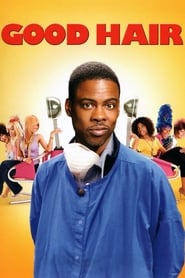
Good Hair
Pobierz napisy English
Informacje o wydaniu
Tagi
Podgląd napisów English
Pierwsze 200 wierszy.
Those are my daughters, Lola and Zahra,
the most beautiful girls in the world.
And even though I tell them that they're beautiful every single day,
sometimes it's just not good enough.
Just yesterday, Lola came into the house crying
and said, "Daddy, how come I don't have good hair?"
I wonder how she came up with that idea?
Well, there's always this sort of pressure within the black community,
like, "Oh, if you have good hair,
"you're prettier or better than the brown-skinned girl
"that wears the Afro or the dreads or the natural hairstyle."
I mean, have I gone around thinking it,
and have I said it to myself, "l got good hair"?
Do I say it to my daughter,
like, and not even thinking what I'm saying?
I'm like, "Honey, you have such good hair.
"You have such beautiful hair."
Growing up, I considered anybody's hair but mine good hair.
Like, my mom is white.
I'm half Russian and Norwegian on my mother's side,
so my mom's hair is silky and blonde, and I was like, "Why?
"Just why didn't I get your genetics?"
That was what I looked at as, you know,
good hair was white hair.
The lighter, the brighter, the better.
And that's a thing that causes great dissension
within the black community and with black women.
You know, I look in the black hair books,
and it's like all the hair is straight.
It was a hard, like, decision in the beginning.
I said, "No, I'm going to be strong against all the forces
"that are going to try to get me to straighten my hair."
You know, you look at the magazines
and you want to be that girl, you know.
You want to be that girl,
and you have this fantasy where you think,
"If they straighten it out,
"then all of a sudden it's going to grow
"and it's going to really move and it's going to really flow
"and I'm going to have this hair."
Well, you never had the hair to begin with,
but you don't know that, you know.
When you look at a woman's hair,
it's a fantasy come true if they can really pull that off.
So, for me, yeah, hair's real important.
Well, I would say that hair is a woman's glory,
and that you share that glory with your family.
And they get to see you braiding it,
and they get to see you washing it,
and they get to--It's a glory.
But it is not a bad thing or a good thing. It's hair.
If you have it on your head, it's good.
If you have it growing between your toes,
it probably isn't so good.
So what feeds this hair machine?
How do we decide what good hair is?
Well, at least for some people, that decision is made
where all major black decisions are made...
in Atlanta at the Bronner Brothers Hair Show.
That's right, the Bronner Brothers Hair Show.
Twice a year, for over sixty years,
the Bronner Brothers have hosted this massive hair show
with over 120,000 hair professionals in attendance,
over twenty-eight major hotels booked exclusively,
and over $60 million pumped into the Atlanta economy.
Good hair is good business.
My father started it sixty years ago,
and the show was actually a seminar
to teach the people buying the products
how to use the products.
And sixty years later,
the number-one purpose of the hair show,
to come learn how to use new products.
Certain products, we index triple what the white market does.
We're at 12°/° of the population, but we buy 80°/° of the hair.
Wow!
I got in the wrong business.
All I know is, we spend a ton of money on our hair.
No matter what, we going to look good.
We going to look good.
You know, that's the bottom line.
We're going to look good regardless.
While the main purpose of the show
is to promote products and make tons of money,
the three-day event culminates in a hair contest
where stylists from around the world
come to compete and show off their skills
in front of an arena of cheering hair fans.
The winner not only takes home $20,000,
but also receives lucrative endorsement deals
and establishes themselves as the leading voice in black hair.
Now, can you tell me, how are the hairstylists chosen
to compete in this competition?
We try and select the best of the best.
If we see someone that's exciting on stages,
we invite them in to do our Battle.
Tanya, I really can't say her strength,
'cause this is her first time doing the Battle.
Her weakness is that she's sort of new.
Well, I'm happy to be nappy. How about that?
Oh, Lord. See, Tanya, don't take it there.
She don't want to be nappy.
No, I'm not saying--
I know my hair can get very coarse, but...
Ooh, and then they try to find a better word for it.
Yes!
Dress it up, baby. It's okay.
That's a stigma.
Chris, are you listening?
It's not called bad.
Nappy's not bad.
Well, actually--
It can still be good.
It's just nappy.
I changed it around.
'Cause people with that soft, natural, curly hair,
I call that bad hair now.
Okay, 'cause it's hard to curl?
'Cause nappy hair holds curls.
Tanya's new to this, but she's also business partners
with former Bronner Brothers champion Kevin Kirk.
Kevin won twenty grand back in 2005,
when twenty grand really meant something.
If that belt could talk, what do you think it would say?
It'd say, "Bring home my brother August 18th."
So the brother's held captive?
It's held captive.
Bronner Brothers got it on lock right now.
I picture myself being David
and all the other contestants being Goliath.
Derek is a very exciting person.
He's a unique person.
His performance is always at the top.
Styling, he might be a little bit weak on that,
but exciting, very exciting.
Derek competed last year
and many people, mostly Derek, felt he should have won.
But he ended up losing on two technicalities:
nudity and too many people on stage at one time.
My biggest scare was me
trying to find a pair of boots to wear for the show.
A guy hit me up on MySpace,
and he ends up being a boot designer.
Jayda, Tyree. Terrence, Tyree.
And he basically takes boots that you--
A boot that you already have,
and redesigns it and customizes it
and, hopefully, you guys will see a phat pair of boots.
I can't wait. I'm so excited about this right now.
Freddie...
very smart.
That's her strength. Smart, can do hair.
Her weakness is that she over-thinks it.
She goes over the audience's head.
Last year's theme was Broke Front Mountain.
So that was based
- on the movie Brokeback Mountain. - It was, kind of.
When we did the...
We did a video clip
that was in the beginning that was about thirty seconds.
I'm going to work on her with all these.
I might have to hide from them to get them, though.
I'm going to be hiding more than Harriet Tubman was hiding.
You know, I liked Broke Front Mountain.
I think I just shouldn't have cut the hair in the boxes.
I put this "FJ," my logo on there,
and people thought it was something Asian.
They just couldn't keep up.
Now, which of the other stylists are you most worried about?
Probably Jason.
Jason Griggers.
Me and Jason know of each other.
Do you have any enemies in hair?
No.
Jason's strength is his incredible hairstyles.
L, actually, am from the same hometown as Jason.
He's been doing my hair since about 2000,
and my hair was her length when I started coming,
and this is mine.
No tracks in this.
So he has what we used to call "the growing hand."
I never said that.
So, Jason, you seem to be able to get women off the weaves.
You're kind of like the Betty Ford of black hair.
I refer to it as the Rosa Parks of hair.
Jason...
where does a white man learn how to do black hair?
In school, they teach you everything.
This one teacher that I had,
she would always give me a pair of these
to walk around school with, and she'd say,
"l don't hear you clicking and twisting.
"l don't hear you clicking and twisting."
Was she a black woman?
She was a black woman.
She was the only black teacher at school.
And she was determined to teach you--
She was determined to teach me how to work those Marcel irons.
So she's like Branch Rickey and you're the Jackie Robinson.
That's "The Jackie Robinson Story"
Good Hair subtitles in other languages
More English subtitles for Good Hair
- Good Hair 2009 1080p WEBRip x264-RARBG English · 70 downloads · 2019-12-08
- goodHair-faye-xvid · 39 downloads · 2010-05-07
- Good Hair 2009 DVDRip XviD-Emery · 32 downloads · 2010-02-12
- Good Hair 2009 DOCU LIMITED DVDRip XviD-DEPRAViTY · 43 downloads · 2010-02-08
Komentarze
No comments yet. Be the first to leave one.