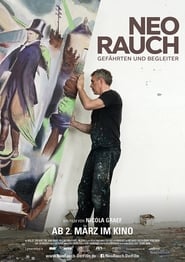
Neo Rauch - Comrades and Companions (Neo Rauch - Gefährten und Begleiter)
Pobierz napisy English
Informacje o wydaniu
Tagi
Podgląd napisów English
Pierwsze 200 wierszy.
Where are the assistants?
The thirty?
Shit.
Slapstick.
5 years ago I did everything blindfolded.
I carried in two at a time. Now I'm struggling away here.
Not one assistant far and wide.
I'm doing something wrong.
I'm making a fool of myself.
COMRADES AND COMPANIONS
Of course I'm always trying
to feel out new ways.
To walk on untrodden paths.
But that's becoming more and more difficult with the time.
Why?
Because I've already set a few flower beds,
and beaten trails
through my inner woodlands.
And the untrodden is slowly becoming rare.
I have to do something
in order to develop virgin forests.
By what are you then awakened again?
Through the disgust of repetition.
I start to notice that I've thousands of times...
...gone through this.
That becomes stale in the mouth if you say it too often
or the movement becomes simply tedious and banal
if you perform them too often.
The childlike joy of discovery, to keep that alive within
which senses behind every corner a totally new perspective,
That is the simple thing which is so hard to do.
NEW YORK USA
DAVID ZWIRNER GALLERY
Difficult.
HANNA SCHOUWINK DIRECTOR
What do you think about hanging this picture here
and this one on the left?
We can try that.
The central figure is really a magnet
which draws the attention.
This one here is a sort of rebirth, isn't it?
Yes.
Yes, that doesn't work...
- It was better before. No. Ok.
I found it better here.
We simply have to come in.
With a fresh sense.
Do you find that nice together?
Yes. That's good because it's so light, so open
and here we have this darkness over the left half.
- Yes I think that's better too. - A leaden heaviness.
I think we now need a bit of distance.
- Yes. Tomorrow is the decisive day. - Very nice. Ok.
When do you know whether it is finished, when it is hung up like this?
You know that intuitively?
I leave that anyway
to the gallery owner in the end.
He has proved himself many times...
...as very sensitive
and precise,
when it comes to hanging the art.
And this time he will also make the final adjustments.
Well, after a while I can't look at it anymore.
I'm then professionally blinkered from a certain point on.
I painted them,
I've had them moved here and there.
And then at some point it's enough.
You said before that you had the room in your head,
but does that correspond to the real room at the end?
No, never. Of course not.
Because the paintings announce their own spatial requirements.
Also inwardly.
Their internal space.
And this is not consistent with the real room.
Now I have to yield.
JOHN THOMSON COLLECTOR
HELEN AND EDWARD NICOLL COLLECTORS
We always wait feverishly
when Neo's ready again.
DAVID ZWIRNER ART DEALER when Neo's ready again.
DAVID ZWIRNER ART DEALER
DAVID ZWIRNER ART DEALER Now it's almost 3 years since the last exhibition.
DAVID ZWIRNER ART DEALER
DAVID ZWIRNER ART DEALER He is a superstar in America.
He is a superstar in America.
An artist was here a minute ago who gave me some drawings
because I promised him that he could meet Neo.
He's his absolute favourite artist.
Of course he's special
to the local artists, a legendary figure.
So it's a very meaningful exhibition for us.
What do you think, why now have the Americans such an affinity
to his paintings?
Well, there is now international affinity to the works of Neo.
But he is of course a completely authentic,
a completely German character.
He comes from a world of images and a contemplative world
which is really only possible in Germany.
He's a German painter.
And here that has of course also something very exotic.
Of course he's a great talent, that goes without saying.
But his iconography is very particular,
and the Americans find that incredibly exciting.
You were his favourite artist. I wanted you two to meet.
- He gave me these. - Amazing.
I really don't know what to say.
Say thank you.
I did.
COTTON MILL LEIPZIG
Do the figures come really from an inner impulse?
Yes.
They are imaginarily created in advance as a basic form.
So I know of course from the outset
the type of character I want to develop.
But the details unfold during the work.
So of course, I must know whether I want to have an old matron
or a beautiful maiden.
Or something in between.
Mostly it is something in between.
And that then results in the making. It then grows...
...under the hand.
It's always such a pleasant experience
to perceive yourself as creator.
Really as a producer of characters.
That is simply incomparable with anything else.
Do you take the characters with you when you leave the studio?
Yes.
They also accost me at night,
if they still haven't acquired the appropriate form,
if they are still fractious
or simply mock me, as their producer,
then they shake my bed.
And say something to you?
Yes they simply don't let me sleep.
That is then simply a penetrative followership.
This is sometimes rather overbearing, what happens here.
- Restlessness? - Yes, an inner restlessness.
It seems to me,
that often the figures are very occupied loners.
They are for themselves in what they do.
Yes, they're contemplative.
Every one of them is pensive, introspective,
occupied with themselves.
They are almost somnambulant moments.
I'm trying in general to maintain that, or to provoke that.
This is important to me, that it's not too...
...too direct.
In the interaction.
The fact that there is no sweaty realism,
but that there are moments of hesitancy, of timidity,
of introspective inhibition.
- So like sleepwalkers? - Yes.
Yes, sleepwalkers.
And go!
Heel!
And go!
SMYLLA
You can hear it tastes good.
PINAKOTHEK DER MODERNE MUNICH
Neo Rauch was born in 1960 in Leipzig,
but didn't grow up there.
BERNHART SCHWENK HEAD OF CONTEMPORARY ART but didn't grow up there.
BERNHART SCHWENK HEAD OF CONTEMPORARY ART
BERNHART SCHWENK HEAD OF CONTEMPORARY ART when he was a very small child.
He then grew up with his grandparents in the Harz region, in Aschersleben.
Aschersleben, Saxony-Anhalt is a totally different, a rural area.
And I think the earliest memories
are connected with this central German landscape, with the Harz.
But Neo Rauch came back to Leipzig in order to study,
and studied there at the Academy of Visual Arts
and later there took up an assistant's post.
He was professor there until 2009 and still lives in Leipzig.
Do you regard Neo Rauch's painting as something special,
as particularly German? In comparison to other artists?
One has with Neo Rauch's paintings often the feeling
that they are a mirror
for Germany or for Europe
and that is from two sides.
Neo Rauch experienced the fall of the Wall
and with that also the collapse of two opposite standing world views
and political systems.
And also the immediate effects in the 1990s.
One has the feeling of a person torn apart
not only an outer, but also an inner negligence.
This is not just typical for the East, of course this was also in the West.
But you have the feeling that it is a mirror image,
in which also very personal experiences of the artist are reflected.
I think we came away from it all,
without even a black eye.
Because we simply benefited from the grace of a late birth.
Someone perhaps two years older than me,
had to maybe experience the drastic influence of the state
on their art.
And really it was over.
In the 80s the system was lying in agony already
and practised in polite disinterest compared to the processes
in the field of visual arts.
Because the worst had been endured.
But I still have this anticipatory mindset
stored as a moment of horror.
Komentarze
No comments yet. Be the first to leave one.