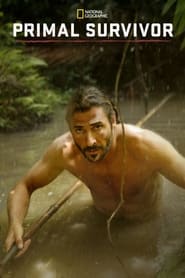
Primal Survivor
Pobierz napisy English
Informacje o wydaniu
Tagi
Download English Subtitle Files for Mobile (6)
Podgląd napisów English
Pierwsze 188 wierszy.
This is wild Africa.
It's the time during the day when lions could just easily
be sleeping on the other side of that bush in the shade.
I'm not at the top of the food chain.
Oh, wow.
Three-toed, big, huge, heavy animal.
In this kind of environment, you want to try to see them
before they see you, for sure.
They're right there, they're right there.
Right there, that is the black African rhino.
I would have never in my entire life
ever imagined I would see
African black rhinos in the wild.
So incredibly rare.
Wow, wow, wow.
This is incredible.
I'm Hazen Audel, wilderness explorer.
I'm on a grueling solo journey
into East Africa's legendary Great Rift Valley.
I've always known that this place in the world
is a mecca for wildlife.
As a biology teacher,
I've done a lot of talking about this place,
and here I finally am,
in one of the wildest places on Earth.
Formed 25 million years ago,
the Great Rift Valley is considered
the cradle of human evolution,
and it's one of the most biodiverse places on Earth.
It's home to Africa's most iconic wildlife,
known as the big five,
lions, leopards, rhinos,
elephants, and buffalo walk these lands.
And I'm on a mission to see them all.
This is a special spot this special morning.
Look at that.
How many olive baboons are there?
It's the nature shows
that I used to watch when I was a kid
that got me so excited about wildlife.
And right now, I'm living it.
My Rift Valley solo safari south
will be a 500-mile wildlife journey like no other,
through some of the most extreme environments on Earth.
I'll be tackling windswept deserts,
towering escarpments,
massive lakes,
and deep gorges.
My ultimate goal is one of the greatest wildlife destinations
on the planet,
the legendary savannas of the Serengeti.
I specifically chose this time of year
to begin this expedition.
I still have a ways to go,
but I've got to get to essentially
what is the beginning of a race,
the beginning of, of a marathon.
The southern migration is fast approaching,
when big animals start to descend on the Serengeti
to eat, breed and give birth.
It's one of nature's greatest spectacles,
and it's right where I'm headed.
There won't just be tens of thousands of animals,
it'll be millions of animals beginning a giant migration.
And if I time it right,
it's gonna be an adventure of a lifetime.
My first challenge is to cross the notorious Chalbi depression,
a harsh mix of arid desert and wind-blasted flatlands,
one of the toughest terrains in all of Africa.
My target is Lake Turkana,
the gateway to the Great Rift Valley beyond.
But before I hit the desert, I need to find water.
Oh, wow, oh, wow.
Really.
So, I'm climbing down to a potential watering hole.
As far as cliffs go, woo, it's a doozy,
but doable, I'm pretty sure.
I don't want it to be my last climb.
The rock is really crumbly.
Sometimes you just have to believe.
Alright.
Okay. These seem solid enough.
These will work.
Okay.
Agh!
Hoo.
Okay. Nice.
I've made it down,
but there's a problem.
The watering hole is dry.
Buffalo, or it was.
This is an incredibly challenging place
for any kind of wildlife to survive.
So, it's just as difficult for me as well.
Survival and death out here.
But there are still some animals around
that are adapted to these arid conditions.
There's some zebras down there.
Those are Grevy's zebras.
The Grevy's zebras can survive for five days
without drinking water.
They're looking right at me.
They're different from other zebras
in that they have really big, round ears.
They're the biggest of all the zebras,
and they're by far the rarest.
They have the very coolest of the paint jobs.
We have different faces, we have different fingerprints,
zebras have different stripes,
and that's how they identify themselves.
Normally there would be water,
there would normally be a lot more animals.
But since they're all gone, this just gives me a heads-up
that I've got some ground to cover.
If I'm to survive my journey ahead,
across the Chalbi Desert,
I'll need to find water.
And my best hope rests with the remarkable tribe
that call this desert home, the Gabra.
Nomadic herders, they make settlements in the sand
and find water in the arid wilderness,
and they will be crucial to my chances of making it
through the Chalbi Desert.
It's all opening up here.
Wide open spaces.
Here goes.
As I reach the outer edge of the Chalbi Desert,
the forest becomes withered scrub,
and I hit the eeriest environment
I've ever encountered.
Can you hear that?
There's these very bizarre trees.
Weird.
So weird.
This dead-looking forest is singing.
The branches whistle a haunting tune.
And I think I know why.
Okay, right there.
All these ants that are living inside of their little home
inside a thorn.
They all have these little entrance holes,
and they act like a flute.
So, it's got these branches full of flutes
that wind up collectively acting like a whole bunch of whistles.
And that's why this place has that weird sound.
And oh, yeah, they're coming, they're coming in force now,
and stinging, getting in my facial hair.
The fire ants that hollow out these thorns are feisty
and injecting me with venom.
Woo. Ah, ay!
The ants are already getting me.
A whistling thorn acacia forest.
It's just a totally bizarre natural ecosystem
in the Chalbi Desert.
No desert is the same, it just depends on where you're at,
what kind of neighborhood you're in,
and it's just so totally bizarre.
Leaving the whistling forest,
I now enter the desert for real.
The Chalbi was forged by ancient volcanic activity.
A harsh expanse of black lava rock is ahead of me.
There's a stone corral up there.
Looks like it's just recently built,
this is where all the rocks were,
that they're building this rock wall.
Yeah, it's all new rock, so this isn't super old.
So, whoever is out here, they have goats,
and they put them in these stone corrals,
they keep them nice and protected from the predators,
more than likely, hyena.
Turning this volcanic rock to their advantage
must be the work of the Gabra tribe.
This is a good sign, it means people are around,
but I don't know how anybody can make it out here.
But there are people passing through here somehow.
Whoa.
I just caught that in the corner of my eye.
Can you see it? Can you see that snake hidden?
It is a big, heavy snake.
Look at that.
Wow!
That is a puff adder.
It's highly venomous.
You have to make sure that you are out of its striking range,
so I am being very cautious.
A monster like this is the most dangerous snake in Africa.
Its Latin name is Bitis arietans,
which means violently striking.
Primal Survivor subtitles in other languages
More English subtitles for Primal Survivor
- Primal Survivor S08 DSNP WEB-DL DDP5 1 H 264-playWEB · 26 downloads · 2024-08-29
- Primal Survivor S09 720p DSNP WEB-DL DD+5 1 H 264-playWEB · 12 downloads · 2023-10-18
- Primal Survivor S09 720p DSNP WEB-DL DD+5 1 H 264-playWEB · 12 downloads · 2023-10-18
Komentarze
No comments yet. Be the first to leave one.