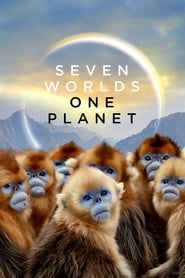
Seven Worlds, One Planet
Pobierz napisy English
Informacje o wydaniu
Tagi
Podgląd napisów English
Pierwsze 189 wierszy.
200 million years ago,
our planet looked very different from what it does today.
It was entirely covered by sea,
which surrounded one single supercontinent we call Pangaea.
And then Pangaea began to break up.
Life was cast adrift on fragments of land.
And these fragments eventually became our seven continents.
We will see how life developed on each continent,
giving rise to the extraordinary and wonderful diversity that we see today.
We'll venture to the frozen wilderness of Antarctica...
...where life thrives against the odds...
...and to the riches of South America,
full of the unexpected...
...from the wilds of Africa...
...to the vast expanses of North America
and the searing heat of Australia.
We'll explore the remote reaches of Asia...
...home to rarely seen creatures...
...and Europe, a world transformed by humanity.
And we'll discover how this may be the most critical moment for life on Earth
since the continents formed.
We are changing the world so rapidly
that wildlife is now facing some of its greatest challenges yet.
Never has it been a more important time
to reveal the precious diversity of life
on our seven continents.
This is Seven Worlds, One Planet.
Of all the continents...
...one was first sighted by humans just 200 years ago.
And only now are we beginning to understand what it takes to survive here.
It's the most hostile of them all.
98% of mainland Antarctica,
an area one and a half times the size of the United States,
is covered in ice...
...on which virtually nothing can live.
50 life is dependent on the ocean that surrounds it.
But even the ocean freezes.
Only one mammal can live this far south...
...the Weddell seal.
SEAL GRUNTS
She has to keep her breathing hole open
by grinding back the ice with her teeth.
Out here on the sea ice,
all these seals are far from the predators of the open ocean...
...so this is the safest place for her to give birth.
Leaving the warmth of the womb and landing on ice
is the sharpest drop in temperature any animal ever faces.
PUP MEWLS
But her pup can't swim for the first ten days of its life.
It's trapped here, out on the ice.
WIND GUSTS
PUP MEWLS
She shields her pup from the wind.
Although it's spring, temperatures can drop
to minus 40 degrees Celsius
and blizzards can rage for days.
Three days on, and the storm is still raging.
She now faces the hardest of decisions.
Does she stay with her pup?
MEWLS
Or shelter in the water?
Now her pup's best chance of survival is for the storm to pass quickly.
WIND HOWLS
Some pups didn't make it.
YOWLS
MEWLS
An answer.
YOWLS
MEWLS
If this pup nowjoins its mother in the water,
it will be safe from any future storm.
It's minus 2 degrees Celsius,
but being in water is warmer than lying on the ice in the howling wind.
Its chances of surviving here are now extremely good.
Only a few hardy animals can live all year round as far south as this.
Further from the Pole, on the fringes of the continent,
lie islands that are free of sea ice.
CAWING
Here there are other challenges.
Saint Andrews Bay on South Georgia
is packed with half a million king penguins.
In spring, the chicks are left for days
whilst their parents are away collecting food for them.
There is a simple arrangement.
The chicks must stay exactly where their parents left them
to be sure of being found again.
CHEEPS
CHEEPS
But this chick has decided to look around.
There is a lot to be investigated.
CHEEPING
But it must not stray too far from its meeting place.
This parent has returned with food in its crop.
But its chick isn't where it left it.
It's hard to stay put when there's so much to play with.
GRUNTING
Elephant seals are here too.
Very mysterious.
SEAL GRUNTS
SEAL GRUNTS
GRUNTING
Finding it in the crowd of youngsters is not going to be easy.
They must recognise each other by their calls.
CAWING AND CHEEPING
CHEEPS
But to hear these in such a noisy colony
they must be within 15 metres of each other.
CAWS
CHEEPS
CAWS
CHEEPS
Reunited.
Saint Andrews beach is one of the most crowded on the planet,
and so holding a territory here is a constant battle.
This bull elephant seal holds the mating rights to 60 females.
GRUNTS QUIETLY
For two months, he's guarded this stretch of beach.
Unable to feed, he's losing ten kilos a day...
...and he's exhausted.
But other bulls are lying around, waiting their chance.
GRUNTS
GRUNTS
PENGUINS CAW
GRUNTS
GRUNTING
Blubber 15cm thick
is protection against the cold,
but not from the impact of a four-tonne opponent.
He holds his ground and forces the intruder back out to sea.
Life in the Antarctic is harsh indeed,
but all these creatures come here
because the Southern Ocean is one of the richest on Earth.
When, 30 million years ago,
the continent broke away from South America and drifted south,
currents began to swirl right around it.
They are now the strongest of any currents on the planet.
They sweep up nutrients from the depths
and so create one of the richest feeding grounds in all the world's oceans.
And some of the creatures that come here to feast
do so in a most sophisticated way.
Humpback whales.
It's summer, and they've come here for a banquet.
The cold waters contain great shoals of krill.
It's estimated that there are 400 trillion of them
and that their combined weight is greater
than that of any other animal species on the planet.
To collect them, the humpbacks blow curtains of bubbles
which the krill won't cross.
The whales then rise,
spiralling inwards to concentrate the swarm.
Summer in Antarctica is a time of plenty,
when most humpbacks are able to put on the reserves they need for the whole year.
But the wildlife in these waters faces an uncertain future.
The Southern Ocean is warming.
90% of the world's ice lies in Antarctica,
and in some parts the rate at which it's melting is doubling every decade.
Sea levels are rising.
But there is a more immediate threat.
The warming of the coldest region on Earth
is having a profound effect on global weather patterns.
And this change in the climate is already being felt right here.
SQUAWKING
This grey-headed albatross chick is four weeks old.
So far, it has been sheltered from the gales by its parents,
who take turns to collect food for it out at sea.
It is the only chick that they will have in two years.
CHEEPS
A delicate touching of beaks strengthens their bond.
But these tender moments cannot last for ever.
As a chick grows, so does its appetite,
so one parent has to leave to find food before the other returns.
CHEEPS
Parting is a big step,
and they take time over it.
CHEEPS
For the first time in its life,
this chick is alone.
The Antarctic is the windiest continent,
and in recent years, climate change has brought storms
that are more frequent and even more powerful.
WIND GUSTS
Winds now regularly reach 70mph.
But the albatross chicks must try to stay on their nests.
CHEEPS
Surviving the storm is one thing...
...but now, off the nest in these freezing temperatures,
this chick has just hours to live.
The brutal conditions have taken their toll.
Some chicks have already succumbed to exposure.
Seven Worlds, One Planet subtitles in other languages
More English subtitles for Seven Worlds, One Planet
- Seven Worlds One Planet S01 On Location 720p UHD BluRay x264-SHORTBREHD · 102 downloads · 2021-05-01
- Seven Worlds One Planet S01E01 Antarctica 720p kurdish · 63 downloads · 2020-09-20
- Seven Worlds One Planet S01E01 Antarctica 720 srt · 81 downloads · 2020-09-20
- Seven Worlds One Planet S01 On Location UHDRip x264-HAGGiS · 117 downloads · 2020-06-17
- Seven Worlds One Planet S01E07 Africa 2160p UHD BluRay REMUX HDR HEVC Atmos-EPSiLON · 110 downloads · 2019-12-09
- Seven Worlds One Planet S01E06 North America 2160p UHD BluRay REMUX HDR HEVC Atmos-EPSiLON · 98 downloads · 2019-12-09
- Seven Worlds One Planet S01E05 Europe 2160p UHD BluRay REMUX HDR HEVC Atmos-EPSiLON · 94 downloads · 2019-12-09
- Seven Worlds One Planet S01E04 Australia 2160p UHD BluRay REMUX HDR HEVC Atmos-EPSiLON · 115 downloads · 2019-12-09
Komentarze
No comments yet. Be the first to leave one.