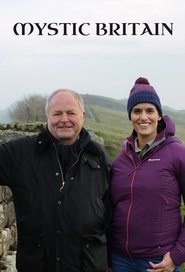
Mystic Britain
د English ژباړه ډاونلوډ کړئ
د خپرونې معلومات
تګونه
د English سرليکونو مخکتنه
لومړۍ 200 کرښې.
This time Mary-Ann and I
dig into Britain's pagan past.
So, what have we got here?
Anglo-Saxon Tupperware?
I get up close and personal
with their warrior gods.
I'm imagining Thor with a hammer having fights with giants.
I uncover amazing treasures...
It's pure gold.
So it's not something you'd get free with your petrol.
And delve into the mystic world
of Anglo-Saxon board games.
That's probably cheating.
I discover a new skill as a ballad writer.
There once was a chap called Clive
whose pee took an age to arrive.
Do you want a job?
And I go feasting...
It's always good to have a hold of your horn, isn't it?
It is indeed, yeah.
As we uncover the secrets
of one of Britain's greatest archaeological finds
this century.
Nothing like this
has ever been found in Britain before.
Hwat!
The British isles have a very long history.
People have been living here for tens of thousands of years.
And the further back you go,
the more elusive and mysterious
the lives of those ancient Britons appear to be.
Stonehenge. What's the point?
It's a bit like Lego.
Oh.
Who were these ancient Britons?
What did they believe?
What was their world like?
Are you a fan of human sacrifice?
I don't practice it myself.
As a talk show host,
I should know how to ask a good question.
Where are we going to, Mary-Ann?
Clive, we are off on an adventure.
But answers are not really my strong suit.
Mummies or not mummies?
It's a tricky one, isn't it?
So I've roped in
someone with more insight into the ancient world
than I'll ever have...
Anthropologist Mary-Ann Ochota.
Old bones, looking at the past,
you know everything, don't you?
I like to ask a lot of questions about the past.
Together we're going to unlock the mystic secrets
of the ancient Britons.
I've decided to harness the forces of evil.
Prepare to embrace the very odd indeed.
Right. I'm ready for all comers.
Southend-on-sea,
the Monte Carlo of the Thames estuary.
Famous for its seven mile of beaches,
a pier that's almost as long as that,
cockles, winkles,
kiss-me-quick hats.
Not exactly mystic, is it?
But surprisingly, Southend is the site
of one of the most exciting archaeological finds
in Britain this century.
Southend sits at the mouth of the Thames estuary,
40 miles east of London,
in the county of Essex.
And there's a clue right there,
because Essex is short for east Saxon.
1,400 years ago, this was a powerful Anglo-Saxon kingdom.
These were war-like pagans with fearsome gods,
straight out of the pages of a comic book.
But all that was about to change.
Something big was coming,
and it would turn the world of pagan gods upside down.
A key to this seismic change was discovered here
in an uninspiring triangle of land
between a railway and a busy road.
In 2003, the local council decided to widen the road
here at Prittlewell,
just a couple of miles north of Southend.
Just weeks before the bulldozers moved in,
they asked archaeologists to have a quick dig around
and make sure there was nothing important here.
Ian Blair was in charge.
Ian Blair.
Clive, good to see you.
So this is your site?
Yes, yeah, this was.
When you say a site,
it's a sort of triangle, I suppose.
It's a fairly uninspiring
land-locked wedge
200 meters long.
Ian handled it just like any other routine job.
Before we came on site,
we did a plan as to the best position for the trench.
Yeah.
The digger that turned up wasn't as big as he expected,
and that changed everything.
We moved the trench to one side.
I mean, if we'd had a larger machine with a longer reach,
the trench would have been over there.
As opposed to here.
And you'd have missed it.
We would have missed it.
So basically,
one of the greatest British finds of the century
came down to the wrong kind of digger.
What did you find when you dug down?
In the first hour or two of excavation,
we uncovered a copper alloy hanging bowl.
Progressively, more and more objects were uncovered.
Yeah.
We realized that we were looking at something much larger
than just an ordinary burial.
Yeah.
The deeper they dug, the more astonishing it got.
I mean, there was a sword and a shield.
There was a gold belt buckle.
- Yeah. - There were two gold coins.
So, valuable goods,
all of these things you're talking about.
I mean, basically, it was like a time capsule.
Their time capsule turned out to be
a huge burial chamber sealed more than 1,400 years ago.
It's location is now marked by a mound of earth,
topped with a drawing of the chamber interior.
You're sure this was a burial chamber?
This could be somebody's underground house,
with a bed and a...
He's got his buckets and things for whatever you need.
It was definitely a coffin.
It was definitely a coffin. Alright.
So unless it's a vampire, sort of, you know, I think...
Well, I'm just exploring other theories, you know.
It's a substantial burial chamber.
A room like that in London,
it'll cost you millions of pounds.
This astonishing find
comes from an era often called the dark ages...
Not because the sun didn't come out,
but because we know so little about it.
It covers the period
from approximately the fifth to the tenth century,
a time when few written records survive.
This was the world of the Anglo-Saxons.
Sounds terribly exciting to discover this.
Was this the best thing you've ever discovered?
Totally.
I mean, it is a real one-off sort of find.
You can keep your mound of grass, Clive,
because I've come to the museum of London archaeology,
where they've promised me
I can see the actual body recovered from the burial.
Okay, I'm here to see the Prittlewell body.
Well, here it is.
That is, I have to say,
moderately underwhelming.
Well, maybe a little bit.
It is true that the whole of the Prittlewell prince
would fit in this little test tube,
which is why I've laid him out here for you.
But, you know, this still shows us
that there's a person buried in that chamber.
So what is it that I am looking at there?
So what we have here
are lots of tiny bits of dental enamel,
just the outside part of the tooth,
the hardest bit.
But some of the fragments actually fit together.
And these three here, for example,
you can see they show us that it's a molar tooth.
Oh, yeah, like one of your big back teeth.
Yep.
And they tell us that this person
can't have been less than six years old when they died,
'cause that's when that... Your first molar comes through.
That's extraordinary.
Just from those tiny, tiny fragments
we can actually say something about who these belonged to,
who this was.
Absolutely.
Why is it, Natasha, that we do only have
this tiny amount of human remaining?
I mean, what happened to the rest of him?
The bone itself has basically,
over the period that the body has been in that grave,
has dissolved away over time,
because of the free-draining sands,
and the soil is very slightly acidic as well.
So you've got the kind of,
the drip, drip, drip through the sand,
and all those minerals that our bodies are made of just...
Washing away.
Washes away.
More English subtitles for Mystic Britain
- mystic britain s01e10 time tripping 720p WEB H264-UNDERBELLY · 19 downloads · 2019-10-17
- mystic britain s01e08 ice age shaman 720p WEB H264-UNDERBELLY · 16 downloads · 2019-10-17
- mystic britain s01e07 human sacrifice 720p WEB H264-UNDERBELLY · 19 downloads · 2019-10-17
- mystic britain s01e06 mummies 480p web x264 rmteam · 17 downloads · 2019-10-17
- mystic britain s01e04 the revenants 480p web x264 rmteam · 12 downloads · 2019-10-17
- mystic britain s01e03 hadrians mystic wall 720p WEBH264-UNDERBELLY · 22 downloads · 2019-10-17
- mystic britain s01e02 the rollright witch 720p WEB H264-UNDERBELLY · 21 downloads · 2019-10-17
- mystic britain s01e01 witches and demons 720p WEB H264-UNDERBELLY · 17 downloads · 2019-10-17
تبصرې
No comments yet. Be the first to leave one.