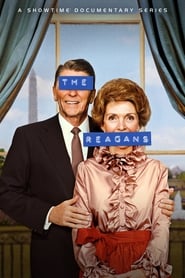
The Reagans
د English ژباړه ډاونلوډ کړئ
د خپرونې معلومات
تګونه
د English سرليکونو مخکتنه
لومړۍ 200 کرښې.
Economic future, priority B.
Get the last line in,
be that much more convincing.
This is roll one, sound two.
Stand by and action.
In 1980, we said we would reduce inflation and we have.
We said we would create new jobs, lower taxes,
and rebuild our defenses and we have.
But in the next four years, we must do more.
We must help those who haven't fully shared in the recovery.
We must build a lasting peace for our young,
security for our aging,
and create millions of new jobs.
We pledged cities of promise, a countryside of abundance.
I don't think America ever stops wanting to be better
because Americans are only satisfied with doing our best.
20 seconds.
How much?
- 57, perfect. - That was good.
- Perfect. - That was good.
- Okay. - Okay.
Ronald Reagan said himself, if you are not a good actor,
you cannot be a good president.
And it came to pass,
it absolutely came to pass.
If someone's running for president,
and they are not willing to do what an actor does,
look good, read your lines well,
you cannot lead.
There were some strange aspects to my father,
particularly by Washington standards.
He was just a very different kind of person.
He was intelligent,
but at the same time, it's like, huh.
You know, knowing him as well as I do,
this is kind of a strange fellow
to be president of the United States.
You couldn't change Ronald Reagan.
We just made sure that he never got off script.
It was our job to protect him, protect him from himself.
We want Reagan, we want Reagan.
He was a caricature out of American culture.
Here's the story as I see it.
A caricature reinforced by our belief
that what happens in the mass media,
particularly in the movies,
is more real than real life.
And that was the appeal of an actor turned president.
I hope you're a good driver,
you know what you're doing I hope.
Yes, I've been driving this for quite a while.
You probably got used to one new.
I don't want to hurt your feelings,
but this is the scroungiest jeep.
Ronald Reagan was an incredible myth maker.
He reinforced a myth of America that served many,
but actually hurt many, many people.
Mr. President,
the Soviets say that your position has made it impossible
to meet in Vienna in September.
Well, we would come to realize that Nancy Reagan
was the most powerful person behind the president.
She was like the studio head.
She was like the consigliere,
because people around her were afraid of her.
And she was kind of the presence over everything.
It was 9% or 8% in the 1970s.
By 1979, it brought it down to 5%...
...and we are holding it to 7%.
Blow the candle out.
Make a wish.
Make a wish.
And you have to take the first piece.
Did you bake it yourself?
As a matter of fact, Sam,
since she cut that one smaller here,
here, take mine, and I'll trade.
No, no, no, no, that's bad luck.
I have learned not to argue with her superstitions.
So much about the Reagan presidency,
so much about the man was mysterious.
People studied Reagan,
biographers, historians,
and nobody ever really figured him out.
There was this 10% under the surface
that really very few people had access to.
In many respects
Ronald Reagan lived in a world he created.
It's the triumph of the human mind.
It's the triumph of the human imagination.
His imagination was gigantic, okay?
And that was true throughout his whole life.
The way he portrayed his own childhood.
The way he had the marriage with Nancy
was kind of imagination,
what the ideal couple would look like.
It was imagination, rather than reality.
He saw himself as a hero,
and he was playing an American hero.
It was a role first in the movies,
and then as a politician.
Reagan was more than an expert on this American mythology.
That was based on an America that really didn't exist.
Do you actually think of yourself
as a politician?
What?
Do you think of yourself as a politician?
No, ex-actor.
How do you do, everybody?
I'd like to introduce myself.
My name is Ronald Reagan.
A few months ago I was a sports announcer
on a radio station in Des Moines, Iowa.
One day I ran into one of these movie talent scouts,
I think I caught him off guard
because the next thing I knew
I was taking a screen test for Warner Bros. in Hollywood.
First picture,
well what do you think it was about?
A radio station.
In these United States,
a man is always innocent until he is legally proven guilty.
What was it, Mr. Warner,
that caught your eye
when you looked at that first test of Reagan?
Well, he had his personality projected in what,
as I term it, off the screen into the audience,
it comes through.
He had a good smile, happy delivery,
rather a little good sense of humor.
In those days your Hollywood life was a confection.
It was something that gossip columnists created.
That was an era when there were basically
two reigning queens of the gossip columns.
Hedda Hopper and Louella Parsons.
And they really wrote the story of Hollywood
for the American heartland.
Reagan was often referred to as a lucky man.
Louella Parsons was from his small town.
So for Reagan to be mentioned favorably
or to be written up in a nationally syndicated column,
it made all the difference in the world.
Suddenly, this hugely powerful gossip columnist
latches on to this good-looking, young guy,
essentially becomes his sponsor.
But it starts, as to my mean,
if you took people and built them,
exploited them, and developed them,
as I did with Greta Garbo, Joan Crawford,
Norma Shearer, and all of those young women.
You mean by signing them up,
putting them under contract
and publicizing them?
Well, I think people shop for stars.
Well, here's to you, Louella.
And to you.
Now I see a great many more celebrities coming down here.
I'm gonna try and get some of them up to the microphone
to say hello to you.
I'm sure that you're going to wanna meet...
In many ways he was playing himself
in almost all of his movies.
He was always the dependable one,
often the best friend
and just had this winning way.
Louella Parsons not only becomes the stage mother
of Ronald Reagan's career,
but she also becomes the godmother
of his first marriage to actress Jane Wyman.
She wanted to bring Ronnie up to Jane's level
'cause he wasn't as big a star.
So when they're seen out together, gives him publicity,
which is good for his career.
He was willing to be influenced
and do whatever she told him to do.
Pretty soon you believe the Hollywood myth.
He was very assiduous about editing and shaping his story
until the story became the reality.
In the '20s, early '30s,
he really wanted to be a football player
because that's how you became a national hero
if you were a young man.
Problem was he was blind as a bat,
he was not terribly fast
and was not really all that large.
So my father never became a real hero on the grid iron,
but he did get to be a football leaguer eventually in
"Knute Rockne All American" where he plays George Gipp,
uh, the famous Notre Dame star.
So when Reagan in that film could connect himself
to being the hero, George Gipp,
it helped put him in the American grain.
And he became Ronald Reagan, All-American.
We're all the heroes of our own stories.
He was just a little better at it than most people, I think.
He has appropriated other American folk tales,
making it difficult at times to distinguish
between the teller and the tale,
between this one American and America itself.
That explains Reagan's intimacy with the American psyche.
More English subtitles for The Reagans
- The Reagans S01E03 WEBRip x264-ION10 · 25 downloads · 2020-12-01
- The Reagans S01E02 WEBRip x264-ION10 · 28 downloads · 2020-12-01
- The Reagans S01E01 WEBRip x264-ION10 · 26 downloads · 2020-11-15
تبصرې
No comments yet. Be the first to leave one.