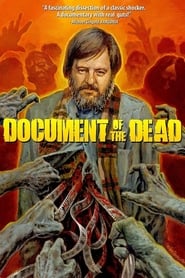
Document of the Dead
د English ژباړه ډاونلوډ کړئ
د خپرونې معلومات
تګونه
د English سرليکونو مخکتنه
لومړۍ 200 کرښې.
You want a light? Mm-hmm.
How are things down the other end?
This is like living in Pittsburgh. If you can call that living.
A couple of people have made that observation,
that it's like working in a foreign country,
working in Pittsburgh. It gives you a lot of freedom.
In addition to freedom, it gives you a different perspective.
You're not so much a victim of trends,
of popular thinking, of, you know...
What's in the State-of-the-Art head right now.
This is a scene from "Night of the Living Dead,"
a low-budget film co-authored, directed,
In 1968.
Already the head of a successful commercial production house in Pittsburgh,
this was his first venture into feature Filmmaking.
Its flaws were mainly budgetary,
while its virtues were clearly visionary,
earning it popular success as a horror film,
and a cult following for exploratory uses
of genre and technique.
Even in this disembodied clip
the technical aspects of Romero's style
are making themselves apparent...
They're in his cutting...
His camera angles...
In his two-dimensional design within the film frame...
Great spatial movements from shot to shot...
And even within shot.
Just making films in Pittsburgh for 10 years
has become a sort of stylistic statement.
In January of '78,
Romero and his Producer Richard Rubinstein
allowed a film crew from the school of visual arts onto the set
of their latest production,
the second part of the "Dead" trilogy,
"Dawn of the Dead."
Using footage shot over one long weekend,
a documentary took shape,
focusing first on the Filmmaking process
and secondly on directorial vision...
What part of it reaches the screen unhampered,
what external forces affect it.
But first, let's introduce our cast.
In pre-production... George Romero, Screenwriter.
Richard Rubinstein, Producer.
In production... George Romero, directing.
Richard Rubinstein, producing.
Michael Gornick, Cinematographer.
Carl Augenstein, Lighting Director.
Tom Savini, Creator of Special Makeup,
Actor and Stuntman.
Ken Foree, Actor.
Scott Reiniger, Actor.
David Emge, Actor.
John Amplas, Actor in "Martin"
and Casting Director of "Dawn,"
and in post-production... Editing the film.
Pre-production involves writing the screenplay,
raising the money and organizing the shoot.
- All aboard. - Good morning.
Hiya. How long to Pittsburgh?
- 10 hours to Pittsburgh. - Is there a bar car?
- On your left. - Thank you.
Madam, traveling alone? All alone.
- Shall I wake you for Pittsburgh? - No, I'm going to New York.
- The Big Apple? - Right?
- Thank you and good night. - Thank you. Good night.
These are the opening moments of "Martin,"
the film Romero made just before "Dawn."
As the story unfolds, you'll see the screenplay qualities...
All inherently cinematic...
Which begin to articulate his style.
First the visual imperative.
With few exceptions, cinema relies
as little as possible on the spoken word.
Characterization and plot
are best revealed through action
and accumulation of detail.
Montage concepts begin in the screenplay.
The story is developing with literally no dialogue,
and suspense is being generated
not only in the horror of the situation
but in the mystery of the plot itself.
We still don't know his identity,
his motives, or his goal.
Romero's use of dual linear movement
fleshes out the two dimensions of film into three.
A use of such devices as the manipulation of time...
Or other devices such as irony...
As you can see from the final page of the "Dawn" screenplay,
Romero's use of the form is unorthodox...
In a medium where one page
generally equals one minute of film.
The script seems long. Did you plan to shoot it all?
I mean, giving yourself leeway in the cutting?
Pretty much. I usually write long scripts.
"Martin" was a long script that was really a long script.
The first cut came out at almost two hours and 45 minutes.
- Wow. - This is a long script that seems long.
It's not really long.
There is so much description.
And if you read those pages,
there is so much action
described in great paragraphs
where I got carried away describing the action itself.
Some of those things take a second and a half.
And it's not cutting that long.
We did... I cut the first half of the film
and it came in at 45 minutes,
so I think the first cut will be about a two-hour cut.
- Great. - Which is not bad for a first cut.
To what extent do other influences creep into a work?
And at what stage?
A lot of people have often compared you to Hitchcock.
But you don't buy that. How come?
They have some nerve.
No, I don't... Filmmaking is funny.
Filmmakers... All artists to some extent
are parasitic of what they've seen,
and what they are basically imitating,
what attracted them in the first place.
Filmmakers, maybe more than any other form,
I mean, it's not like you can sit down with a pencil
and do your thing... Or a canvas or whatever.
It's very expensive and very few people
get enough chance to work with the hardware,
and get enough chance to really
develop a style...
Except on a very intellectual level.
That's why unfortunately the State-of-the-Art
has somewhat gone towards menus and pre-planning
and everything else... Which is a little bit destructive.
I would say that if I'm parasitic of anybody it's more Welles,
and some of the early... Like Howard Hawks and people like that.
Those were films that really affected me.
There are certain Hitchcockian things that...
First of all, I don't consciously when I'm setting up a shot
say wow, remember that shot in...
And then try to imitate that.
They are Hitchcock-type influences...
The sequence in the cemetery in "Night of the Living Dead"...
Where you see the figure way in the background and don't know what it is.
And it gradually gets worked into the plot.
It starts to become a threat, and then the threat is a real threat.
That's kind of a Hitchcockian sequence.
Hey, I mean praying's for church, huh?
Come on.
I haven't seen you in church lately.
Well...
Not much sense in my going to church.
Do you remember one time when we were small
we were out here? It was from right over there.
I jumped out at you from behind the tree,
and Grandpa got all excited and he shook his fist at me
and he said, "Boy, you'll be damned to Hell!"
Remember that? Right over there.
You used to really be scared here.
- Johnny! - You're still afraid.
Stop it now, I mean it.
They're coming to get you, Barbara.
Stop it. You're ignorant.
They're coming for you, Barbara.
Stop it! You're acting like a child.
They're coming for you.
Look, there comes one of them now.
- He'll hear you. - Here he comes now.
- I'm getting out of here. - Johnny...
A couple of pieces that I've seen written
about "Night of the Living Dead" say that it takes us back
to silent cinema storytelling.
Johnny! Help me.
I can see now a couple of specific things
in a couple of my films that are Hitchcockian in that way.
Sometimes people say it because of the plot lines...
The very certain ironies in the plots that I use.
I don't think that has anything to do with form,
I think that's more a content association people are making.
"The Thing" was the movie that knocked me down when I was a kid.
That's the one, I think, horror film.
Everyone says "What attracts you to the genre?"
And it was probably "The Thing."
I was the right age at exactly the right time
and it had exactly the right effect on me. I've never forgotten it.
The cineographics of "The Thing,"
and those of "Night" and "Dawn"
are remarkably similar.
Confined spaces within which groups of protagonists
are eternally on guard against a deadly foe.
Tranquility never exists in Romero's world.
You could say his style is derived from D.W. Griffith's because he uses closeups.
The truth of it is, artists imprint distinctive auras on their films.
"Genre" is a term which should have been invented by the distributors.
For the artist, it's just a departure point.
Thank you
Casting occurs in pre-production.
Is it an irony in both "Night and "Dawn"
that Romero's main protagonists are black?
In "Night of the Living Dead"
the character, if you read the script...
If you read my shooting script,
تبصرې
No comments yet. Be the first to leave one.