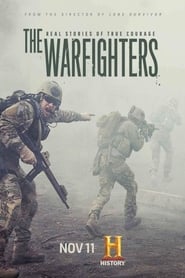
The Warfighters
د English ژباړه ډاونلوډ کړئ
د خپرونې معلومات
تګونه
د English سرليکونو مخکتنه
لومړۍ 200 کرښې.
On April 7th, we were really just moving
from Camp Fallujah over to another base
which should have been a routine drive.
The mission obviously changed
the moment we encountered the enemy.
They kicked off with RPGs,
and a lot of machine gun fire.
If we're gonna get shot, we're gonna fight back,
and sure enough, that's what we did, we fought back.
When you decide that you want to survive,
whoever it is, if they have a weapon, they're gonna die.
One thing we brought to the table that day
was that overwhelming acceptance of violence.
We deployed to Iraq in 2004.
I'd been to Iraq before with the invasion,
but I could tell that somethin' was different.
It went from the groups of kids cheerin'
and givin' you the thumbs up
and wavin' on the side of the road,
saying things like "Bush, number one," you know,
to staring us down,
derisive looks, you know,
like they weren't hiding the fact that we weren't welcome.
So I knew it was a different war.
And I knew that it was gonna be more dangerous and more difficult.
Today, four American contractors-- civilians,
were massacred in Fallujah.
- Four Americans in two SUVS - stuck in traffic.
They're ambushed. The four men, all civilians,
ex-military, worked for a Carolina firm, Blackwater USA.
The jubilant crowd, honking their horns
the same way people here rejoice at weddings,
set the SUVs on fire,
then tied ropes around the charred bodies
and dragged them through the streets,
and hung two of the Americans on a bridge.
When the Blackwater contractors got killed,
we had just spent a little bit of time with them.
I don't know, maybe a week before? Something like that.
So that brought it home.
Once we'd heard about it,
we're like, "Man, we were just with them."
And now to find out that two of their bodies
were hanging from the bridge,
and the other two were drug through the streets,
it kind of hit us.
We'd only been there about a month when that happened,
so we hadn't really learned what was actually out there.
You know? How many of the enemy were actually out there.
Our platoon sergeant pulled us aside
and said, "All right, let's put this in perspective.
because it's gonna be us out there on the line managing this.
We're gonna be the response to this
in some way or another."
This is outside Fallujah, Iraq.
They pretty much have the whole city surrounded
and they've been hitting it for a couple days.
- Second Platoon, Bravo Company, - 1st Recon Battalion.
I couldn't have asked for my first recon platoon
to have been a better group of guys. We just meshed well.
So this is one of the things that we do out here--
drive around looking for cachet sites.
We just found some IEDs on this road.
We had darn good leadership.
Dan Griego kicked us square in the nose and made sure we were ready.
I was platoon sergeant for Bravo Company.
I wanted to make sure that my teams had as much
as they needed, so they would be ready
in case of, you know, contact or fighting with the enemy.
This is from our rooftop position here in Fallujah.
He was a hands-on platoon sergeant,
but he let the team leaders run the teams.
He didn't micromanage,
and he did well working with our platoon commander,
Captain Brent Morel.
- Captain Morel and I - were like--
we were friends.
We worked well together,
and he would listen to any input I had
on what we were gonna do or how we were gonna do things.
Some of the guys, you know,
were having a hard time warming up to him.
He took us to the gym one day before we deployed.
He proceeded to try to box everybody in our platoon.
And I was impressed at how many shots he could take.
I thought that was cool of him to put himself out there like that.
Blair-- "Doc Dell"-- knew his job really well.
He worked real hard with us
and ran us through combat trauma,
and made sure we were all well-trained
on first aid and trauma medicine.
I was an assistant team leader.
Assistant team leader
actually does most of the controlling of the team
and making sure everything's together.
The team leader tasks him with that and he takes care of it.
Ready to go out and patrol.
Eddie Wright was a machine gunner.
Definitely serious as hell when it came time to do the job.
This was a platoon of straight-up alpha males.
Everybody out there was the baddest dude on the planet.
But we loved each other through our hard training
and we were real tight.
- One, two, three-- - Kill!
All right, get in your vehicle, get out of here.
April 7th was supposed to be an administrative run
to move our company headquarters.
We knew we were just gonna go down
this main supply route, Route Boston.
It was gonna be our platoon, five vehicles,
the headquarters element with administrative personnel leadership.
We were gonna take them to a secure point.
- We have, total, - 25 Marines.
We've been on this route before.
Usually there's kids running around,
there's people walking.
There's local vendors.
But this day, there wasn't.
It was just eerie.
Almost like in one of those movies
where you get the little tumbleweed
that jumps across the main street.
It was almost that quiet.
- On this movement, - I was in the lead vehicle.
so I could see the vehicle traffic coming towards us.
When you see... flip a U-turn and take off,
you know, that right there's a big red flag, like,
"" you know.
So I stopped the convoy. I got on the radio.
and I radioed back, you know, like,
"Hey, something's going down here.
We should probably stop and get eyes on it."
And the word came back, like, "Okay,
well, push forward and pick up your speed."
"Roger that."
Yeah, I just got ready.
It was like we knew we were rolling into an ambush.
It's one of those things where you've got a job to do
and don't have the luxury to worry about it.
It's like, "Okay, here we go."
It was two low fields
with one road right down the middle of it,
and we're talking about hundreds of meters.
Basically, if you were to pick
the ultimate place to set up an ambush,
they chose wisely.
Those senses start kicking in, you know,
that sixth sense that some people have?
- Contact right! - Contact right!
Contact left!
I see muzzle flashes.
We're getting shot at from both sides.
It looked like they wanted to wipe us out.
Contact right, contact right!
It was basically a close ambush.
And our SOPs for this type of engagement
was to stop and lay down a base of fire...
...so it kind of was counter-intuitive
to what you'd think you'd do,
like run away or get out of Dodge.
No, you go right to it.
We were not in a good spot.
We were in the kill zone, basically.
I kept hearing these explosions.
You know, just boom, boom, boom, boom.
I thought, "Damn, they're shooting RPGs
at the back half of our platoon."
Well, they weren't shooting 'em at them,
they were shooting 'em at us.
They were missing us and exploding-- hitting behind us.
That's when I got hit.
It was like-- like a tremendous thunderclap
originating from inside your head.
You know, like, you can't really--
it was just a "boom!"
I thought I got shot in the face.
I was thinking to myself, "All right,
I guess I'll see what it's like to die."
And then I thought to myself, "Okay,
you gotta chill out, 'cause you're going into shock.
Like, relax."
And as soon as I made that conscious thought,
it's like somebody hit the light switch
and turned the lights on.
Everything cleared up in my vision,
and I started to assess the situation.
My hands were killin' me.
Like, I was just in pain everywhere,
and I remember liftin' my arm up and looking down,
and it was just nasty. It was gone.
It was shredded, and I remember thinking, "Damn."
And my right hand was hurting,
and I, you know, lifted my arm up and I looked down,
and I saw...
where, you know, my hand was blown off
right at the base of my palm.
And it was kinda strange, 'cause my hand was hangin' down.
It was like a-- it looked like a glove that got shredded,
like somehow all the meat and bones were out of my hand,
so it was like an empty glove, but shredded.
More English subtitles for The Warfighters
- The Warfighters S01E09 HDTV x264-W4F · 8 downloads · 2017-11-15
- The Warfighters S01E09 HDTV x264-W4F · 10 downloads · 2017-11-15
- The Warfighters S01E06 HDTV H264-W4F · 37 downloads · 2016-11-13
- The Warfighters S01E04 HDTV H264-W4F · 33 downloads · 2016-11-13
- The Warfighters S01E03 HDTV H264-W4F · 32 downloads · 2016-11-13
- The Warfighters S01E02 HDTV H264-W4F · 38 downloads · 2016-11-13
- The Warfighters S01E01 HDTV H264-W4F · 38 downloads · 2016-11-13
تبصرې
No comments yet. Be the first to leave one.