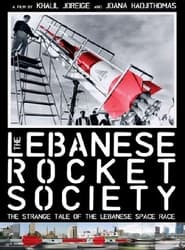
The Lebanese Rocket Society
د English ژباړه ډاونلوډ کړئ
د خپرونې معلومات
تګونه
د English سرليکونو مخکتنه
لومړۍ 200 کرښې.
I was born in 1969.
A few days after a man walked on the moon.
The USSR and the US were fighting over earth and sky.
Space and science reigned.
In any case that's how I imagined it.
I was born in 1969.
A few weeks after a man walked on the moon.
The time of revolutions and militancy
of dreaming and pursuing those dreams.
That's how the story came to us.
First, we saw the image of a rocket.
Not just any rocket
a rocket with the colors of the Lebanese flag.
Did the Lebanese dream one day of conquering space?
Impossible to believe.
At the beginning of the 60's
a small group of students from Haigazian University
led by Manoug Manougian a mathematics professor
launched rockets into the Lebanese sky.
They produced the first rocket in Middle East.
Oddly we had never heard anything about their story.
It is like a secret hidden, forgotten story.
The Strange Tale of the Lebanese Space Race
Under "Lebanese rocket"
this is what we get.
And if we typed "rocket"
or "conquest of space"?
It's not exactly the same thing!
And no trace of our rocket.
At the University where this project started
the Armenian Haigazian University we search through the archives.
We find several editions of Armenian newspapers of the time
but we can't decipher them.
We ask a student to translate them for us.
There aren't many details.
But there are some dates
of relatively successful rocket launches
that seem to soar higher and higher
going gradually from 12 km to more than 450 and eventually 600 km!
It is hard for us to believe.
Even the student is surprised.
So it was not a joke!
We find few images of the rockets.
In the University's yearbook from the 60's
a surreal photograph.
Manoug Manougian
founder of the space project that's him.
Over there, some of the students who worked with him on the project:
Garabed Basmadjian
Ham par Karageozian
Hrair Antablian
Simon Abrahamian, John Tilkian
Jean-Jacques Gubekian Hrair Sahagian...
These faces, these gazes...
These young students are maybe the children
of Armenian orphans who by the thousands, in 1915, fled Turkey
crossed the desert
settled in Lebanon after their community's genocide.
Gradually, they integrated political and cultural life
becoming one of Lebanon's most important communities.
And now a new finding:
they dreamt of a rocket and built it!
We search.
In dailies and newspapers.
Indeed the Lebanese space project captivated front pages often.
It seems serious, ambitious
totally in synch with the research of the time.
At the outset of the 1960s while NASA in the United States
was readying to send Apollo its first rocket, into space
and the USSR, to launch its first manned spaceflight
with Yuri Gagarin
Manougian and the students of the modest Haigazian College
began exploring spacecraft propulsion.
What was this wild challenge for such a small country?
How is it possible that we've never heard about it?
Why hasn't anyone ever told us their story?
Stranger still, is the fact that images of the rockets
were never part of our collective imaginary
but absent from the nostalgic rosier of Beirut's 1960s
the so-called Switzerland of the Middle East and its Dolce Vita.
This absence surprised us.
How can we forget Harry Koundakjian's impressive images
we had first come across at the Arab Image Foundation?
There are only about ten.
When Harry left Lebanon
he might have taken the others with him.
We find other photographs that yet need to be indexed
like photographer Assaad Jradi's images.
2, 4, 6, 8, 10...
Are these the only images?
Thank God, we have these ones.
I'm from Khayzaran, North of Saida.
I had important archives.
When Israel occupied the town my brothers burned half of them.
Out of fear.
When did you last see this photo?
About...
50 years ago.
Maybe 60.
You see, that's it, rocket number 4.
Look at this crowd...
Can you see Harry?
I'm looking for him.
I'm looking for all of them.
That's a cameraman filming for the news.
Do you remember anyone?
No, I don't know.
I look at this photo and I think: "What an idiot!"
I photographed the moving smoke and not the rocket.
But it's artful.
Artful would be to show at least part of the rocket.
But I cut it off.
This one is perfect.
This is the good picture this is the one.
The others can't work.
This one is the one for the cover.
This one or the other one.
Of course, we should crop it.
So there might be news footage of the rocket launches.
Full of hope, we head to the Lebanese National Cinema Center's archives.
We'd never been to the Center
even though several of our 35mm films are kept there.
We're received by Zafer Azar
a critic, writer and cinephile
who's in charge of printed documentation of Lebanese cinema.
But the head of the film archives isn't there.
He resigned.
And considering the state of the site, we understand why!
Unknown.
Look at this.
It's stupid.
It's a crime.
Some of the films are originals with out copy.
Unique documents that can no longer be found.
There are old films I remember them well.
There are newsreels.
- All those are newsreels? - Yes.
They were shown in movie theaters.
Before the film.
It was before the war.
We were young, we loved cinema. That's how it starts.
We would see this at the movies.
It's the same period.
The 60's.
These reels are newsreels?
Perhaps, we have to look inside.
We finally come across some current events footage from the 1960s.
But our joy is cut short...
What about our own films?
Around The Pink House
They are still here.
Manougian doesn't seem to have forgotten about this adventure.
Today, a professor at University of South Florida's math dept.
Which he chaired for 10 years
he dedicates a significant part of his website to the space project.
Another headline draws our attention:
"Peace through education".
To Manoug, science and education
are a life mission.
The hopes that transpire from all this
prompt us to board a plane for Tampa.
Manoug is moved by our interest.
He's been waiting to share this since he left the Arab world
more than 45 years ago.
Rockets are his life's passion.
As a young child in Jerusalem where he was born
at the St. George school
he used to draw rockets on his desk.
His dream could come true only once he arrived in Lebanon, at Haigazian.
Even the choice of Tampa was dictated to him by Jules Verne.
Yes, Jules Verne!
In "From the Earth to the Moon" Verne sets his rocket launch there
in Tampa.
He discovered a century before NASA
that it affords the best latitude for that purpose.
How did he know?
Manoug still can't explain it.
So when he received the invitation to teach in Tam pa
he saw it as a sign.
On the table we find an unexpected treasure:
the first rockets the very small ones
and also the Cedars: Cedar 2A, Cedar 2B, C, 3...
up until Cedar 8.
From the smallest to the largest
photographs, articles loads of films.
Manoug saved everything.
For over 50 years, carefully.
We're overwhelmed.
And Manoug gives us his treasure.
He longs for us to tell this story
that is gradually coming together.
To say: We'd love to fly rockets in the sky.
To say: What do we need to do that? Propellant?
We don't have any.
So let's make it.
The rocket? We build it.
We make bigger rockets launch them higher and higher...
To dream and believe it is possible.
To want to do it and do it.
To say: I want to share this dream of space with others.
تبصرې
No comments yet. Be the first to leave one.