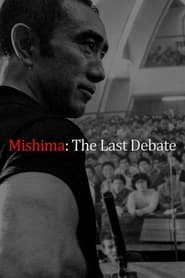
Mishima: The Last Debate (三島由紀夫vs東大全共闘 50年目の真実)
د English ژباړه ډاونلوډ کړئ
د خپرونې معلومات
تګونه
د English سرليکونو مخکتنه
لومړۍ 200 کرښې.
This documentary is based on archival footage from 1969.
Opinions expressed have not been altered in any way.
A time of activism
Radical student movement
The World Revolution
Confrontation at Yasuda Auditorium, the University of Tokyo
May 13, 1969
At the University of Tokyo in Komaba
over 1,000 students waited in Lecture Hall 900 for a man.
They belonged to a radical leftist league called Zenkyoto.
Here to face his archenemies was Yukio Mishima.
The iconic right-wing novelist idolized the Emperor.
I saw resolve in his eyes.
He wanted to persuade those 1,000 students.
He was a genius.
Very sharp.
A superstar.
He was at his most brilliant.
Communism is my enemy.
For Mishima, the Emperor is...
We struggle with the same difficulty.
You can't transcend being Japanese.
That's OK.
It was a debate of polar opposite political ideologies.
This is where the legendary debate between intellectuals begins.
This 50-year-old footage is in TBS Television archives.
With accounts from 13 witnesses and experts
we attempt to reconstruct the legend.
Mishima: The Last Debate
In the 1960s, war was an imminent threat to the Japanese.
As the Vietnam War raged on
students protested against it and university bureaucracy.
Activism spread rapidly.
Students who rejected the existing New Left groups
formed Zenkyoto groups at universities, with more autonomy.
It became a nationwide political movement.
Demanding affordable tuition and autonomy
they became radical and confronted the school authorities.
The students protested against the war
on and off campus.
The combatting students and riot police made Tokyo a war zone.
January 1968 Protest against the nuclear-powered USS Enterprise
October 21, 1968 Riot on Anti-War Day
1968 was dubbed the "Political Season."
While some feared a revolution in Japan others wanted one.
One man who observed the riots became concerned about society.
He was Yukio Mishima, the novelist.
Mishima was born in 1925.
While at Gakushuin High School the prodigy wrote a novel,
The Forest in Full Bloom.
He studied law at the University of Tokyo during WWII.
He continued to write and survived the devastation of war.
When Japan lost the war,
the Emperor renounced his divinity.
Mishima quit his Finance Ministry job to focus on writing.
He explored inner turmoil in Confessions of a Mask
and youth in The Temple of the Golden Pavilion
among other masterpieces.
He wrote prolifically for 25 years.
There are 42 volumes in the complete Mishima collection.
World-famous, his books were translated into various languages.
For the sake of my art.
Mishima, the "writer in action" did not only write.
He took up bodybuilding to get a body of steel.
He was proud of his physique and modeled for magazines.
He wrote and directed plays and kabuki.
Be more cunning like you have a hidden motive.
He starred in a yakuza movie.
He did boxing and karate.
Also skilled in kendo, he had 4th dan ranking.
He wielded both pen and sword.
He trained with the Self-Defense Forces
and flew in a jet fighter at supersonic speeds.
During the 1960s Mishima became openly political.
His writings reflected his political beliefs.
In October 1968, Mishima founded a private organization named
"Tatenokai" or the Shield Society.
He recruited students who believed in right-wing nationalism.
Whereas the leftist students wanted a communist revolution
their motto was "anti-revolution".
Mishima and his militia trained with the Self-Defense Forces as
they anticipated conflict.
We need young men who are trained in firearms for an emergency.
He was also writing his magnum opus The Sea of Fertility tetralogy
and was up against Kawabata for Japan's first Nobel Prize in Literature.
In the spring of 1969, Mishima got a phone call.
It was the Zenkyoto branch from the University of Tokyo.
The Zenkyoto branch at the University of Tokyo
was formed in 1968 to reform the school with activism.
On January 18, 1969
riot police dispersed students occupying Yasuda Auditorium.
Students fought back with gasoline bombs but
were contained by tear gas and water cannons.
Zenkyoto was defeated.
Zenkyoto embraced violence to fight the Establishment.
They invited Mishima, a reactionary, to a debate.
Their motives were unclear.
Right vs. left.
Conservatism vs. Radicalism.
A public debate discussing two extreme political views
was a dangerous yet thrilling proposition.
It was to be held in Lecture Hall 900 in Komaba campus
not in Hongo campus where students occupied Yasuda Auditorium.
A poster at the door called Mishima an "Anachronistic Gorilla"
asking for a 100 yen "to feed the beast".
"We'll shut him up with logic and make him"
"commit harakiri on stage."
That's what students said, apparently.
Mishima, the Zenkyoto members and the audience members
waited tensely for the debate to start.
And it started at 2:05 PM.
Chapter 1 Mishima's resolve: Seven enemies
Mishima's opening speech went for over 10 minutes.
1,000 hostile students were occupying the hall.
His conviction was surprising and provocative.
You saw the act of having me on the podium as reactionary...
I guess that I am qualified to be here as I am reactionary.
As the saying goes, "When a man leaves his house he has 7 enemies."
There are more than 7 of you so I needed resolve to come.
On the morning of April 28, I met a man who's part of the "establishment."
He's brilliant but not a top guy.
There was a nationwide anti-war demonstration
on April 28, 1969.
Activists protested in Tokyo and cities across Japan.
As a result, nearly 1,000 students were arrested.
The "establishment" guy said that the protesters were deranged
and that they were idiotic to protest like that.
I'm not saying this to grovel but his remark bothered me.
He can send you to a nuthouse if that's what he wants.
But it's undignified for a government to panic over a bunch of nuts!
I think nutcases should be looked after.
Medicate them. Psychiatric medication has improved.
Lock them up and look after them.
Don't go hurting and killing them.
That's inhumane and unacceptable.
I don't think any of you are nutcases.
I came here with the intention
of seeing if words
are still an effective method of communication.
That's what I came here to verify.
Keiichiro Hirano (44) Novelist
Mishima said that he wanted to see how effective words could be
between people with opposite beliefs.
Which was an essential issue for Mishima.
The impact of his words was a pressing concern for him.
Would they affect reality?
Would his words affect people with opposing beliefs?
That idea intrigued him.
Looking at that man from the establishment
on that morning of April 28, I saw no fear in his eyes.
Fearful eyes
That impressed me.
It made me wonder what it's like on your side.
If I imagine that, I think of the novel, Therese Desqueyroux.
In the novel, Therese attempts to poison her husband.
What was her reason?
It's not clear. Maybe she didn't love him.
Maybe she hated him.
It's unclear but she felt compelled to poison him.
The author, Francois Mauriac, explores her psyche.
In the end Therese says, "I wanted to see fear in his eyes."
I guess you want to see fear in the eyes of Japan's establishment.
I do too, from a different angle.
I don't like assured people.
In fact, I don't like this false sense of comfort I have now.
I heard that you all chipped in 100 yen or more for this event.
I don't like how I'm unwittingly helping your fundraising.
It's too political for me.
I'd rather take my share for my Shield Society.
A Liberal Democratic Party politician asked me the other day
to sign a petition against the violence.
I've never protested violence so I told him I couldn't comply.
Left-wing or right, I'm not against violence.
Because of the ironic way
violence affects our society nowadays.
I think that unconditional denial of violence would
only play into the hands of the Communist Party.
I don't like that.
Observing the LDP and the Communist Party join hands
I knew something dreadful was happening.
Observing the University of Tokyo student riots
I never said that I feared violence or that we should deny it.
You won't read that in any of my writings.
The worst part for me was that
after the assembly at Chichibunomiya Rugby Stadium,
your university tried to resume entrance exams.
On January 10, 1969 Acting Chancellor Ichiro Kato
negotiated with communist and non-political students
in an effort to stop the students' strikes
at the University of Tokyo 7-faculty assembly.
The Communist Party and the LDP fell into line.
Not every student is combative and
politicians saw it as an opportunity to end it.
They know that most Japanese don't care about ideology.
They value order over logic and integrity.
Order is more important and the police maintain it.
As long as the police maintain superficial order
left and right-wingers can unify.
A poster on the door calls me
an "Anachronistic Gorilla".
Mishima: The Last Debate subtitles in other languages
More English subtitles for Mishima: The Last Debate
- Mishima The Last Debate 2020 1080p Blu-ray Remux AVC DTS-HD MA 5 1-MPN · 41 downloads · 2022-11-14
- Mishima The Last Debate 2020 1080p JPN Blu-ray AVC DTS-HD MA5 1 · 71 downloads · 2022-10-27
تبصرې
No comments yet. Be the first to leave one.