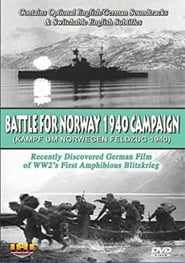
Kampf um Norwegen - Feldzug 1940
د English ژباړه ډاونلوډ کړئ
د خپرونې معلومات
تګونه
د English سرليکونو مخکتنه
لومړۍ 200 کرښې.
The Treaty of Versailles.
When the Fuhrer took office -
- An impoverished and humiliated Germany becomes a great power.
The Third Reich is established. Austria joins the reich.
Sudeten released.
The Reich Protectorate of Bohemia and Moravia was established.
The territory of Memel is once again included in the Reich.
There is still a gap between the ancient city of Danzig and Reich.
Poland and Western powers reject all reasonable solutions.
Poland supported.
Then the weapons speak.
Warsaw.
The Polish capital capitulates.
Mobilization for the Western Front begins.
The new front lines are drawn.
Despite the seemingly calm winter 1939/1940 -
- Our opponents were looking for an advantageous attack position.
Chamberlain believed that England could put the Germans knees -
- With a lock. Women and children had to starve.
The Russian assault to Finland gave Britain a pretext -
- To take important positions in Norway and Sweden.
Above all, the port of Narvik, which is crucial for the transport of iron ore.
This strategy continued after the Russian-Finnish War was over.
The Norwegian government seems reluctant to defend its neutrality.
All signs point to an imminent Allied occupation of Norway.
A British attack on Germany from Norway and Denmark should be avoided.
One can only imagine the consequences for the German army:
Northern Germany would be exposed to massive British air raids!
When the British destroyer Cossack Jøssingfjorden came in February -
And attacked the German Altmark steam -
- The first shots in the battle of Norway were fired.
In early April, Allied forces are carrying ships bound for Norway.
In our adversaries news later found out this material.
Meanwhile, the British are mining Norwegian waters.
Out of Stavanger.
And Bergen.
And Vestfjorden: The important entry port of Narvik.
Reliable intelligence reveals enemy intentions of the Fuehrer.
German countermeasures were prepared in detail.
An order was enough to start instantly.
The campaign against the occupation of Norway and Denmark -
It was led by General von Falkenhorst.
Secretly, troops and equipment loaded into warships.
To avoid exposure, cargo planes with supplies only used later.
The fleet is under the overall command of Admiral Carls.
Almost all the German navy was ready for battle.
This was the only way to transport an entire army to Norwegian quickly.
These are the destroyers bound for Narvik.
The seizure of the most important ports on the Norwegian coast -
It was a daring and difficult operation.
Imagine the distances.
A few months later, German soldiers have entered Kirkenes.
Not far from the Finnish border.
To realize the value that is required must take into account not only the distances.
Also keep in mind the imbalance of power between the two navies.
In April 1940, the British fleet includes 14 warships.
The German fleet has only two.
The British have 15 heavy cruisers.
The Germans have four.
Against 49 light cruisers of Great Britain, the Germans have six.
193 British destroyers against only 20 Germans.
In addition, the British navy was nine carriers.
The German fleet had none.
Against this overwhelming force, the operation was performed.
German units planned departure to arrive at the same time.
Only in this way, the element of surprise can be secured.
For the first time in the history of war, armed forces travel through the air.
For example, the important city of Stavanger is taken only from the air.
10,000 soldiers flying to Norway by plane during the first days.
Initially, General Geisler was in charge of these airborne forces.
Later it was replaced by the high general.
The group insurance aviation and marine supplies.
Reconnaissance aircraft monitored the movements of the enemy at sea.
The transport of German troops is protected by fighter aircraft.
For the first time in the history of the war -
- Marine British pride is hampered by the powerful air force.
This protection service, one has to include Denmark.
The consequences of adversary control over Denmark would be incalculable.
Denmark is under the protection of the German Wehrmacht.
The General Kaupisch is in charge of this operation.
Copenhagen.
At dawn, the Citadel of Copenhagen is captured.
Paratroopers ensure the bridge between Zealand and lolland.
At the king's command, the resistance ends even more.
Denmark, the decisive stage before Norway, is secured without a fight.
And the same day the king rode through the streets as usual.
The conquest of the Oslo fjord was the most difficult operation.
It took place on April 9, as the landings at the other ports.
The fjord is 100 kilometers long and heavily fortified.
The Blücher, Lützow and Emden cruises were venturing into the fjord.
Two minesweepers and two torpedo boats approaching the military port of Horten.
The occupants were met with resistance in the morning.
Their determined struggle to bring arsenal of Horten German hands.
70 men taking 1,200 prisoners.
Meanwhile, three more cruises sail in the fjord.
In its narrowest part by Drøbak, reach the innermost fortification.
They have to pass between the arms and Drøbak Oscarsborg torpedo battery.
The coastal defense shooting from 500 meters. Blücher is severely affected.
Two torpedoes decide the fate of the proud ship.
Troops landed Lützow and Emden.
Can not find any major resistance on the way to Oslo.
The battery torpedo that sank the Blücher. It is tucked away in the mountains.
The torpedo is brought to water. This is the aiming device.
This is the trigger mechanism of the torpedoes.
The viewing slots are well hidden behind a hedge.
At first, it was impossible to Oslo by sea.
But soon the planes approach the Norwegian capital.
Machine guns that Norwegian had placed at the airport, were defeated.
Some German aircraft are destroyed due to the short runway.
The infantry soon join and march towards Oslo.
The fjord is still locked in Oscarsborg.
On 09 April, the fort is attacked with heavy artillery from the Lützow.
He then bombed from the air until the resistance was crushed.
Now the channel is also open oslo.
The cruiser Emden has docked in the port of Oslo.
The Blücher wounded are brought ashore.
The deceased are paid the ultimate honor.
For the musical accompaniment, the troops march through downtown Oslo, -
Past Major General Engelbrecht.
The next day, panic breaks out because British radio emissions.
Reportedly, the British naval attack in Oslo a few hours.
But this was a false alarm, of course.
While the troops are pressing on the Oslo Fjord -
- The landing takes place in Kristiansand. The first attempt fails.
In thick fog, strong resistance should be crushed by the troops to land.
This Kristiansand.
On the return trip, the cruiser Karlsruhe is achieved by British torpedoes.
The königsberg cruise bound for Bergen.
Bergen is busy. The city is not opened by the sea, -
- But behind a chain of islands. It only comes through narrow channels.
The approach is heavily fortified, but the risk of breaking.
It's a tough fight!
The batteries that protect the western and northern entrances are captured.
General title joins the first troops to enter the city.
It lies with the Norwegian commander and urges him to capitulate.
The next day, British planes sink the cruise königsberg damaged.
The capture of the batteries with the massive support of the Air Force.
Currently, the first German planes land at the port of Bergen.
The ten destroyers sailed bound for Narvik to Trondheim group -
Heavy cruiser and four destroyers.
They are accompanied by the battleship Scharnhorst and Gneisenau.
Reconnaissance planes are crucial to the success of the operation.
They regularly report the position of the enemy at sea.
On the afternoon of April 9, four of the ships broke -
- For the narrow and heavily guarded Trondheim Fjord, at full speed.
In Trondheim.
And the British?
Even before April 8, ie. Before the German landing -
- The boats were loaded, and some were on their way.
British surveillance aircraft reported German battleships in the North Sea.
The British Admiralty immediately called her cargo.
British battleships quickly tried to stop German unity.
It was too late.
On the way to Narvik, German forces are caught in a storm.
Equipment and boats are challenged to extremes.
Successful, thanks to their perseverance.
No pilot or navigational aids, destructors must enter the fjord Ofot.
Near Narvik are stuck in the fog. The headlights are off.
But poor visibility makes it easier to reach the harbor unnoticed.
Two Norwegian armored ships trying to stop the Germans with gunfire.
Both are sunk.
General dietl leave their destructive and goes ashore.
His negotiation skills avoid senseless bloodshed.
25 cargo aircraft from various nations are docked in the harbor.
Most of them are loaded with ore.
A German whaling oil stocks are a welcome support.
Under the plan, the destroyers were to sail the same night.
However, the output was postponed again and again.
The oil transfer was a problem.
Tankers en route to Narvik has been lost with the enemy.
As troops occupy Narvik, mountain troops have landed in Bjerkvik.
They have taken the elvegårdsmoen camp.
Its mission is to insulate Narvik from the north.
At night April 9, all major coastal ports are seized.
In Narvik and the task has been carried out as planned.
The Navy has done a splendid achievement.
The next day, five British destroyers get near the port -
- Through the fog and drifting snow. Shoot at the Germans.
The destroyer wilhelm Heidkamp sinks.
The death of a hero.
It is British material.
The British collect their survivors.
Two of his five destroyers are lost. Three damaged ships escape.
Two German destroyers are also lost. A third destroyer is on fire.
After much effort, they manage to extinguish the fire.
After the British attack.
Much is required of reconnaissance aircraft.
Based in Trondheim is located 650 kilometers from Narvik.
The first aid of their country of origin:
A large transport plane arrives with ammunition and provisions.
Why this tough battle for Narvik? It's all about iron ore.
In Kiruna, Sweden, there are abundant reserves of iron ore.
There is a railway line from Kiruna to Luleå.
In winter, this port is frozen for 5-6 months.
Narvik is important. The Gulf Stream keeps the port open all year.
So Narvik is a great port of transhipment and a battlefield.
This is the mountain of ore in Kiruna.
In peacetime, ten percent of the ore was sold to England.
Ninety percent went to Germany.
The iron ore train from Narvik.
تبصرې
No comments yet. Be the first to leave one.