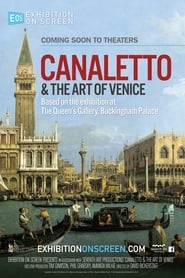
Exhibition on Screen: Canaletto & the Art of Venice
د English ژباړه ډاونلوډ کړئ
د خپرونې معلومات
تګونه
د English سرليکونو مخکتنه
لومړۍ 200 کرښې.
We're in the Queen's Gallery at Buckingham Palace
and this is the display space
where the Royal Collection can be seen by the public.
The Royal Collection is unique
in that it's spread across many royal residences.
So the paintings can be seen on display at Buckingham Palace and Windsor Castle,
but also at Hampton Court, Kew Palace or Kensington Palace.
The Royal Collection is the art collection
that's been accumulated and collected by many successive generations of monarchs
and it includes paintings, drawings, prints and decorative arts.
The Royal Collection is now held in trust by Her Majesty the Queen
and it's here that the public can come to see parts of the collection.
The Royal Collection has the largest assemblage of works by Canaletto
in the world.
It has major paintings, drawings and etchings.
So one of the things we can show is not only the range of works by Canaletto
but also the way in which he moved in his creative process
from drawing to the final painting.
With this exhibition, all the works were originally assembled
by the collector, Consul Joseph Smith, an Englishman who was living in Venice
and who sold his entire collection to George III in 1762.
Smith not only collected works by Canaletto
but also by the other artists working at the same time in Venice.
These artists included Sebastiano Ricci, Marco Ricci,
Rosalba Carriera, Luca Carlevarijs,
Zuccarelli, Piazzetta, and others.
This gives us a unique opportunity
not only to show a large body of Canaletto's works in the Queen's Gallery
but also to examine and put into context
some of Venice's most influential artists of the 18th century.
There are three main characters in this exhibition.
First of all, of course, Canaletto, Venice's most famous view painter.
And secondly, his main agent and dealer, a British man called Joseph Smith,
and thirdly we have Venice itself, Venice the city.
Venice was a great tourist destination in the 18th century
and somewhere which was a real thriving centre
for all kinds of artistic production, not just Canaletto's view paintings.
Luca Carlevarijs is the great precursor.
He's the first great view painter of Venice.
But when you compare his work with Canaletto's,
it looks very stiff and old-fashioned.
In fact, there's a remarkable letter
written by an art advisor in 1725 to a client,
in which he advises him to stop buying view paintings by Luca Carlevarijs
but to turn to this new artist, young Canaletto,
whose work is like Luca Carlevarijs's but you can see the sun shining in it.
It's his eye which separates him from his rivals
and what makes him into one of the great Venetian artists of the 18th century.
The first time when I visited the exhibition,
I was particularly struck by the variety of Canaletto's visual intelligence.
The quality of his draughtsmanship varies immensely,
and there is a sort of continuous balancing
between optical accuracy, geometrical layout,
and then a visual impression and transformation of the optical data,
and then the ways in which the paintings are composed.
They always show different aspects of Canaletto's invention,
to the point that you can feel, or you can follow, Canaletto
thinking not only about Venice,
but thinking about architecture,
thinking about the difficult, sometimes, history of Italy,
and how this architecture is an important part
of what Venice, the Veneto, Italy was for Canaletto and his contemporaries.
Canaletto has defined the image of Venice to the British to such an extent
that it's easy to forget he was working in a much broader cultural sphere.
So by reuniting Canaletto's paintings with works by other Venetian artists,
we get a much fuller picture
of the cultural and social life of the city in that period.
So we've got history paintings,
which were the most highly regarded genre of the period,
by Sebastiano Ricci,
landscape paintings by his nephew, Marco Ricci,
and also some of the undercurrents that were influencing Canaletto at this time.
So the interest in Palladian architecture, for example,
which was of great interest to Joseph Smith
and to other scholars and collectors in Venice and in Britain,
the capriccio, which was a genre of painting
that was particularly taken up by Venetian artists
involving the combination of reality and elements from the imagination.
So we see a much broader picture of the life of Venice
through this lens of the collection of Joseph Smith.
So the thinking behind this exhibition was to showcase the finest collection
of Canaletto paintings, drawings and etchings in the world
and to further the understanding of his work and his life
and to recreate and show Venice
in all its cultural diversity and life in the 18th century.
You had huge numbers of British Grand Tourists travelling to Venice
and enjoying the pleasures that it had to offer.
Not only the annual carnival,
which took place in the period between St Stephen's Day on 26 December
and the beginning of Lent,
which was when people would wear masks and carnival costume,
you had lots of annual festivals that were celebrated in the city.
Venice was also a thriving centre for the opera.
There were 17 opera houses in the city by the end of the century.
We are in the north fringes of Venice,
nearly facing the lagoon, the sestiere of Cannaregio,
one of six sestieri, six districts of the city.
So the city is in the middle of a lagoon.
In the Middle Ages, in early Middle Ages, in the fifth century,
when the lagoon started to become what we know as Venice,
this area was just muddy waters and natural canals with no buildings on it.
But originally the Rialto side of the lagoon, the Venice we know,
was made up of a cluster of islands,
and they were not necessarily connected with each other.
The basic unit of the city, of the urban space of Venice, is the square,
with a well at the very centre, a church possibly,
and the buildings around the square.
Each of these units was an island, a small insula, in Latin.
Every building in the island rests on a layer of mud,
where posts are thrust in.
This mud actually helps to preserve the wooden posts.
Every building is staying on this stable layer, but very flexible layer of mud.
So basically we can say the architecture of Venice
stems out of the sea, of the lagoon.
That's why so many travellers over the centuries were in awe,
because of this miraculous architecture just springing out of the water.
There were two particular places in Venice which were really important.
One was the area around San Marco,
which was the political and religious life of Venice,
and the other was the Rialto,
which is geographically the narrowest point of the Grand Canal
and where it was obvious to build a bridge.
And around this bridge grew up the major trading offices of the Venetians
but also of foreigners working in Venice,
for example, the Turks and the Germans and so on.
Its power was in trade
and importing and exporting goods from the East to the West.
Venice had an extraordinary reputation from the medieval period onwards.
For a start, it's an extraordinary city,
the fact that it is in the sea, it's an island in the sea.
But it was one of the wealthiest and most populous cities
of the medieval period and had this extraordinary trade with the East.
So this was the emporium
where all the luxuries and exotic goods from the East came through.
So the velvets, the spices, the silks which are imported into Britain,
these come from Venice.
From the medieval period Venice has been associated in people's imaginations
with ideas of luxury, with ideas of the exotic.
And it's been extremely powerful.
Because it was so wealthy, it was a real player in European power politics
and formed alliances with other European states.
This is the era when Italy was composed of city states and small principalities.
So because of its wealth, it was a mover and shaker
and played a very important part in the crusades, for example,
led resistance against the encroaching Ottoman Empires.
It was also extraordinarily stable.
It had been established, so the story had it,
by Romans fleeing Rome after the fall of Rome
and so this is where its pride and its liberty came from,
that it was the last remnant of Roman liberty and it had never been conquered.
So it had always been independent.
It had always existed without being conquered by another power.
It had an extraordinarily stable government
and in the 17th century this became extremely attractive or interesting
to politicians in Britain
because Britain was going through enormous political upheaval
with the Civil War and the debates about the monarchy
and where does political power lie, what is the best sort of government.
And Venice seemed to offer an example of what was regarded by Aristotle
as the best form of government, mixed government.
That is, it combines monarchy in the person of the doge
with the aristocracy in the senate and the people in the Grand Council.
And this system of checks and balances
ensured that power didn't become despotic
and there wasn't any danger of popular uprising
and therefore these checks and balances provided the stability.
This is a commercial republic that Britain feels it can identify with.
It has the kind of balance of power that many people in Britain were aspiring to.
It was resisting the papacy, and so they see a lot of similarities.
So particularly in the late 17th century,
there was a lot of political interest in Venice
as offering a model of government.
Canaletto was baptised Antonio Canal in the parish of San Lio in Venice in 1697.
His father was Bernardo Canal, a stage painter.
Canaletto must have begun his work training in his father's studio,
where he would have learnt the skills of perspective,
these skills very important in theatrical stage designs.
His name appears in the libretti for some operas in Venice
by Vivaldi and Orlandini.
The Canal family were, I think, what we would call upper middle class.
Unlike some of Canaletto's rivals, for instance,
who came often from the lowest echelons of Venetian society,
Canaletto did fancy himself as slightly grand.
There is a da Canal coat of arms,
which, in fact, he uses as a signature in the later stages of his career.
He's obviously rather proud of coming from a family that has a coat of arms.
Canaletto was called Canaletto
because he needed to be distinguished from his father Bernardo Canal.
He was a little man and canaletto means "small canal".
I imagine him as being rather gentlemanly,
solitary and quite possibly a bit difficult.
Canaletto ended up supporting all three of his sisters
and was clearly kind to them and good at being supportive.
I think if he was more flamboyant and a well-known social figure in Venice,
one would have heard more about it from contemporary diarists.
There are very few references to him.
We think that he was born in a small courtyard in the middle of Venice,
which one can still go and see, in an upstairs apartment.
We know that he lived there,
because he did drawings from it, two of which survive
تبصرې
No comments yet. Be the first to leave one.