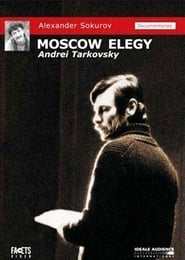
Moscow Elegy (Московская элегия)
د English ژباړه ډاونلوډ کړئ
د خپرونې معلومات
تګونه
د English سرليکونو مخکتنه
لومړۍ 200 کرښې.
Leningrad Documentary Film Production
The war dream
The relatives of this woman, Maria lvanovna Vishnyakova,
were villagers.
They insisted she give birth in the village.
A boy was born, named Andrei,
in Zavrazhye,
Yurievets District, Ivanovo Oblast,
on April 4, 1932.
Soon after, his sister was born.
She was named Marina.
Their father
was a prominent Russian poet,
Arseni Tarkovsky.
The Tarkovsky family originated in Dagestan
at least seven centuries ago.
The Tarkovsky princedom existed in the Caucasus
up until the middle of the 19th century.
In Maria's family, there were generals and engineers.
Laura! This is Andrei.
Andrei Tarkovsky.
The Soviet filmmaker was invited to Italy
by RAI, an Italian state-owned TV and radio company,
to work on his film Nostalghia.
Talking with Tonino Guerra, poet and script-writer.
You know, Andrei, tonight I wrote a poem for you.
I'd like to read it now.
I write poetry in dialect, not in literary Italian.
Yet I want you to listen, perhaps you'll understand.
What's a home?
Perhaps it's a coat, or when it rains, an umbrella.
It's full of bottles, rags,
wooden ducks, curtains and fans.
No desire to ever leave here, it seems.
Then, is it a cage
for anyone who happens to come?
Even for a bird like you, with traces of snow...
It's very good, only too sad.
There's some hope.
We must have a programme, or we'll get no results.
We must look through all we saw during our trip,
all we may need for the script,
and leave out all we won't need.
We still need a general list,
to begin with Sorrento.
Toni, salute Michelangelo. Thank him for everything.
When the work on Nostalghia started,
he was already 50.
We travel all the time around tourist sites.
I haven't yet seen a single place
our character could come across.
I show him all these places
so he can absorb all the beauties of Italy.
Then, of course, he can forget it all.
However...
However, I'd like to ask you:
if a Russian comes here,
what's his purpose?
He may come for business.
Or he may have a cultural purpose.
I agree we must show some of Italy's beauty,
but I don't want our character to be abstract.
It's interesting to watch him.
His movements, his silence.
His speech.
One easily remembers his gestures, his smile,
his particular concentration.
His image is immediate and remains with us.
You're going to see some footage shot long ago.
It strikingly resembles
though it was long ago, many years ago
the images you have just seen.
A literary hero is not a superman.
Among literary heroes, there is Bashmachkin,
from Gogol's Overcoat,
Dostoevsky's Prince Myshkin,
Raskolnikov, Pushkin's Hermann.
One can't understand what's heroic
about Myshkin, or Raskolnikov, who killed an old woman.
Or about Bashmachkin, a clerk who had his overcoat stolen.
Or about Prince Myshkin, who wasn't quite sane.
It appears that art influences the public
not by contagion, that's wrong,
but through a kind of ethical enlightenment,
through one's encounter with the world
of artists...
This has such an impact on the human soul
that it changes, and...
one who's seen or read a work of art,
can no longer remain the same... as before.
It's hard to give advice.
Yet the main thing I would say to young directors,
is to learn not to separate their work,
their films, or cinema in general,
from life as it is.
One should try to avoid gaps
between one's work, one's own films,
and one's acts.
This is because a filmmaker is like a poet or a musician,
and total self-sacrifice is required.
It would be strange to see a filmmaker
consider his work as a special gift of fate,
follow a certain way of life,
but make his films in a different way.
I'd like to tell all the young filmmakers
to be morally responsible for the acts
they intend to transfer onto the screen.
That's the main thing. Besides...
They should get accustomed to the idea
that it's is a serious, difficult art,
with great sacrifices.
It's you who must belong to the art, not vice versa.
They should get accustomed to the idea
that cinema is too serious, too difficult...
It's cinema that makes use of you, not vice versa.
I think one's got to learn how to serve film,
not be its victim.
It makes use of you, not vice versa.
His life in the West was not a miraculous dream.
He shot Nostalghia freely, but not easily.
The great doubts and tragic clarity of thought
that had pursued Tarkovsky all his life,
followed him here.
No matter what he did, nor in what country he lived,
he remained a Russian humanist.
It was painful. He said:
"After all, happiness isn't all in life".
Listen, I want to ask you a question.
Why is it women who always ask for something?
You ask me'? I'm a simple sacristan, what can I know?
Perhaps you've already asked yourself?
Why women should be weaker than men?
You should know that best.
Because I'm a woman? But actually...
I never understood it.
I'm an ordinary man. To my mind...
women were created to bear children,
and raise them patiently through self-sacrifice.
They're not good for anything else?
- I don't know. Thank you. You've helped me a lot.
You've asked me what I was asking myself.
You want to be happy.
This isn't all in life.
Wait!
Passed away the leader of the Soviet Communist Party,
of the Soviet State
a prominent figure of the world Communist movement,
a true fighter for peace.
In their Appeal to the Party and the Soviet people,
the Central Committee,
the Supreme Council of the USSR
and the Council of Ministers
called on the Communists and all the Soviet people
to rally closer around the Leninist Central Committee.
The Appeal said: "Our people are sure that
"no matter what the event, or ordeal, our Party...
remains at the height of its historical mission."
By the coffin, hundreds of wreaths from...
the Central Committee, the Supreme Council of the USSR,
from the Council of Ministers, from the Soviet Republics,
from Party bodies,
from our country's workers and public organizations,
and foreign states.
The awards honoring Leonid Brezhnev
for his numerous activities
as leader of the Communist Party
and Soviet State.
The funeral procession is approaching the Kremlin wall.
Paying last respects.
The mourning...
has stilled our country.
Before the Mausoleum, troops of the Moscow garrison
are marching.
Leonid Brezhnev's life and activity
will remain an inspiring example
of devotion to the cause of the Communist Party...
What're you reading?
Poems by Arseni Tarkovsky.
- In Russian? - No, in a rather good translation.
- No, it's a poor translation. - Why?
Verse can't be translated.
Perhaps I'd agree for poetry,
Here is someone coming down the hill...
What does it mean?
A Russian song.
But then, how shall we learn Tolstoy...
and Pushkin'? How to understand Russia?
You don't understand anything about Russia.
Then you know nothing about Italy,
if you don't need Petrarch, Dante or Machiavelli.
We simpletons are unable to understand this.
Then what should we do to know each other?
Remove the borders.
What borders?
The state borders.
- Good morning. - Good morning.
- This is the maid who set the master's house on fire.
- What house? - The one where she worked.
- Why? - Out of nostalgia.
She wished to return to her native Calabria,
Moscow Elegy subtitles in other languages
تبصرې
No comments yet. Be the first to leave one.