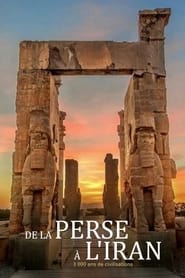
Art of Persia
د English ژباړه ډاونلوډ کړئ
د خپرونې معلومات
تګونه
د English سرليکونو مخکتنه
لومړۍ 200 کرښې.
This is a land known by two names.
The first is Persia.
TRADITIONAL MIDDLE EASTERN SINGING
Ancient.
Mysterious.
A place of adventure...
..of mighty temples and palaces...
..built by powerful kings.
A land of unimaginable beauty.
The other is Iran.
Isolated...
..proud...
..defiant...
..especially of foreign interference.
Western documentary teams are seldom given access,
but I am a British journalist
and I've been granted a rare opportunity to travel
across this vast country
and discover its complex history and culture for myself.
The Persians can seem like a mystery at the edge
of the western imagination,
in the Old Testament, or battling Alexander and the Romans
in classical history.
But the ripples of Persia's art and language have travelled
outwards throughout the world,
transforming culture across Europe and Asia.
If you think you know the Persians, think again.
In this first episode,
I'm going to start at the birthplace of Persian civilisation,
at one of the world's first cities,
and discover the mysterious writing of its people.
Persia's great kings built a vast empire and a rich culture
that became the envy of the ancient world.
I'll find out how they defeated no less than three Roman emperors
and how the Arab armies eventually conquered the Persians
to build a new Islamic empire.
So, come with me on a magical journey
to reveal Iran's fascinating ancient past
and its impact on the world.
To most people, Iran is a closed book
and our understanding of it has been largely driven
by the last 40 years, when, in 1979,
revolution came to Iran and Ayatollah Khomeini
transformed it into an Islamic republic.
The country has been locked in conflict with the West ever since.
When you look at modern Iran,
when you see it surrounded by hostile forces,
by countries that are hostile to it,
Iran would like to remind them that there was a time
that we were, not only were we up there at the top table,
we were the hosts of the top table.
And look at this.
And look how much it has actually influenced your literature,
your art, if you like.
The Persian civilisation and the art and culture it produced
was once the envy of the ancient world.
But, over the centuries, Persia was invaded again and again
by brutal conquerors, greedy for her lands and treasures.
They brought with them new laws, new languages and a new religion.
But Persian culture survived, even thrived.
Today, Iranians' sense of who they are
is as strong as it was when their story began.
They are the only people in the Middle East
to preserve their identity and language
despite waves of invasion and revolution.
If you look at the people of North Africa,
they used to speak Latin, now they speak Arabic.
If you look at the Syrians, they used to speak Greek,
now they speak Arabic.
So do the Egyptians.
It's the Persians who have kept their language,
and, by the way, only the Persians.
There's something special going on there.
That special thing that allowed Persian language and culture
to survive was, remarkably, this book.
It's called the Shahnameh...
..a collection of tales about Iran's pre-Islamic kings.
The characters are part-mythical and part-historical
and the book tells of their heroic deeds
against divine and human forces.
It's a poetic rendition of these supernatural tales,
historical tales, romances.
It's really a most magnificent, grown-up storybook.
Shahnameh is the soul of Iran.
It's the absolute essence of being Iranian.
It's a masterpiece of Persian
literature and history and language.
And, to most Iranians, certainly to me,
it's like a Bible.
Although it was written in the 10th century,
the characters and tales are still much-loved today
because they provide a link between the present
and 3,000 years of Persian culture.
I'm starting my journey here in Tehran
because I want to get a taste of this magical storybook.
I'm in a south Tehran teahouse where a 1,000-year-old story book
is about to come alive on stage.
The Shahnameh, the Persian Book of Kings,
is part-myth, part-epic history
and Iranians can't get enough of its adventures.
It's central to their sense of identity.
If you want to understand the story of the Persians,
you need to dive into the Shahnameh.
The performance is about to begin.
HE SPEAKS IN FARSI
Tales from the Shahnameh are retold by storytellers
in theatres and teahouses all over Iran.
And the man who wrote it would have been astonished
to learn his life's work would still be performed and read
1,000 years later.
He was called Abul-Qasem Ferdowsi.
Handed down from one generation to the next,
his epic book became Iran's national myth.
Ferdowsi took 30 years to write the Shahnameh,
but its storytelling power has lasted 1,000
and travelled far beyond the borders of Persia.
I'm of North Indian heritage with a Persian name, Samira,
and was raised speaking Urdu, a language closely related to Farsi.
And in the Indian comics I read as a child,
there were all these stories about the Persians as conquerors,
as bringers of culture, as religious refugees.
I want to find out how Ferdowsi's stories protected Persian language
and culture from repeated attempts to destroy them.
But, first, I'm going to explore the fabled civilisations
that emerged in this region...
..and find out how the Persian Empire was born.
Our story starts over 3,000 years ago...
..with some ancient plumbing.
This is the end of a qanat,
an underwater tunnel that was dug to bring water down
by the force of gravity from the mountains
right here to where people needed it to drink and irrigate their fields.
And it's still icy cold when you touch it.
Qanats made life possible.
They made barren landscapes fertile.
They allowed people to put down roots...
..to start making art...
..crafting beautiful objects, such as this ornamental axe head...
..adorned with the tiny figures of two wrestlers.
Or this figurine of a mysterious, stocky warrior dressed in snakeskin.
Archaeologists have nicknamed him Scarface.
But the skills of these early people
went far beyond the ability to fashion bronze and gold.
They also made extraordinary monuments...
..like this.
I've come to explore the ziggurat of Chogha Zanbil
in Iran's southwestern desert.
The people who built it were called the Elamites
and they attached great spiritual importance to mountains.
Where there were no mountains, they built their own.
This was constructed over 3,000 years ago.
This place is such a beautiful mystery, a relic of a lost world.
And I'm trying to imagine it as it was,
bustling with temples to the many Elamite gods and goddesses,
and the brickwork burnished with gold and silver,
a statement of power by its king.
Time, wind and sun have since taken their toll,
but the temple was once full of beautiful objects and statues
devoted to the Elamite gods.
The bull was central to Elamite culture.
In early Iranian creation myths, it was the first animal in the world.
The Elamites worshipped a bull god called Inshushinak.
And their kings constructed ziggurats like this to worship him.
In its shadow,
archaeologists found this blue, quartz pendant
polished and etched with two Elamite figures.
This is a really remarkable and absolute unique piece
of stone working because it depicts an image of the king
and then his daughter, and we rarely see women coming to the fore,
of course, in Elamite sources, unfortunately.
So, here we have one. And she's named as well as Bar-Uli.
And there she is, standing diminutively.
She's depicted on a much smaller scale in front of her father.
But the fact that she's there at all, her presence is really quite
remarkable in an age, really, where women just get bypassed
in the royal record.
We know of very, very few Elamite queens or princesses.
Archaeologists made other finds, too,
taking us even closer to the people who once worshipped here.
This footprint is over 3,000 years old.
It's tempting to believe it belongs to Bar-Uli,
the daughter of King Shilhak-Inshushinak,
who gave her the pendant.
Perhaps she came here with her father to worship,
to watch the bloody sacrifices carried out by priests
to gratify the Elamite gods.
But Chogha Zanbil is much more than a temple.
It's a book designed to be read by future generations.
This is the writing of the Elamites called cuneiform.
There are thousands of engraved bricks.
Only nobody knew what the writing meant until the 19th century
when archaeologists unlocked their secrets.
The Chogha Zanbil inscriptions are very repetitive
in many respects,
but they're important because what they do is quite
literally stamp the authority of the king on to the building itself.
So, every brick essentially is saying,
"I am the King of Elam, the King of Kings".
The Ziggurat of Chogha Zanbil is testimony to the sophistication
of the Elamite civilisation,
Art of Persia subtitles in other languages
More English subtitles for Art of Persia
- BBC Art of Persia 2of3 1080p HDTV x265 AAC MVGroup org eng · 11 downloads · 2020-08-22
- BBC Art of Persia(All Episodes 1 3)1080p HDTV x265 AAC MVGroup org eng · 31 downloads · 2020-08-22
تبصرې
No comments yet. Be the first to leave one.