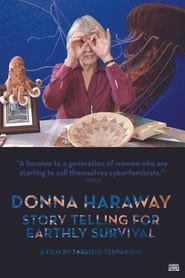
Donna Haraway: Story Telling for Earthly Survival
د English ژباړه ډاونلوډ کړئ
د خپرونې معلومات
تګونه
د English سرليکونو مخکتنه
لومړۍ 190 کرښې.
So I took the train up
and I landed at Princeton Junction.
And it was a beautiful spring day
and there were lots and lots of Princeton undergraduates
sunbathing on this nice, expansive green lawn, smiling.
And I looked at them and I thought,
"There'’s something really strange about this picture."
Sort of unnerving.
It was, "Has there been an alien visitation
and are these pod people?"
They were all beautiful and, you know,
really healthy and so on.
But what really struck me
was that they all had very straight teeth
and straightened teeth
that it looked like everybody
had been to an orthodontist.
And, of course, I had had orthodontia as a child
because my father had had very crooked teeth
and I inherited very crooked teeth
and I had exactly the same orthodontist he did.
And he showed me my father'’s plastic models
of his teeth from my father'’s childhood
and matched them against mine
and they were exactly the same.
And then he'’d put on braces
and so on and so on.
So there I was
lecturing to these Princeton undergraduates
with all of us having these extraordinary teeth.
And I got interested in the history
of the profession of orthodontia.
And the question that drove it was,
"How did the orthodontist,"
if you'’re fixing an underbite
or an overbite or whatever,
"how does the orthodontist know when to stop?"
What counts as a correct bite?
Because that'’s an historically very molten matter,
it depends on how you use your teeth.
People who use their teeth to process leather
or chew a different kind of food or many other things,
they'’re gonna have very different shaped jaw.
And then there are also the genetic screw-ups
like my father'’s and mine
with teeth all over the place,
you know, getting fixed.
So, um,
I found this wonderful physical anthropologist
named Loring Brace who had written a paper
about the history of orthodontia
and, you know, a group of dental specialists
that consolidate into their own profession
in the late 19th century,
which is exactly the period
when a lot of the differentiation
of medicine is happening
into separate bodies of specialists, so on.
This was very familiar.
Remember, I was an historian
of biology in those days.
But what Loring Brace was also interested in
was how the orthodontists knew when to stop
if they'’re correcting a bite.
And what he argued, um,
was that in the, uh,
evolutionary bioanthropology
of the late 19th century
and well into the late 20th century,
the sort of progression from the big jawed, uh,
pre-Homo sapiens and then on through the races of man,
the fundamentally racist racialized picture, uh,
that the, uh, orthodontia organized itself
around the correct facial angle, right?
Straight out of racial anthropology
of the 19th century.
And the correct bite was derived from a population
that has never lived on planet Earth
except in sculpture.
The correct facial angle is the facial angle
of the statues of the Greek gods.
I grew up in a family where storytelling
was part of the air we breathed
and a big part of what happened
around the dinner table.
It was a family that loved words and loved language,
not an intellectual family,
not a family of scholars at all,
but a family full of laughter
and full of the vitality of sharing stories,
especially at dinner time.
And there was an anchor to that,
and the anchor really was my father,
who was a sports writer.
He worked for the Denver Post
for more than 50 years
in the sports department writing game stories
for baseball, basketball, football, hockey,
covered the Kentucky Derby sometimes, so forth.
And Dad loved to write the game stories.
He didn'’t want to be one of the columnists,
he didn'’t want to do the muckraking,
to dig up the dirt on corporate, big time sports.
He wanted to write about the drama of the game.
And I think that'’s something that he brought with him
into his adult life from childhood.
My father contracted tuberculosis
as a very young child,
and it was tuberculosis in his bones,
not in his lungs,
and particularly in the bones of his hips
and his upper legs and his knees.
It was very serious and it kept him
in a full-length body cast from, you know,
just at his chest level down to his knees
for three years,
immobilized and in significant pain.
There was no real good treatment
for tuberculosis in those days.
And he was blessed with, you know,
parents and friends and a neighborhood full of kids
and folks who made his life very full.
And my dad was not an intellectual,
neither was my mother or...
The family had a love of words
and a love of stories,
but not in a-- they weren'’t critics,
they weren'’t, um,
they weren'’t particularly political.
And so far as they were political,
I try to forget what they thought.
Uh...
Sort of an embarrassing part of one'’s childhood,
you know, I mean, on the one hand
there was Cardinal Spellman and the, you know,
the Catholic scene of the 1950s
in Irish Catholic Denver.
Uh, yeah, I try to forget the political scene, basically.
But the love of story I don'’t forget.
And I think that, you know,
my father was a tremendously positive presence.
He--his sense of storytelling
was a kind of making live for an audience
what made something vital.
I also think I inherited a strong love of storytelling
from growing up Catholic.
There'’s no way you grow up Catholic
as the serious little girl I was.
You know, with a profound immersion in the liturgy
and the colors and the symbols
and the rituals and the incense
and the dressing up and the--the, you know,
I wanted to lead a children'’s crusade
to the Holy Land, for Christ'’s sake,
I mean, this is really bad.
You know, I mean,
you think about today'’s world
to remember that, you know,
as a seven-year-old girl
I wanted to lead a crusade as, uh...
Well, less said the better, you know?
Except that it also helps me remember
how deeply rooted, um, the--
how deeply rooted Christian culture is
in this thing we call the West
and how profoundly Islamophobic it is.
And that in some way, uh, you know,
I inherited that without even knowing
that I was inheriting that.
What I thought I was inheriting
was the drama of a little girl
leading other children into battle for truth
or some other weird fantasy.
No wonder I liked Fellini
when I started going to real movies, you know?
I think I want to say that it doesn'’t look maybe,
at first glance,
that this beautiful Navajo basket,
which of course I have no right to own,
one of the reasons I held it up here
is '’cause it'’s also embarrassing.
How is it that a daughter of conquest
owns this object?
Uh, I sort of leave that there as a question.
There'’s no way that we can touch
without inheriting the whole thing.
It'’s not that I feel guilty with holding this basket,
but the basket is also this eruption
of the whole story
of dispossession
More English subtitles for Donna Haraway: Story Telling for Earthly Survival
- Donna Haraway Story Telling for Earthly Survival 2016 1080p WEBRip x265-RARBG · 50 downloads · 2024-03-25
تبصرې
No comments yet. Be the first to leave one.