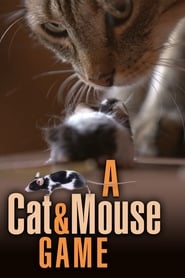
A Cat and Mouse Game
د English ژباړه ډاونلوډ کړئ
د خپرونې معلومات
تګونه
د English سرليکونو مخکتنه
لومړۍ 176 کرښې.
- The story which we are about to tell you
happens in a holiday cottage in the summertime.
The story in question is more like an animal news report
than an animal fable, although that is debatable.
Once upon a time, a cat had a weak liver due to overeating.
Let's not beat around the bush.
Marcelle is a greedy cat and a thief
whose owner, this time, caught red-handed.
Two days beforehand in this very same place,
Cheeky, the former tenant's mouse, escaped from his cage
which wasn't shut properly.
Now left to his own devices,
he will have to deal with the trials and tribulations
of a life of freedom.
Between this predator and prey
who should really never have met, a chase full of danger,
tricks, and twists is about to start.
The game of cat and mouse is an old story
but what appears on the screen as a game
is not funny in real life.
It's a cruel game that can result in death for the mouse.
Left to his own devices but more alive than ever,
Cheeky makes a feast out of a crumb
without anybody noticing.
The new occupants of the place, city slickers,
hate mice except in cartoons.
On the other hand, they love cats.
Rita is a Burmese cat, a rather sophisticated one.
With a strict eye, she watches over one of her kittens.
Meow.
- When he's not stealing salmon,
Marcelle is the favorite, a stray cat rescued by the family.
At six years of age, this city cat is in the prime of life
and his fur is as soft as a caress.
But watch out.
Under the guise of a friendly tom cat, Marcelle is a killer.
During the course of this story,
we are going to witness the strategies put in place
by the predator and his prey.
In plain language, will Cheeky escape
the murderous instincts of Marcelle the feline?
In general, the predation drama takes place at night
when man is sleeping peacefully in his bed.
Then, at twilight, the animals take over.
Let's join Cheeky taking refuge between two walls.
Loyal to his opportunistic mouse tendencies,
he takes advantage of his new environment.
Cheeky has found room and board, and a piece of biscuit.
An adult mouse can snack 20 times a day,
with an appetite that is pleasing to see.
As curious as he is hungry,
Cheeky explores the big world of the kitchen
and comes face to face with the pantry, proof that man,
who often complains about the presence of mice in his home,
is also the one that feeds them.
Mice are omnivorous.
They eat very discretely.
Well, almost.
Marcelle is nocturnal, with over-developed hearing.
His ears, able to move 180 degrees,
help him find the slightest hissing
or ultrasound emitted by his prey.
It's one o'clock in the morning
and Cheeky has his nose in the flour.
Usually Marcelle chases gray mice.
This type of mouse is a first.
For his part, Cheeky, who has been living in a cage,
has never seen a cat up close.
He weighs 30 grams to Marcelle's four kilos,
except that in the animal kingdom,
the strongest one isn't always the winner.
A cat like Marcelle doesn't kill the first mouse
that passes by just to eat him.
He can also kill as part of a game
or he can just have fun with it,
even if this time, the game didn't last long.
Cheeky has saved his skin, but what will happen next time?
In the morning, it needs more than the crowing of the cock
to awaken Marcelle.
Marcelle.
- Marcelle can't resist the call of his kibble.
He has a voracious appetite
and eats a dozen small meals per day.
Nevertheless, instinctively, a well-fed cat still hunts.
Marcelle is an eclectic predator.
As well as mice, he likes fish, including raw fish.
In his field of vision are Moby Dick and Bubble,
a couple who literally go round and round in circles.
The cat can spend hours lying in wait.
The sideboard in the lounge is a stressful environment.
Attracted by the movement of the water
more than by the goldfish, Marcelle quenches his thirst
because he's not really hungry.
Having renounced fresh flesh,
Marcelle scratches the mat with his claws.
He's acting fishy.
At the end of this tragicomic adventure,
Moby Dick and Bubble continue to swim in circles.
They return to their normal existence.
Between these partition walls,
Cheeky the mouse moves between two universes.
He has already visited the kitchen.
Now he has arrived at the back of the barn.
This mouse, reared and bought in a pet shop,
meets gray mice, called Mus musculus, for the first time.
These mice sneak into our homes all year round.
A dozen of them live here as a family
but outside of their clan,
any newcomer is an intruder who can be killed.
Cheeky is a stranger and the dominant males
are about to give him a hard time.
The quibbling stops and this little mischief of mice
ends up in the nest that the Mus musculus have built
with twigs, paper, cardboard, pieces of tissue,
fiberglass, and cotton.
Barely tolerated, Cheeky chases a female.
But just at the moment where he's about to get lucky,
as we say, a competitor intervenes.
When it comes to flirting,
it's important to respect the rules of the Mus musculus.
Cheeky will have learned at his expense.
In the meantime, he's champing at the bit.
In the garden it's picnic time.
The lady of the house is feeding the kittens
with a baby bottle
because due to lack of milk after the birth,
Rita the cat couldn't fill her role as a nurturing mother.
After two months not yet weaned,
the kittens attack the treat greedily.
The lady of the house helps raise
her two adorable little felines, two future predators
with their blue eyes.
At the other end of the garden, let's join Marcelle
whose behavior is intriguing.
He scrutinizes the ballet of the blue tits.
The more they eat, the hungrier he is.
A cat like Marcelle spends on average three hours a day
on the act of predation.
A stray cat can spend double that time.
With exception of rodents and some lizards,
birds represent 1/4 of the prey killed by Marcelle.
But the world is cruel.
A glass door separates the cat from the blue tits.
Disappointed, Marcelle goes on to new adventures.
In the barn, Cheeky lives his life on a beam
six and a half feet high.
And to think that the mouse's vision is blurred
and he's aware of very few details.
He compensates with his tail and his whiskers,
very sensitive tactile organs,
and he has a powerful sense of smell
that helps him find his bearings.
If he could see further than the end of his nose,
he would see that a mouse is making a break for it.
Where is he going?
It's a mystery.
If this intrepid mouse is going so far from his nest,
it's because he's hungry.
To eat, he's ready for anything.
The owl is too.
But let us return to the mouse
who doesn't have the characteristic trait
of making provisions, which forces him
to search for food when he is a little peckish.
A mouse weighing 30 grams eats
between three and five grams per day.
That's a lot.
At the end of a successful search, the mouse eats the seed
which he usually shells before eating.
The mouse doesn't know that the barn owl is biding his time.
It's also called the death owl.
One might think that his face is mourning his prey.
Although his ears are hidden under a bed of feathers,
he has exceptionally acute hearing.
Even better, he has the discretion of a ghost.
In flight, you can't even hear the flutter of his wings.
A Cat and Mouse Game subtitles in other languages
تبصرې
No comments yet. Be the first to leave one.