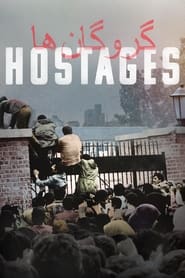
Hostages
د English ژباړه ډاونلوډ کړئ
د English سرليکونو مخکتنه
لومړۍ 193 کرښې.
Announcer: This is a CBS News Special Report.
Good evening. In Tehran tonight, the American Embassy
is in the hands of several hundred Iranian students
who took control after a three-hour skirmish
with US Marines.
Jessica Savitch: The American Embassy in Tehran
is in the hands of Muslim students tonight.
Ed Bradley: They're holding hostages, one report says
as many as 100, most of them American.
Massoumeh Ebtekar: Here was not an embassy.
It was a CIA center.
This was a den of espionage,
where they were plotting
against the Iranian people.
Excuse me just a minute, okay? If you feel that
some of the people in the American Embassy are spies,
-wouldn't that be-- -Well, I don't feel. I know.
You know, we know. It's not that I feel.
We know. Everybody knows.
Barry Rosen: They blindfolded me, tied me up.
And from that day on, I was in captivity.
Ann Swift: The terror that built in you. You were never sure
if they were gonna take you out and then execute you.
Walter Cronkite: Lesley, what about the White House?
What's your sense of the feeling there tonight?
Well, I sense tension, Walter. I was told this morning
that the administration is now preparing for a long siege.
William Gallegos: I hope I'm home before Christmas.
I leave it up to the American people and our President
to make the right decision.
I want my son home. I want him back,
and I want him alive.
So, at this hour, on this night,
the fate of nations and their leaders
still is tied inextricably to the fate
of those Americans held prisoner
in their own embassy in Tehran.
Ebtekar: We're not trying to take revenge
on the American people. We don't hate them.
We're trying to help them understand
the consequences of the actions of their government in Iran.
Radio Host 1: This is KPFK Los Angeles.
It's 4:30 AM. This is a live telephone call
to Tehran, Iran.
-Iranian Caller: Hello? -Radio Host 1 : Hello?
We're trying to reach the United States Embassy.
Radio Host 2: We'll speak to any party.
Radio Host 2: Yes.
May I speak to one of the people
you are holding who is an American?
Radio Host 2: How do you think this will all turn out?
Radio Host 1: It's now about 27 minutes here before 11:00
in the morning on NIRT International...
Radio Host 2: The American Women's Club General Membership meeting
is scheduled for Tuesday at 9:30 at the Hilton...
Radio Host 3: Attention, bowlers. All AWC member
who wish to participate in the Saturday Morning Bowling League
must register now...
Radio Host 4: There's interesting concepts going on
at the Iran-America Society from now
through the 26th in galleries one and two
from 5:00 until 8:00 PM...
Radio Host 5: 58 degrees outside, looking for a high today of 74 degrees...
Michael Metrinko: I arrived in Iran to work
in the visa section of the Embassy in March of 1977.
I loved the Iranian culture.
The poetry, the literature, the music,
you know, the painting, the tile work,
the sculpture, you know, the engraving.
I could see the history there
going back thousands of years.
It's the history of the Old Testament, the Bible.
It's the history of Esther, and Mordecai,
and Daniel, Cyrus the Great.
This was their country.
Everything about it,
I found fascinating.
John Limbert: My own connections to Iran go a lot deeper
than 14 months being a hostage.
When I first went to Iran,
it was 1962.
Ali Amini was prime minister
of Iran, and John Kennedy was President of the United States.
You know, what drew me to Iran
and the culture and the language,
when I was in Peace Corps training in 1964,
I encountered Persian.
I encountered Iranians who were our teachers,
and I thought, "Wow, this is amazing!
What an amazing language!" I mean, first of all,
it has no genders,
not even for pronouns!
It's just incredibly rich.
Maybe it was that, and because I did find
my wife in Iran, and for reasons I still don't know,
she was willing to marry me.
And, of course, being part of a Iranian family,
then you start learning the subtleties of language.
You either participate in what goes on
or you don't.
Those days, Iranian girl wanted to marry
Americans or foreigners.
The Ministry of Interior
has to give permission,
and I said, "Why?" And they said,
"Because we are protecting you.
"We want to know who is this guy
and how is his background."
Took about a month, month and a half,
and then they gave us the permission to get married.
And then our daughter was born 1969.
John Limbert: If you ask Americans
where did the problems start?
They'll tell you the original sin was in 1979
with the hostage crisis.
But things go much deeper and the ties go much deeper.
I mean, the ties go way back.
Seventy, 80, 90 years before that,
and most of it was positive.
David Frost: Here at Persepolis,
the symbol of Persian Kingship at its zenith.
Mohammad Reza Pahlavi,
the Shahanshah Aryamehr,
has been the monarch of Iran
since 1941.
When Americans think of the Middle East in the 1970s,
they think of the Arab oil embargo.
They think of Arab wars with Israel,
but then just to the east of all that,
lo and behold, there is this mythical kind of kingdom,
led by a Shah
who's impossibly wealthy and glamorous and pro-American.
Reporter: The Iranian monarch visits New York.
With his beautiful empress, he rides up Broadway
through cheers and ticker tape.
Chris Matthews: You know, the Peacock Throne,
like the Royal Family in Britain,
that's the kind of way he was treated.
It was like this dynasty
that was a fact of life.
-(quiet chatter) -(shutters snapping)
Mansour Farhang: The Shah was a modernist living a very modern life
with his wife, who was in "Vogue" magazine.
This ostentatious life of the monarch
was regarded as something normal,
something ordinary, very much like Europe.
Frost: What is it that makes an Iranian?
I mean, what is
the common bond that links them all?
I'm not making any propaganda,
but I think it's the crown, the King.
John Ghazvinian: Mohammad Reza Shah
believed that the people love their King,
and the King understands what his people want.
He sort of understood the pulse of the people,
that he held their wishes, their hopes, their dreams,
their aspirations in his hand.
That he just understood that instinctively.
-(quiet chatter) -(shutter snaps)
He, in many ways, had grown up in the lap of luxury.
He had gone to one of the world's most elite
boarding schools in Switzerland.
He understood Western constitutional tradition.
Reporter: In the United States Capitol in Washington,
members of Congress hear the Shah speak of the friendship,
respect, and firm alliance that exists
between the people of Iran and the United States.
Mohammad Reza Pahlavi: I wish to express
to you our deep gratitude
and sincerest thanks.
Jonathan Alter: From Eisenhower, Kennedy,
Johnson, Nixon, Ford,
the Shah was always
a major ally of the United States.
He was our man in the Middle East.
Elaine Sciolino: We needed Iran.
-That's all there is to it. -(explosion)
You want to know why Iran's important? Look at a map.
You've got a huge border with the Persian Gulf,
and you have the former Soviet Union.
The American Embassy
was one of the biggest pieces of real estate
in central Tehran.
At one point, there were a thousand people
working for the American Embassy.
It was like a palace
right in the heart of downtown.
It had a football field,
tennis courts, swimming pool,
huge residence,
walking paths,
you know, beautiful gardens.
It went on forever,
Hostages subtitles in other languages
More English subtitles for Hostages
- Hostages-S01E04-1080p-webrip · 36 downloads · 2022-11-20
- Hostages-S01E03-1080p-webrip · 36 downloads · 2022-11-20
- Hostages-S01E02-1080p-webrip · 37 downloads · 2022-11-20
- Hostages 2022 S01 10bit x265 1080p WEBRip RARBG · 42 downloads · 2022-10-07
- Hostages 2022 S01 10bit x265 1080p WEBRip RARBG · 72 downloads · 2022-10-07
- Hostages 2022 S01 10bit x265 1080p WEBRip RARBG · 58 downloads · 2022-10-07
- Hostages 2022 S01 10bit x265 1080p WEBRip RARBG · 46 downloads · 2022-10-07
تبصرې
No comments yet. Be the first to leave one.