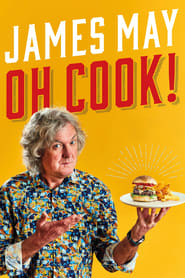
James May: Oh Cook!
د English ژباړه ډاونلوډ کړئ
د خپرونې معلومات
تګونه
Download English Subtitle Files for Mobile (7)
د English سرليکونو مخکتنه
لومړۍ 200 کرښې.
-Action! -Now, this is
a professional, TV-friendly kitchen,
and it has in it everything you could ever imagine
you would need to cook.
But all of this stuff--
this massive fridge,
the double oven, the pots and pans,
the-the equipment in the drawers,
the five-ring hob,
the pantry full of unimaginable goodness--
all of this counts for nothing
without the one vital implement
on which TV cooking shows depend,
and that is...
a home economist.
Mine is in here,
and she's called Nikki.
-Hello, Nikki. -Hello, James.
We'll be seeing you later. Goodbye.
Now we've cleared that up, let's start the series.
Hello, viewers. I'm James May, and I can't cook.
Welcome to my cookery show.
It's not entirely true that I can't cook.
I have mastered about three dishes.
Horse's arse.
But if you can cook a few things passably well,
I believe you can learn to cook anything.
I mean, I'm not saying it will be easy.
-Oh, God. -
It's not burnt. It's just well-done.
However, it can be done with confidence...
Yeah!
...common sense...
I learn. You learn. And then we are all fed
by knowledge.
...a bit of rudimentary organization...
The hilarious thing here is I can't remember which one
was which when I put them in.
-Hi. -Nikki, hello. Would you like to come
and check on my progress?
...and, of course, Nikki, who's worked
with some of the TV cheffing greats.
All those things you see being cooked
on the television are actually made
by Nikki and people like her.
Not celebrity chefs.
Celebrity chefs can't actually cook.
I'll be learning as I go.
That's perfect, look.
-I didn't say you could do it. -Sorry.
Trying out the latest kitchen gadgets.
Sometimes I will succeed...
-Mmm, mmm. Mmm! -Mmm, mmm.
...and sometimes I will fail.
-It's nasty. -It is. Actually, it's disgusting.
I don't know why I'm trying to...
-It's absolutely vile, isn't it? - Nasty.
I'll also be learning what it takes
to make your own cookery show.
- Can I make a suggestion? -No.
- It would be such a lovely intro... -I said no.
But there will be enough great recipes and,
thanks to a very expensive TV cameraman,
enough slow-mo shots of really great food
to stimulate your gastric senses.
So, there you go. We've learned...
nothing.
Today, I'm paid a visit by some big movers
in the world of publishing,
because by some miracle, they have paid me to write
a cookery book.
So I'm out to impress
with some rice and noodle-based dishes.
That's the noise of waiting
for a Chinese takeaway, isn't it?
There's fusion.
There you go, we got the picture. Can we eat it now?
And a bit of confusion.
I can't remember where I was going to use the limes.
I'll be using some unlikely ingredients
and dishing up an exotic breakfast...
That's murderous.
...a stunning stir-fry
and a very unusual ramen.
Nikki, I've screwed up.
We'll start with a starter.
Hello, viewers. Now, in Jewish and Australian cooking,
chicken soup is regarded as the cure for everything,
what William Langland might have called
the font of peace
and the most precious of virtues.
We could make a standard chicken soup here, like a broth,
but we're going to make Thai chicken noodle soup.
This exciting procedure begins
with preparing some ginger.
Now, this is a trick I've just been taught,
or it's just been explained to me.
Rather than try and use my ancestral peeler,
apparently, you can use a spoon. Hey.
This actually works. Look at this. Are you getting this?
A spoon, a teaspoon peels ginger.
And I don't need that whole piece.
I need roughly a teaspoonful of grated ginger.
Um, and then,
using the surform, which is here,
we will grate that onto a thing.
-Just cut round this. -
-Nikki? -Hi.
Sorry, I need a-a small white plate.
-A small white plate? -To grate the ginger on
because it's got to be white 'cause the publishers are here,
-and they say everything's got to be white. -I'll go get one
from the special white plate department.
As I said, the publishers
of the book that accompanies this series are present.
They like white plates.
-Your special white plate. -Thank you very much.
Sorry about that. Would you like a glass of wine, actually?
-I'm gonna have one. -Can I take it to my cupboard?
Yes, of course you can.
Now, uh, this is a Sancerre
because we're dealing with spicy food.
Spicy food without any sort of fattiness...
-Plenty, thank you. -...or, um, oiliness
in it, so it can go with something quite mineral.
Quite flinty, as the wine bores would say.
So, this is a Sancerre.
Should be absolutely delicious with this.
- Cheers. - Cheers.
- Thank you. - See you
-in a few minutes, I suspect. -See you later.
White plate, white wine. Let's start again.
A teaspoon of ginger.
Two cloves of garlic.
Lemongrass.
And a couple of teaspoons of Thai green curry paste.
You could make this from scratch.
Very complicated. We've got this out of a jar.
Let's cook that for a minute. Then we're gonna chuck
the chicken in, and it will be beautifully coated
with all these things.
I'm using 450 grams of sliced chicken breast.
You can make this with leftover chicken
from your Sunday roast, in which case
you put the chicken in at the end.
This is looking great already.
And it smells...
fantastic.
This is gonna have rice noodles in.
A little bit of history about rice noodles.
They actually came into their own after World War II
when the rice harvest in Thailand was very poor,
mainly because of flooding.
And the Thai government realized that by turning the rice
into noodles,
you actually doubled the size of the harvest,
because a kilogram of rice
makes two kilograms of rice noodles.
And the Thai government actually invented a dish,
pad thai,
as a sort of national way to help
make the, um, food go a bit further.
To eke out their harvest and their supplies.
It's still popular to this day. Everybody eats pad thai.
James has got something in his hair, guys.
-What? -Something in your hair.
-Bit of garlic or something. -Where?
- Calm down. - It's not in any...
Well, it-it doesn't really matter, does it?
It's not a bloody fashion sh...
- Hang on. -
Oh, I put that there this morning.
Right, the chicken has gone in.
It's cooking very quickly.
Smells like the Thai café down the road from my house,
which always smells fantastic.
Even when it's shut, actually, it smells fairly fantastic.
You sort of get the spiciness.
It's in the woodwork or something.
There you go. Now, if you could just quickly cut
to a shot of the publishers
looking nervous in the background.
Because they're here today, I can check the instructions,
which I've put in this drawer.
The presence of the publishers,
who've paid me in advance,
means I have to be on my mettle.
So earlier, on their arrival,
I made a very sophisticated breakfast.
And it was this.
Now, you might be thinking, that just looks like
a load of rice and seaweed.
Itisrice and seaweed.
Sticky rice.
It's a popular breakfast in Japan,
where it's called noritsukudani.
You take a quantity of rice--
in this case, 200 milliliters--
and then add half as much again in water,
so that's 300 milliliters.
James May: Oh Cook! subtitles in other languages
More English subtitles for James May: Oh Cook!
- James May Oh Cook S02 WEBRip AMZN · 35 downloads · 2023-05-24
- James May Oh Cook S01 AMZN WEBRip DDP5 1 x264-NTG · 71 downloads · 2023-05-24
تبصرې
No comments yet. Be the first to leave one.