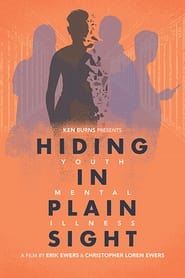
Hiding in Plain Sight: Youth Mental Illness
د English ژباړه ډاونلوډ کړئ
د خپرونې معلومات
تګونه
د English سرليکونو مخکتنه
لومړۍ 200 کرښې.
Boy: I remember having sad thoughts and asking myself,
"Why are you, like, acting like this?
What's wrong with you?"
If you feel very uncomfortable throughout the day,
then you need, like, an answer of what is going on.
Woman: I couldn't make sense of the emotions.
Why am I acting this way?
And it became a very frustrating thing
whenever I'd look in the mirror and there's nothing wrong
with me on the outside, there's absolutely nothing wrong
to make sense of that pain.
When I'm mad on the inside, I'm mad on the outside.
I feel very unmotivated, disinterested.
My friends had no clue what I was going through at all.
I felt like, well, my mom didn't care
and my dad was so busy and tired and...
I had so many emotions that I had to deal with.
I was like, "Oh, I could never be depressed,
I could never be-- have anxiety problems."
I was always like, "I'll be perfectly fine."
I just didn't want to talk about it.
I just wanted to leave it alone.
It was constant sadness, and anything that I did,
I couldn't find myself to be happy.
I was being reckless with my body and, like, taking
a lot of drugs and stuff and just being careless
and not caring if I wake up.
At that age, how are you ever gonna admit,
"I can't see past tomorrow"?
Woman: I think there's So many things you can say
about mental illness.
It comes out of nowhere, and then it just creeps
into your body, and you've got something
inside you, and you don't know
how to deal with it.
Narrator: Mental illness is one of the most significant
health crises in the world--
as pervasive as cancer, diabetes, and heart disease--
but it often exists in secret and is endured in isolation.
It's the place where sadness leaves off
and depression begins,
where nervousness becomes anxiety,
excitement becomes mania,
and habit becomes addiction...
the place where simply living becomes painful.
Greek philosopher Hippocrates called it
the "inner darkness,"
President Theodore Roosevelt the "black care,"
Poet Sylvia Plath "This dark thing that sleeps in me."
Young woman: It's the overwhelming feeling
of being stuck,
like, stuck in my head, stuck in my feelings,
stuck with this persona,
like, this... person that people saw me as
and that I couldn't escape from.
I can't even imagine myself without it,
you know, when something so toxic becomes
such a part of you.
Narrator: All of us are affected by mental health challenges
in some way,
whether in our own lives
or the life of someone we know.
It is everywhere-- in rural communities
and major cities,
in the workplace, schools,
even in our own homes,
often hiding in plain sight.
Young man: You could see someone walking down the hallway,
a kid on your sports team,
the most popular person in school,
the kid that everyone likes, you know,
and you would never know that that person
could be going through something themselves.
It's a silent battle that a lot and a lot of people
go through and that hasn't really
been talked about a whole lot.
Narrator: For some, it is a chronic illness.
For others, it comes and goes.
Some people can't put a name on it.
Those who can use words like "devastating,"
"hopeless," "a living hell"
to describe their pain.
All too often, they are called "nuts," "crazy,"
"out of their minds,"
labels that perpetuate stigma and isolation.
Even professionals debate what to call it--
an illness, a challenge, a disorder--
but that doesn't change the way it feels,
how it affects everyday life and relationships.
I do feel like once people find out you have
a mental illness, they just sort of treat you a certain way.
People often say, "What's wrong with you?"
instead of "What happened to you?"
No, they really don't care, like, how, like,
we feel, how I feel,
and, like, it gets to me a lot.
Narrator: Mental illness is, in fact, a disease,
a complicated and controversial one
that has been a part of the human condition
for thousands of years.
While there are now hundreds of diagnoses based
on all kinds of symptoms, the experience
and the treatments are different for everyone.
Man: I do believe that this is a very personalized illness.
It's hard for people to really compare one person's
experience with another.
That's often what keeps people
from getting help
because they think,
"Oh well, it's not that bad."
Well, compared to who?
Narrator: When you're suffering, it's hard to know what to do
and even harder to find help.
It affects all ages
in families both rich and poor,
healthy and dysfunctional.
It most often appears in childhood
and teenage years.
Trauma can be the trigger, from personal crises
such as divorce and neglect to environmental disasters,
racial injustice, and pandemics.
Over time, the symptoms can progress and lead
to increasingly extreme behaviors
like eating disorders, self-harm,
and thoughts of suicide.
Woman: When feelings become so excessive,
where it really interferes with their everyday ability
to live, that's a-- that's a challenge.
It can be at any age,
and it can be very impactful,
but it can be figured out.
You need to connect with someone who can help you,
problem-solve, listen, sort it out,
be able to work through those things.
Narrator: Intervention can help, and with the right treatments,
you can feel better...
Boy: It was just a lot of confusion in my family.
Young man: I don't talk to my parents openly about my...
Narrator: but the first and often most difficult step
is to simply start talking about it.
Girl... talk about them. I never tell anybody.
Boy: At school, they were like,
"Gabe, what is wrong with you?"
Woman: I was basically homeless because... Man: I am a gay man.
Man: On this planet right here,
we all have problems,
but that is the great thing about the human race.
Most people understand their problems,
and they work on it to get better,
but sometimes you might need just a little bit of help,
someone to help get your life back on track,
because you are the one who defines your life.
Narrator: These are the journeys of more than
20 young Americans from all over the country
and all walks of life who have struggled
with thoughts and feelings that have troubled
and at times overwhelmed them.
They share what they have learned about themselves,
their families, and the world they live in.
They speak for many of us.
They speak to all of us.
Woman: It's taken me a very, very long time
to even speak openly about it.
My roommates don't even know half of this stuff
that I'm telling you guys now,
and I'm nervous.
Like, I'm kind of shaking inside,
to even talk about it,
but I feel like if I don't talk about it now
then I'm wasting potential time where I could help somebody,
and that's all I really want to do, is, I just want--
if I can even reach two people from everything I say
or this story, then I did my part in this world.
How would I describe mental illness to somebody
who has never had it?
No experience of it?
Oh, boy.
Oh, my goodness.
I would want to shake their hand first of all.
Congratulations you made it that far, you know?
Nothing's wrong with you.
I don't know if you could explain it
to somebody like that.
Young man: It's person by person.
It changes with every brain.
With every set of eyes,
it's different.
Samantha: I would ask you how you were feeling.
Then I would ask you if you believe that.
Man: We don't understand how common it is,
we don't understand
how important it is
to talk about it
and be open about it,
so this is the problem that we all
deal with in secret,
and the result is that we don't deal with it well.
Film narrator: The thoughts of youth
are long, long thoughts.
What dreams, what feelings shape the pattern
تبصرې
No comments yet. Be the first to leave one.