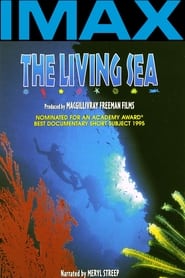
The Living Sea
د English ژباړه ډاونلوډ کړئ
د خپرونې معلومات
تګونه
د English سرليکونو مخکتنه
لومړۍ 137 کرښې.
4 billion years ago,
as the molten Earth cooled, a vast world ocean was formed.
This sea became the cradle of life on Earth.
The ocean average is 2 miles in depth, and it's filled with life.
The underwater world supports lifeforms in a far wider diversity of shapes and colours ...
than exists on land.
The oceans encompasses creatures as delicate as the jellyfish, or as powerful as the whale.
Somehow they all fit together.
And we're just beginning to understand how.
Our growing knowledge is important.
We can't protect what we don't understand.
We live, because the sea lives.
Here, in the Islands of Balah,
the rhythm of our life is the rhythm of the sea.
We are born on a certain tide, we die on another.
The tide carries our boats out to the fish.
It brings us back to feed our families.
The seasons of our lives depend on different currents ...
that guide us to the schools of feeding fish.
Ocean currents caused by winds and the Earth's rotation,
circle the globe, linking what we once thought were many separate seas.
We now realise there is only one ocean —
the world ocean.
The waters of the world ocean wash the warm volcanic coastline of Hawaii.
These same waters lap against the frozen inlets of Alaska ...
and pulse through the Red Sea between Africa and the Arabian Peninsula.
These world currents also nourish the giant kelp of California ...
which can grow a foot or more in a single day.
The world's aquatic plants including kelp, provides 70% of the oxygen we breathe.
The world ocean is a single interconnected system.
For example, one current flows halfway across the world from Australia past Africa,
then joins the Gulf Stream in the North Atlantic.
Just as currents move the waters of the world oceans,
so do the tides which ebb and flow under the gravitational pull of the Moon.
High tides follow the Moon as it orbits the Earth.
Canada's Bay of Fundy on the Atlantic coast is famous for its immense tidal flow.
Up to a trillion tons of water enter and leave the Bay with each tide.
High tides can reach 50 feet and more.
Low tides empty coastal channels leaving veins of red mud.
The tides enrich the land, the land enriches the sea.
While the Moon's gravity tugs the world ocean to a depth of 1,000 feet,
winds churn its surface.
Ocean waves driven outward from fierce storm centers, often travel for a week or more,
until they explode against the land.
Large waves moving at speeds of up to 70 miles per hour,
surge across thousand of miles of open ocean.
When these waves approach the coast of Oregon, at Cape Disappointment,
they keep the U.S. Coast Guard busy.
Here they teach heavy surf rescue.
First thing cadets learn in this school is ... humility.
In the past two centuries,
over a thousand vessels had been lost here at Cape Disappointment.
When waves are small, Oscar, our search and rescue dummy, likes to take a swim.
- Man over board starboard side! - Darrell ... you got my pointer.
Search and rescue during calm water is no problem, but ...
we need to be able to rescue those in 15 foot seas. That's tough work.
They say a 15-foot wave can drop 200 tons of water on a boat.
The ocean size and power dominate our planet.
For centuries, sailors feared its distructive force.
Today, surfers meet it at the point of its greatest fury,
where they find themselves mysteriously at home.
You're riding these waves, that have traveled thousands and thousands of miles.
You know, you're at the mercy of the ocean.
You're underneath the waves and ...
you hear the rocks rolling around on the ocean floor an ...
you hear thundering ... of the waves ...
ye know it's just amazing.
It would be great to meet the waves forever.
Despite its great power,
the sea invites contemplation.
What is our place beside the immensity of the ocean?
For me, the ocean always has special significance,
just 'cause you're so close to nature.
There's so much life around you under the ocean —
there's fish — there's dolphins, and there's whales — there's sharks, there's ...
Heaven knows what else's swimming around you under you all the time.
There's where you feel as one ...
you sort of melt in and you really do feel part of the ocean,
which is a great feeling,
but you have to look for that now ...
where, I am sure a long time ago that was a natural kind of thing — an ocean person.
Our relationship with the sea is seldom very deep.
Most of our contact with it takes place on the surface.
We are drawn to the ocean,
but how do our ever increasing numbers threaten the health of the living sea?
To find out, we need to look beneath the surface.
Scientists at the Monterey Bay Aquarium Research Institute ...
use remote-controlled submersibles to study the ocean,
and monitor our impact on it.
We call it an ROV,
but officially, it's a remotely operated vehicle.
It's the underwater equivalent of a NASA space probe.
The deep sea project chief is oceanographer Bruce Robison.
Vehicle heading 189,
vehicle depth — 30 feet, moving down.
As the ROV descends to 1,500 feet, it enters the world below.
While we stay on the mother-ship, up on the surface,
the ROV dives, sending us back live video pictures.
On many dives, we find species never before seen by anyone.
Now 1,500 feet.
Is that the same species that you and George described?
I think so, but we're looking at it on the side, so it appears to have a different configuration.
Here, let me put it on a bigger monitor.
Hey, what is this showing up on the sonar screen?
On this particular dive, our sonar locked on to something big.
About half the length of a football field.
It was the first time we'd seen this type of Siphonophor.
We moved in on its head.
Look at the detail of that head.
You can see how the swimming bells pulse the valves close after their thrust,
so that water doesn't go back inside.
The Siphonophors is one of the most remarkable animals on Earth.
It sounds like science fiction,
but it's not.
It's actually made up of hundreds of separate specialized individuals.
The swimming bells are separate units, so are the stomachs,
so are the reproductive sections.
This animal is so huge,
it's hard to imagine all these individual units working together.
How many other creatures are there like the Siphonophor?
And what do they tell us about the vitality of the sea?
The middle ocean level is enormous.
And we've only studied a small fraction of its volume.
We've still got a lot of work to do.
All over the world ...
scientists are finding evidence of the connections that link the living sea.
What we do in one place affects the entire ocean.
Off San Diego, oceanographers are studying the impact of pollution on the kelp forests,
which are nurseries for spawning fish.
In the central Pacific, giant clams some weighing 400 pounds ...
faced extinction from over-harvesting.
Scientists then studied the clams spawning cycle.
An adult clam is both a male and a female. It releases millions of tiny eggs,
and then even more sperm.
Today, using simple techniques, scientists can make clam spawn.
They now produce over one million sea clams a year.
Here at the Monterey Bay Aquarium in central California,
The Living Sea subtitles in other languages
More English subtitles for The Living Sea
- IMAX The Living Sea 1080p BluRay DTS x264-gl · 30 downloads · 2009-06-18
- IMAX The Living Sea HRHDTV Divx6 AC3 · 34 downloads · 2009-04-25
تبصرې
No comments yet. Be the first to leave one.