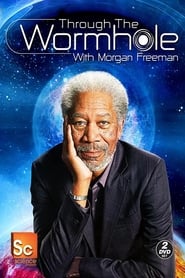
Through the Wormhole
د English ژباړه ډاونلوډ کړئ
د خپرونې معلومات
تګونه
د English سرليکونو مخکتنه
لومړۍ 200 کرښې.
50 years ago in Scotland,
one man had a brilliant idea --
an idea that today pits science detectives in Europe and America
against each other
in a $10 billion race to solve the riddle
of what you, me, and everything around us
is really made of.
It's a journey into the heart of matter,
plunging into the core of our physical being
and of the physical world itself.
But will this journey into the subatomic Universe
revolutionize our understanding of nature,
or will it reveal just how little we really know
about who we are and what we're made of?
Space, time, life itself.
The secrets of the cosmos lie through the wormhole.
What are we really made of --
you, me, everything around us?
That simple question has kept people guessing
for thousands of years.
In ancient times, the answer was easy --
everything in creation was made
from one or more of the four elements --
Earth...
Air...
Fire...
and Water.
When I was a kid, in not quite so ancient times,
we were told that everything is made out of atoms.
But in the last few decades,
scientists have looked inside the atom
and found that things are a lot more complicated.
Despite all of our knowledge,
we still don't understand the true nature of matter.
But right now,
thousands of investigators are following hunches,
tracking down suspects,
and getting closer than ever
to learning how we and everything around us
fits together.
And they're doing it by breaking things apart.
When I was 6 years old,
my father gave me his old pocket watch --
a time keeper.
"How does this work?" I wondered.
I decided to find out.
Taking it apart was a lot easier than putting it back together,
but I learned a little about what makes things tick.
And that's pretty much what particle physicists do today.
They smash things up and look at the debris
through extremely powerful microscopes.
We do what kids do.
We smash things, and we look to see what comes out.
And so, to do that,
we need to smash things harder and harder and harder
to see what's smaller and smaller and smaller.
At Chicago's Argon National Laboratory,
Bob Stanek builds machines that peer into the subatomic world.
So, this is our advanced photon source --
a microscope that's about a half a mile around,
and it contains 33 stations
where 33 individual experiments can go on
measuring tiny structures
of whatever these guys feel happy measuring.
If you remember way back in High School,
when you looked through the microscope
and you said, "wow, look at all that stuff -- how neat it is,"
it's amazing that ordinary light and optics
can bring you to such a detailed level.
However, for a lot of things nowadays,
you need more than just that ordinary light.
You need to get smaller and smaller and smaller.
With the A.P.S., we can see things much smaller
than we could see with our standard microscope.
We could see things a factor of 10 smaller,
a factor of 1,000 smaller, a factor of 10,000 smaller.
In fact, we can see things that are 10 to the 10th smaller
than what we could see with ordinary light.
We can see molecules.
We can see viruses.
We can almost see the structur of life.
The ability to take pictures of molecules and atoms
is an incredible thing, because only 100 years ago,
the atom was just a theory.
At the dawn of the 20th century,
it was believed that if atoms existed at all,
they were either empty shells or solid little balls.
Then one investigation changed everything.
It was the brainchild of Ernest Rutherford,
the Sherlock Holmes of particle physics.
Steve Nahn is a Professor at M.I.T.
and a team leader on the world's biggest Particle Accelerator,
the Large Hadron Collider in Europe.
Steve is going to reproduce
one of the most important experiments
in the history of science --
Rutherford's probe into the structure of the atom.
This experiment is the same as Rutherford's experiment.
We use the same kind of gold foils
and send millions of particles through these gold foils.
Rutherford thought that all the particles
would essentially go straight through and not deflect at all,
but that's not what happened.
The Rutherford experiment
is like firing bullets at a haystack.
The particle are like bullets,
and the atoms in the gold foil are like haystacks.
If the haystack is empty, the bullets go straight through.
If the haystack is packed with cannonballs,
all the bullets bounce back.
If there are a few cannonballs in the center,
some of the bullets will bounce back.
And that's what happened.
When Rutherford fired his particles,
most went straight through,
but some sharply bounced back from the center of the target,
upending the conceived wisdom of the time.
Something small and hard was down in there,
deep inside the Shell of the atom.
This is the evidence for a very heavy, very small object
at the core of the atom --
the high-density nucleus
surrounded by a vastness of empty space.
In fact,
the nucleus of an atom is 100,000 times smaller
than its radius.
It's equivalent to the head of a pin
in the middle of a football stadium.
After Rutherford, physicists probed further into the atom.
They found that it is built out of three parts --
the protons and neutrons that form the nucleus
and the electrons that form the Shell around it.
Between them, they make up atoms.
Atoms stick together and form molecules.
Out of the molecules,
we get more complex shapes, from a strand of DNA...
...Up to the 7,000 trillion, trillion atoms
that form a human body.
For a time, the atomic theory of the Universe
seemed to explain most everything,
but then physicists started breaking atoms apart,
and they discovered a slew of mysterious new particles
that turned their theories upside down.
The most frightening was called antimatter --
matter's evil twin.
If just this much touches ordinary matter,
it will level a city.
So, why are scientists trying so hard to make it?
Turns out it may hold the secret to the mystery of matter.
When scientists first smashed atoms apart,
they uncovered their essential building blocks --
protons, neutrons, and electrons.
Next, they built machines
that let them smash these tiny pieces together,
and out came strange, new particles.
Perhaps the strangest is the stuff we call antimatter --
matter's polar opposite.
It's the most explosive substance in the Universe.
When matter and antimatter touch,
they violently cancel each other out.
Physicists say, they annihilate each other.
It triggers an enormous explosion.
How big of an explosion?
Less than half a gram of antimatter rice
would produce a 13-kiloton blast
as big as the Hiroshima bomb.
Professor Frank Close is a theoretical physicist
at Oxford University.
Antimatter is a perfect opposite to matter.
If I was made of antimatter,
I would look exactly the same as I do today.
If you looked at the atoms that I'm made of,
they would look exactly the same if I was made of antiatoms.
It's only when you get inside the atoms
that you see the difference.
That's the atoms that we're made of
have little negatively charged electrons
whirling around a big, bulky, positive nucleus.
And the antiatoms?
Ask this man --
Joel Fajans,
an antimatter investigator
at the University of California, Berkeley.
Antimatter is everywhere in the Universe.
For instance, this banana contains potassium 40,
an isotope of potassium which emits positrons.
Positrons and other forms of antimatter
are difficult to study, however, and that's my job.
That's what I do, is to study antimatter.
I was partially inspired to do this
by this experiment over here --
the Bevatron Accelerator
at the Lawrence Berkeley National Laboratory.
The Bevatron was the first giant Particle Accelerator.
It's being torn apart now, but back in the '50s,
it was the center of the world for physics research.
The same techniques that were used in the Bevatron
to accelerate particles
are now used in the enormous Particle Accelerators
that are throughout the world.
Through the Wormhole subtitles in other languages
More English subtitles for Through the Wormhole
- Through the Wormhole S02E06 Are there parallel universes · 51 downloads · 2018-02-08
- through the wormhole s08e04 is gun crime a virus internal 720p HDTV x264-DHD · 67 downloads · 2017-05-17
- through the wormhole s08e03 can we hack the planet internal 720p HDTV x264-DHD · 56 downloads · 2017-05-10
- through the wormhole s08e02 can we cheat death internal 720p HDTV x264-DHD · 64 downloads · 2017-05-04
- through the wormhole s08e01 is the force with us internal 720p HDTV x264-DHD · 69 downloads · 2017-04-26
- Through the Wormhole S07E04 Can We All Become Geniuses 720p WEB-DL x264-Sleepless · 72 downloads · 2016-10-10
- Through the Wormhole S07E04 Can We All Become Geniuses 720p HDTV x264-DHD · 50 downloads · 2016-09-22
- Through the Wormhole S07E04 720p HDTV x264-DHD Can We All Become Geniuses? · 54 downloads · 2016-09-21
تبصرې
No comments yet. Be the first to leave one.