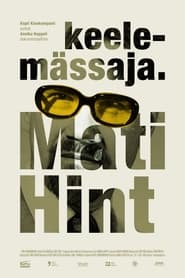
Language Rebel. Mati Hint (Keelemässaja. Mati Hint)
د English ژباړه ډاونلوډ کړئ
د خپرونې معلومات
تګونه
د English سرليکونو مخکتنه
لومړۍ 200 کرښې.
Great personalities are born and leave exactly at the right time.
I Mati Hint's case, he departed
on the very day the Year of Estonian Language concluded.
How symbolically he managed to leave.
The Year of Estonian Language ended, as well as a man's life.
We haven't given enough merit to our great people.
In history, in their time, and later.
What characterizes Mati,
is that would be understatement to say he had no pink glasses,
he had definitely black ones.
And that was an inseparable feature of his character.
So for him, a glass was not only half empty,
it was almost completely empty.
And even if there was something in the glass, it would become empty very soon.
It is inevitable, the glass will be empty, no way to avoid it.
His phrase was: "Lose any hope."
LANGUAGE REBEL MATI HINT
When a change of paradigm takes place in science,
but the theory of phonology is a change of paradigm,
you can't go on with old terminology, you have to set it aside.
It's like with the flat Earth theory. I have explained that.
If you go for a theory of spherical Earth,
you can no more describe the dome of sky coming so close to the Earth
that at the edge of the world, people can only crawl or be tiny as bottles.
You can not imagine yourself sitting on the edge of the world with your beloved
and kick your heels over the edge.
If you embrace the spherical Earth theory,
then you must give up the notion
of the edge of the world and the dome of sky.
But it doesn't happen in Estonian language studies.
They seem to say they understand that the paradigm has changed,
but in fact, they do not.
I was a member of a workgroup
raising the new generation of Estonian linguistics.
It was the group of Generative Grammar in Tartu University in 60's and 70's.
Mati had already graduated by then, a post graduate researcher,
and he was one of the great and wise I met there.
He was a very independent thinker
and engaged in a field nobody knew much,
so we listened very carefully.
He was already kind of stubborn and prone to big speeches,
sometimes exaggerating, too, so we used to say,
Don't believe what Hint says, Hint has crazy ideas.
That's how it was indeed.
In the end of the 70's and the beginning of the 80's.
It really was.
Some one came up with the idea
that in Estonian language, all the vowels and consonants
have four phonological durations.
And vowels have tones, too.
Like in Chinese.
And it was a completely crazy time.
Estonian Papers in Phonetics.
The whole yearbook dedicated to this kind of theories.
"Uncompromising" is the word that applies to Mati Hint.
Because if he was convinced in something,
then he was convinced dead seriously.
And one of these things was our system of durations,
so when in the 70's, there an attempt to introduce 4th duration,
and it was even discussed
whether, if something grows to become a tree (kasvab puuks ),
is any different from simple flatulence .
It goes like this.
Let's say that we have long cores of syllables.
" Kooli " and " kooli ".
Just like the two different o-s are phonemes.
Similarly, two different diphthong durations are also phonemes.
It is, in fact, very simple.
Jakob Hurt has it in a completely contemporary form and examples.
What Mati Hint has promoted for decades, is a syllable duration.
Meaning that when we are talking about long or extra long syllables,
then the syllable carries the duration,
so we can also talk about light or strong stress,
but the stress is carried by syllable.
Yet it was clear for Elmar Muuk as early as in 1938, how it should be done.
But spitefully, we don't do as Elmar Muuk did.
We know better than Elmar Muuk. But we are not! At all!
It adds up to nothing. In the end, it's like...
The Language Act of the year, the big Dictionary of Standard Estonian,
marks the durations of syllables using its own system.
And in the end, recommends to use it all as per Tiiu Erelt's standardization
that has nothing to do with this matter.
Absolutely nothing! It's beside the point.
As if...
As if, growing potatoes, you would study.
Moon rays' impact to the growth of telephone poles.
They have no connection!
Mati's theory was certainly new at the time and developed phonology
and it helped a lot,
but it was not a theory that would overturn all others,
rather a part of the process.
I'd like it if in humanities, it would be as in building bridges.
The engineer who has designed a bridge
has to stand under the bridge during the first stress test.
He knows that he has to do it.
He doesn't steal materials from the bridge
so that it would crumble upon him.
I'd like it if it would be the same way in humanities.
You have to pass certain checks against some criteria.
Is it possible? It's all there.
But it's so much more convenient to sit in a comfort zone
and apply for grants with your friends.
In 1976, Mati Hint published a programmatic article,
"Language as a Giant System".
There he summarizes his achievements
in his research process of a very young person.
He describes language as a giant and complicated system.
How it is a great achievement of mankind to create such a system.
He has developed the idea of a giant system in his later works, too.
Thanks to Uno Rätsep, Ülo Kaasik and Ivar Kull,
an idea appeared,
as it was fashionable in the Western world,
to merge mathematics and linguistics.
I went with this wave.
As I quickly learnt German,
I read a book that profoundly changed my world view,
Saussure in German translation
that should have been destroyed.
For according to Soviet ideology,
linguistic structuralism was a bourgeois pseudo science.
But the German translation of Saussure
turned out to be in the famous Seminarka library.
I made a perfectly good summary of it.
I could use it today.
And this changed my world view profoundly.
So he showed how language is in constant change
and it also means that language is naturally redundant
and standardised written language also has variants.
That was not acceptable for many
as they found that if you learn the rules of the written language,
and know all the exceptions by heart, than that's it.
Some even thought that not everyone is capable
of knowing and speak correct Estonian language,
because Estonians can't speak Estonian anyway.
Most of my papers are about Estonian sounds system,
prosody and morphophonology.
When talking to Finnish professors,
we understand each other instantly.
But not in Estonia.
Just as if I were a deviant.
If that's my truth, if that is how I understand things,
I can't lie just to please some people.
The grammar of Estonian language by Ahrens,
is the foundation of our becoming a cultural nation,
of our becoming Estonians and a literate nation.
Rauna homestead Saaremaa.
As they say, he was rigorous but fair.
And he didn't have an easy character.
After all, he was very...
He was abrupt.
As his students said, he didn't hold anything for himself,
always said what he thought and saw right.
It was the same at home.
But he was indeed fair.
When he was wrong, he made it right.
Estonian language is our only life insurance.
I think Mati Hint has been compared to a canary in a mine.
Things may not be very wrong,
but when Mati Hint wrote or spoke about something,
then he could represent it
with a certain amount of drama
that meant that it's not fun and games
but has to be addressed very seriously.
He became a very important, significant person during the Perestroika.
Because he was a philologist known to the general public,
he was outspoken, straightforward, sharp.
When Vikerkaar magazine appeared during the Perestroika,
they published Mati Hint's article 'Bilingualism Without Pink Glasses'
And I remember that we waited for the next issue to read a new part of it.
It was read in all the Soviet republics
and I think that for many people
it became a spark or launching power
of the national movement against Soviet language policy.
It was a powerful article.
Vikerkaar had appeared for six months
and I met Mati Hint at the office of the magazine
on Toompuiestee street.
An issue bothered him, namely of bilingualism,
rooting, of course, from the russification campaign of 1970's.
One of the manifestations against it was the Letter of 40,
with Mati Hint among the signatories.
Then we really stood shoulder to shoulder
and the phosphorite movement was about to begin, then IME,
then the Popular Front.
And for Mati Hint, the Popular Front became
one of the manifestations of his political life.
At the Song Festival Grounds in 11. September of 1988,
Mati hint delivered one of the most powerful speeches.
Alongside Heinz Valk.
And the proudest moment for Mati Hint was in 1989,
when he wrote his famous manifesto 'The Baltic Way'
that he also delivered at the Town Hall Square.
The history of the Baltic states is one of co-operation of East an West,
but also one of the fight for power.
For many years, this fight has forced the Baltic states under foreign powers
that had always denied the right of the indigenous nations
to shape their own history.
But even under the foreign rule, the Baltic nations,
Estonians, Latvians, Lithuanians, have maintained their national identity.
The Baltic way is the European way,
تبصرې
No comments yet. Be the first to leave one.