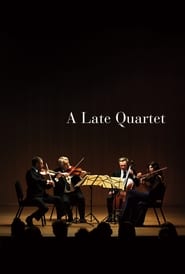
A Late Quartet
د English ژباړه ډاونلوډ کړئ
د خپرونې معلومات
تګونه
د English سرليکونو مخکتنه
لومړۍ 185 کرښې.
"Time present and time past
Are both perhaps present in time future,
And time future contained in time past.
If all time is eternally present
All time is unredeemable.
Or say that the end precedes the beginning,
And the end and the beginning were always there
Before the beginning and after the end.
And all is always now."
That's T.S. Eliot, his take on Beethoven's late quartets.
Today, we think about what Eliot might have meant.
We begin with Beethoven's Opus 131, said to be his personal favorite.
It has seven movements, at a time when the standard was four.
And they're all connected. You're not allowed to stop between movements.
No resting, no tuning.
Beethoven insisted it be played attacca, without pause.
Was he maybe trying to point out some cohesion, some unity between...
Excuse me.
...the random acts of life?
Or being deaf, alone, and sensing the end,
he might have felt he had no time, to pause, to take a breath.
For us, it means that playing for so long without pause,
our instruments must in time go out of tune,
each in its own quite different way.
It's a mess.
What are we supposed to do, stop?
Or, struggle, to continuously adjust to each other up to the end,
even if we are out of tune?
I don't know.
Let's find out.
That was quick.
- (Chuckles) - (Clicks mouse)
All right, hold on a sec.
Hong Kong on the second and fourth.
Shanghai on the 13th.
Let me double-check with everybody first.
Toast, if I may.
I've missed you this pre-season break.
The past year has been difficult, as you know.
Miriam would have been here with us today, celebrating...
Peter, she's always here.
It's a year in three weeks.
But the music, the quartet, us together have gotten me through it,
and I need to thank you and tip a glass to our... Can it be 25 seasons together?
- To the Fugue. - To the Fugue.
The Fugue.
Alexandra tells me your class really rocks.
Really? When did you speak with her?
This afternoon.
She's very good. Advanced, quick.
- You should be pleased. - That's my girl.
She really hardly ever plays for us anymore.
Let's hope she does now that she's back from Curtis.
But to be first violin...
...she needs particular, careful coaching.
In fact, Daniel, I wonder if you'd give her a listen.
Tell her what you think, encourage.
I'll give her a listen. If you want to.
Sure, that'd be great.
- Shall we? - All right, yes.
Ready?
You know, maybe this is the season we play the Beethoven cycle... by heart.
- I've always liked that idea. - I still think it's a gimmick.
I think playing the cycle without these endless markings
would be exciting and a worthwhile risk.
A risk?
A risk.
We're in the casino business now, Robert?
These, these markings represent layers of thought.
I tend to agree with Daniel.
Tie goes to the conservatives, I guess.
Our vibrato doesn't match.
I must be on vacation time still.
- From the top, once more please. - OK.
- Let's do it from, from Juliette. - Sure.
- I'm sorry, my mind's wandering. - It's the cello.
Sorry, guys. I'm not myself. Maybe a day or two, get my hands back.
- That's all right. - Sure.
Let's reschedule?
- Reschedule. Next Tuesday.
You all right, Peter?
Sure. It's just... strange.
Put your hands out like this.
OK. Now close the right fist, and open it.
Left fist. Open it.
Now do it fast.
Open, shut. Open, shut.
All right.
OK. Now, just stand.
Now walk to the end of the room,
to the door, and then walk back, naturally, towards me.
OK.
OK. I think we should get a blood sample,
and arrange for a MRI.
Why don't we meet in a week when we should have all the results?
MRI? Is there something I should know.
I think we should run the test first.
You could tell me what you think, even if you're not certain.
It's OK. We've known each other a long time.
Well?
Well, based on the examination that we just ran,
and the complaints you've described to me,
it's my opinion that you are experiencing
the early symptoms of Parkinson's.
Well, you know...
From this, from what we just did, you can tell that?
- Yes. I'm afraid I can. - Parkinson's?
But we should still run the blood test and have the MRI,
just to rule out any more adverse possibilities.
Wow.
The aroma...
Wake up.
I'll make it worth your while.
What about if I talked in a really bad French accent?
Oui oui?
- Please, I'm not... - Lover?
Robert. Robert, please. I'm really... I'm not...
I'm really not in the mood.
OK. It's an adagio, right?
Slower, please.
The bow goes into the string and out.
You have to feel the resistance, then the release afterwards.
That's what I'm trying to do.
- Without intention. - What do you mean without intention?
This fugue is a tremendous... it's an emotional upheaval,
and I don't hear it.
The color must be dark, always. Again.
Vibrato. From the first note.
Mm-hm.
It's a prayer, Alexandra.
Can you let me play one bar?
I don't think you're ready for this piece.
In class, everybody was very happy with my performance.
That's fantastic.
Peter was too.
Why does he open with a slow fugue? Beethoven, that is.
I don't know.
If you insist on tackling the 131 prematurely,
at least read his biography first. Right?
Try to get into his mind.
Did you know his father used to wake him up in the middle of the night
to play for his drunken cronies?
Imagine the mark that leaves on you. May I?
I...
Pilar.
Hello, Robert.
- Long time no see. - Yeah.
What've you been up to?
Practicing for my new show, remember? We start Thursday.
You've got to come this time. I'll put your name on the guest list.
OK.
I loved the Bartok quartet you recommended.
The Fifth? Explosive.
Hold on, hold on a second.
- You liked it? - Yeah.
I could choreograph a piece to it.
The next step is the... Shostakovich cycle.
- You up for it? - Yeah.
It's all on here.
Listen to it while you run.
What are you playing on this one?
Second violin. Always, that's my part.
Always?
Yeah. Well, without me they'd be a lonely, frustrated trio.
Seriously, the second and first violin aren't hierarchical,
they're just different roles.
Different how?
Well, sometimes I get the melody, sometimes the bass line.
Uh...
I connect the first violin, which tends to be the soloist's part,
with the viola and cello,
which just flow... right underneath the surface.
Simply put, I pull it all together. That's my job.
Sounds important, but still...
Don't you have the urge to play the solo part once in a while?
Yeah. Of course.
So? Why don't you do something about it?
Hm?
Well, I was gonna do something about it, but then, last year, uh...
it just wasn't the right time, so...
I know that feeling.
My mother says, "It's never the right time,
and therefore it's always the right time," Robert.
- Your mother. Yeah. - God bless her.
Let's go, come on.
A Late Quartet subtitles in other languages
More English subtitles for A Late Quartet
- A Late Quartet 2012 LIMITED DVDRip XviD PSYCHD · 51 downloads · 2013-07-12
- A Late Quartet · 63 downloads · 2013-06-21
- A Late Quartet · 57 downloads · 2013-06-21
- A Late Quartet 2012 LIMITED 720p BluRay x264-GECKOS · 49 downloads · 2013-01-26
- A Late Quartet 2012 720p BluRay x264-GECKOS SHQ Ganool com · 65 downloads · 2013-01-26
- A Late Quartet 2012 LIMITED DVDRip XviD-PSYCHD · 57 downloads · 2013-01-24
- A Late Quartet 2012 LIMITED DVDRip XviD-PSYCHD · 52 downloads · 2013-01-24
تبصرې
No comments yet. Be the first to leave one.