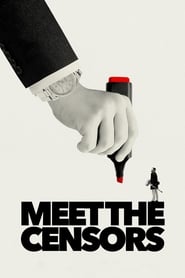
Meet the Censors
د English ژباړه ډاونلوډ کړئ
د خپرونې معلومات
تګونه
د English سرليکونو مخکتنه
لومړۍ 200 کرښې.
Hi. May I pet the horse? It's alright?
Sure, go ahead.
They're the best thing about this rally.
How much does one of these weigh?
How much...800 kilograms or so?
That much.
The ones over there are pretty heavy too.
- The other...horses? - Well, yeah.
- I didn't get that policewoman tried to be funny,
comparing the horse to the pumped-up Nazis,
shouting behind me.
Throw out the scum!
If you had any guts, you'd tell your employer to fuck off!
"Our green banner flies..."
Fucking hell...
Traitors of the blood!
- I just dialled down the madness.
It seems stupid to ship in half the country's police
to look after Nazis,
so they can freely express their shit,
without interruptions.
Everyone's got to have freedom of speech in a democracy.
But have you never felt
that this might need some adjustment?
Is it time to call in the state
and simply censor the most polarising,
deranged expressions?
- To be white is to be a striver,
a crusader, and explorer and a conqueror.
We don't exploit other groups.
They need us and not the other way around.
- He said, "I send the messenger Muhammad,
"with the guidance and the deed of truth
"for it to be dominant upon the whole of the world."
No matter how much they hate it,
our objective, the objective of...
is to dominate the whole world by the Sharia.
- When the preaching of God's word is taking place,
first of all, it's not for a woman
to be doing the preaching.
And second of all, it's not for women to be speaking.
Even the Bible is really clear on this,
even if they were to have a question,
they are not to ask that question in the church.
- What if censorship has become necessary?
Just to keep our societies decent.
What if there's a form of state censorship
that could actually work?
That could be good?
So basically, we're gonna travel
to all those different countries
and figure out the rationale behind why they're censor.
And what do you think about it?
Well, I wish you luck.
Figuring out rationales is not an easy task.
I would say it's anthropological, basically,
or ethnographic.
The point is to understand censorship, not to condemn it.
Yeah.
- People tend to take a simplified idea of censorship
as a struggle of good against evil,
of liberty against oppression.
It's a sort of Manichaean view that gets it wrong.
I mean, having studied censorship
under various authoritarian regimes,
I must say, I am convinced that censorship
can be positive, it's complicated,
so I would recommend,
as you go around interviewing people responsible
for filtering communication
that you try to...
Not exactly identify with them,
but to listen to them, to understand them.
Hm.
- And by doing this, I think it might be possible
to get a deeper comprehension
of what censorship actually is.
- Can we film outside up from the window
when we're driving, or not? - No, no.
These guys you see, I think they are from national security.
Testing.
Okay, the sound is okay.
If you try to say a couple of words?
- Well, only to welcome you to this compound,
the Citizen compound. - Yeah.
- I have thought for myself,
that the government of South Sudan censor,
because the country perhaps needs censorship,
to calm things down.
Hard to argue that the country don't need to calm tensions.
How is journalism being done?
Are everyone really careful, or?
- You are told there are certain areas
which you cannot touch.
You cannot talk about the corruption of the system,
you cannot talk about freedom of expression
freedom of assemble.
You cannot talk about,
a relation between the rebels and the government.
We were closed down because they they told us
that we are pre-empting the peace talk.
The national security they are protecting the government
from being criticised over the issue of peace,
because they don't want anybody to talk against,
to talk in favour of peace.
Because the government programme is war.
Mr. Minister, hello?
How are you?
- I'm fine, fine. - I'm Havard.
I have been talking to some journalists.
And there seems to be some fear
that if you film outside, we might be stopped.
If you film outside?
- You might be meeting some soldiers
that will tell you, you should turn off the camera,
you should not do this sort of things.
How do you think the relationship
between that sort of army activity and the journalists is?
Well, really, that's right.
You know, there are military installations,
that in any country, photographing is prohibited.
If you go to Juba here,
you will find there's no soldiers that is moving
with gun on the streets.
But people have made it known outside,
as if there's insecurity in South Sudan,
and it is the UN that is keeping security?
Is not the UN.
It is a government of South Sudan
that is keeping law and order in the country.
- Your chief says that we should finish now so.
- Yeah. - Yeah.
Do I need to move?
No it's okay.
But what would happen if the national security found us now?
Well,
well, if you got away with it you may be lucky.
Yeah.
You might be lucky.
'Cause they may not like it.
Although you have the papers,
but they may not be happy.
Most of the little
we were allowed to film in South Sudan,
looked like a fucking stereotype circus.
I guess I fear being seen as the arrogant white man,
showing his prejudice view on Africans.
So I deleted the scenes that could put me in a bad light.
I just can't find believable arguments
for why they censor and jail journalists here.
I guess for a government leading
the third most corrupt country in the world,
whose army have used child soldiers and raped girls,
censorship must seem like a tempting way to kill criticism.
So in the morning would you perhaps
go through the newspapers and see what's being written?
- Yes, we have a whole directorates,
and this is called Directorate of Information.
That direction is headed by the Director General.
So generally when I come in here.
First,
I see what we did yesterday,
and what we did not do yesterday,
and then look at the schedule of today.
I can take it later.
- Okay, but we can't talk when it's ringing.
That's okay.
It will give us peace of mind.
Okay.
We told all the media houses,
that we don't censor the media.
We don't censor them.
But just do your work responsibly.
Respect the Constitution, respect the laws,
respect yourself and respect your profession,
by following the professional ethics of journalism.
So whenever there's a mistake,
as you said, or you mentioned.
Whenever there's a mistake in the newspaper,
we call the chief editor of the newspaper,
we sit down with them,
we tell them what we think is wrong
and what is supposed to be done.
- How does it work in practical terms?
What are the steps?
If for example,
they want to say that peace has come to South Sudan?
Yes.
Excuse, can you bring that?
I think the minister is calling me.
Ah.
Yeah.
They try to call on the phone.
- Oh no, and we disconnected it!
Yes.
Yes.
It's already transferred, I just got the message.
- Okay, now. - Mm.
- Let's try to wind it-- - Mm.
- Because they're going to turn off the generator.
تبصرې
No comments yet. Be the first to leave one.