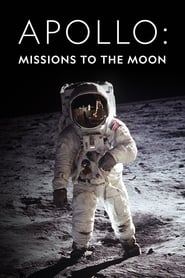
Apollo: Missions to the Moon
د English ژباړه ډاونلوډ کړئ
د خپرونې معلومات
تګونه
د English سرليکونو مخکتنه
لومړۍ 200 کرښې.
Apollo Missions to the Moon
CRONKITE (off screen): It's 3 hours and 32 minutes until man begins the greatest
adventure in his history.
MISSION CONTROL (over radio): Five minutes, Gino, and you're go down here,
you're looking great.
Comm Manager and Attitude.
MAN (over radio): Comm Manager...
CRONKITE (off screen): Man is about to launch himself on a trip to the Moon with the
expectation of landing there.
240,000 miles away from the control station in Houston...
KENNEDY (off screen): A giant rocket more than 300 feet tall,
reentering the atmosphere at speeds of over 25,000 miles per hour.
HYDE (off screen): You well may be the first man on the Moon.
How do you personally feel about it?
LOVELL (off screen): Well I have the same desire as all the astronauts.
We'd all like to make that trip.
MAN (over radio): Verified, go for launch.
PA OFFICER (over radio): All still, "go" at this time.
MAN (over radio): Four, three, two, one.
Roger T minus zero.
MISSION CONTROL (over radio): Liftoff. Liftoff.
Roger liftoff.
REPORTER (over radio): And we have liftoff!
She's lifting up, we have, "Tower Clear."
PA OFFICER (over radio): Tower clear!
REPORTER (over radio): We have tower clear.
We're beginning to feel the first thunderous roar!
BERGMAN (off screen): You claim that morale hasn't sagged here with the cutbacks
in the space program.
Are you concerned that some step in check out may be missed that might
cause a mechanical failure?
MISSION CONTROL (over radio): Seventy.
ALDRIN (over radio): Thirty feet, two and a half down.
ALDRIN (over radio): 20 feet, down a half.
Moving forward just a little bit, all right.
Right.
KRANZ (over radio): Okay, T1 stay, no stay, Retro?
MAN (over radio): Stay.
KRANZ (over radio): Fido? MAN (over radio): Stay.
KRANZ (over radio): Guidance? GUIDANCE (over radio): Stay.
KRANZ (over radio): Control? CONTROL (over radio): Stay.
CAPCOM (over radio): No PDI plus 12.
LOVELL (over radio): Ah, Houston we've had a problem.
MAN (over radio): We've got more than a problem.
LUNNEY (over radio): Okay, listen, listen you guys.
MISSION CONTROL (over radio): We lost O2 tank 2 pressure. GNC, Flight.
LUNNEY (over radio): What do you want on the heater circuit breaker?
AARON (over radio): We ought to get off entry battery and do it with a
flashlight through the LM.
PA OFFICER (over radio): Less than seven minutes now from time of entry into
the Earth's atmosphere.
REPORTER (over radio): There it is, it's coming out of the cloud level now.
1,000 feet to go!
LOVELL (over radio): Welcome from the Moon, Houston.
At Disneyland Park,
the ground devoted to things of the future is called, "Tomorrowland."
DISNEY (off screen): One of the popular attractions here is our simulated rocket trip
around the Moon.
After entering the Disneyland Spaceport, visitors may experience the thrills that
space travelers of the future will encounter when rocket trips to the Moon
become a daily routine.
When we hear the exciting news of how the rocket scientists of today are
preparing for tomorrow's trip to the Moon, we must remember that such a trip
has long been the dream of many men since history began.
KIMBALL (off screen): Roll the moon sequence, please.
BRAUN (off screen): Since ancient times, since the beginning of man's
ability to think,
he has gazed at the heavens and dreamed that
someday he would travel through space,
to explore the Moon and planets,
which have eternally captivated his imagination.
DISNEY (off screen): However, scientists tell us it will be many years before space
travel becomes a reality.
REPORTER (off screen): President Eisenhower and other spokesmen of the
administration have been attempting to relieve the
fears and anxieties caused by Russia's spectacular
breakthrough in the Earth satellite and intercontinental ballistic missile field.
REPORTER 2 (off screen): The rise of Sputnik-1 and the traumatic reaction
of the world's peoples.
Thrust before all Americans, problems wholly new.
REPORTER 3 (off screen): The space age has become the new frontier in the Cold War.
We have one of the most challenging assignments that has ever
been given to modern man.
Expansion of human knowledge about space,
development and operation of vehicles capable of
carrying instruments and man through space, preservation of the role of
the United States as a leader in aeronautical and space science and technology.
REPORTER (off screen): It was expected for months the first man in space
would be a Russian.
But still, the news was not welcome in Washington.
REPORTER 2 (off screen): The United States man in space program is at least
eight months behind that of the Soviet Union.
Now it is time to take longer strides.
Time for a great new American enterprise.
Time for this nation to take a clearly leading role in space achievement,
which in many ways, may hold the key to our future on Earth.
I believe that this nation should commit itself to achieving the goal
before this decade is out
of landing a man on the Moon and returning him safely to the Earth.
REPORTER (over TV): America's team of astronauts was increased
to 16 today with the addition of nine new members.
It was specified that they will be trained for trips to the Moon.
REPORTER (over TV): As more and more scientific instruments marked,
"Made in America"
begin to show up in the space around the Earth,
a wave of business-like optimism is being felt among
American space officials.
In both the House and Senate Space Committees, the committee men have been
pleading with an official of the space administration to tell them that he needs more
money, and he's been saying "No, he doesn't.
His space work has been going fine on its current budget."
That official is Wernher Von Braun,
head of the famous Army rocket team which is now in the process of being
transferred to the National Aeronautics and Space Administration,
known from its initials as NASA.
I'm often asked just what reason there is for man's going into space.
It seems the notion is popular in this age of electronic and
mechanical miracles that man is rapidly becoming obsolete.
Men in space, some people say is a liability and a nuisance.
Equipment can be designed to react to many known and fewer anticipated
situations or events.
But men can observe and correlate facts and respond to the unexpected.
MAN (off screen): This spacecraft built by American Industry for the
National Aeronautics and Space Administration
will be launched into space from Cape Kennedy in a few days.
It will carry no astronauts,
yet this mission is one of the most important space flights
to date for this is Apollo,
the first of a family of spacecraft designed to
transport Americans to the Moon before 1970.
Many of its complex systems will fly in space for the first time
aboard this spacecraft.
After the launch vehicle has placed us at the proper velocity,
the Command Module and the Service Module separate from the launch vehicle.
They've been pitched down at an attitude roughly like this.
This engine, which we will ultimately use to return the astronauts from Earth's orbit
to the Earth's surface and also in later missions to put the astronauts into lunar
orbit and bring them back home from lunar orbit,
will then have its first flight test.
MAN (off screen): From the Mission Control Center in Houston,
Glynn Lunney will direct the flight.
We are conducting the first Apollo spacecraft test,
Apollo-Saturn 201, from this control center
in the Mission Control Center in Houston, Texas.
From now on, the Apollo flights after liftoff will be directed from
this Control Center.
We've been exercising the Control Center for the last couple of months,
and we are ready to start flying.
REPORTER (over radio): Astronauts preparing for America's first lunar mission
follow a complex training program.
Designed to provide them with knowledge about the conditions they will face
during their mission to the Moon.
BURKE (over TV): There's one way on Earth that you can
reproduce the weightlessness experienced in space,
and that's in this plane.
I don't know if I'm talking clearly,
but pretty soon we'll go up over the top and when we
do I'm supposed to float, and, and,
I'm going. I'm going.
It's fantastic.
It's unbelievable!
It's the most extraordinary feeling.
I can't, I can't really control myself.
All the dust is flying with me.
I'm up, I can't control myself at all.
CRONKITE (over TV): Two years, really,
of day and night work and months away from home.
It's a big job these men have.
There's nothing simple about it.
REPORTER (over TV): The question everybody wants to ask,
what do the wives and children of
these men think of their ambitions to go into space?
My wife's attitude towards this has been the same as it has been all along
through all my flying that if it's what I want to do and she's behind it
and the kids are too, 100%.
Well, my wife feels the same way or of course I couldn't be here.
She's with me all the way, and the boys are too little to realize what's going on yet,
but I'm sure they feel the same way.
REPORTER (off screen): Mrs. Grissom, do you hope that he is the fellow who makes it?
Well, I don't know.
How would you feel if your wife,
I still want one of you guys to answer that for me.
REPORTER (off screen): Answer what?
Just how would you feel it was vice versa,
if it was your wife going to outer space.
Now, just how would you feel about it?
MAN (off screen): The Moon is a necessary first step for exploration of the planets.
To fly men there and return them safely in this decade is the goal
of NASA's project Apollo.
The early missions of Mercury and the experience from Gemini have brought
this country to
the next major milestone, the first Apollo three-man space flight.
These are the men to fly that mission.
Command pilot Virgil Grissom.
Mercury, Gemini, and now Apollo.
His third time into space.
One of the original seven astronauts.
The senior pilot, Edward White.
He will be remembered for his spacewalk during Gemini four.
White has been specializing in the computers and training for the upcoming mission.
Apollo: Missions to the Moon subtitles in other languages
More English subtitles for Apollo: Missions to the Moon
- Apollo Missions To The Moon 2019 WEB-DL DSNP · 23 downloads · 2021-04-21
- Apollos New Moon 2019 1080p WEBRip x264-RARBG English · 24 downloads · 2020-03-14
تبصرې
No comments yet. Be the first to leave one.