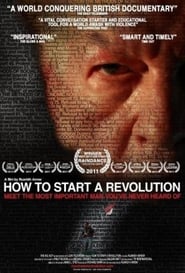
How to Start a Revolution
د English ژباړه ډاونلوډ کړئ
د خپرونې معلومات
تګونه
د English سرليکونو مخکتنه
لومړۍ 200 کرښې.
In 2011, the Arab Spring Revolutions swept across the Middle East;
From Tunisia to Egypt, Bahrain, and Syria.
For more than 50 years, a quiet American scholar
has been helping people bring down their dictators.
His tactics of nonviolent resistance have been used
in revolutions from Serbia to Ukraine and Iran.
To be counted as a threat to a tyrant is a matter of pride, I would say.
It means we're effective. It means we're relevant.
This is the story of the power of people to change their world,
the modern revolution, and the man behind it all.
Gene Sharp's tactics and theories are being
practiced on the streets of Syria as we speak now.
My name is Gene Sharp, and this is the work I do.
How To Start A Revolution
Boston, Massachusetts.
- What do you do? How would you describe your work?
- Oh, that's always a problem, describing my work.
Primarily, I try to understand
the nature and potential of nonviolent forms of struggle
to undermine dictatorships.
This is a technique of combat.
It is a substitute for war, and other violence.
His handbook to revolution –From Dictatorship to Democracy–
has been smuggled across borders and
downloaded hundreds of thousands of times.
We don't know quite how it's read,
but it certainly did into 30 some languages
in different parts of the world,
on all continents except Antarctica.
The hallmarks of Gene Sharp's work can be
seen in revolutions all over the world.
Colors and symbols
signs in English
civil disobedience
and commitment to nonviolent action.
Gene's books contain a list of 198 nonviolent methods of resistance.
Oh, the famous 198 methods.
There seems to have been an extraordinary response.
That's simply the 198 specific methods.
These specific forms of abstract are economic boycott,
are civil disobedience, are protests.
Exactly the counterpart of military,
different kinds of military guns or bombs,
any military struggle.
Unless they have something instead of violence and war,
they will go back with violence and war every time.
In 1983, Gene Sharp founded the Albert Einstein Institution
to spread the knowledge of nonviolent struggle.
For years, people living under dictatorships
have been coming here to East Boston for help.
Jamila Raqib has worked for Gene for more than 10 years.
I began learning about the work at a very basic level.
I did most of my reading and learning as
soon as I started working at the institution
and I was hooked.
I didn't start out to do this.
I had a religious background that
led me to want to leave the world in a bit
of a better place and better condition
than when I came here,
and how to do that was always a problem.
Korean war, 1950-1953.
In 1953, Gene was sent to jail for refusing
conscription to fight in the Korean War.
I had a two-year sentence. I did nine months and ten days.
In those days you counted the days as well as the month,
but I don't think that my action there did any good whatsoever.
It was just to keep my sense of my own integrity
so I would carry on in the work that I thought was really important.
I never met Einstein,
but I wrote to him. I don't know how I got his address.
I said: “Well, I'm about to do such and such and go to prison,
but by the way I've written this book on Gandhi
three quite different cases from each other
about Gandhi's using nonviolent struggle for a greater freedom
through just nonviolent means.”
And he wrote back that he was very much hoped, but couldn't know
that he would have made the same decision I did
and he would be willing to look at the manuscript
which I had sent to him, and he did so and
wrote a very kind introduction to the book.
Oxford University.
While studying at Oxford, Gene had his Eureka moment
a new analysis of the power of people to bring down a tyrant.
If you can identify the sources of a government's power,
such as legitimacy,
such as popular support,
such as the institutional support,
and then you know on what that dictatorship depends for its existence.
And since all those sources of power are dependent upon the good will
co-operation, obedience, and help of people and institutions,
then your job becomes fairly simple.
All you have to do is shrink that support,
and that legitimacy, that co-operation, that obedience,
and the regime will be weakened,
and if you can take those sources far away, the regime will fall.
And how did you feel at that point?
At the point, that Eureka point?
Yeah.
Oh, greatly relieved.
- Greatly relieved, because that's what made it all reality.
Harvard University.
While teaching his theories at Harvard, Gene was
about to meet an unlikely champion of his work
Vietnam War hero, Colonel Bob Helvey.
I first met Gene Sharp at Harvard University.
I was an Army Senior Fellow up there for a year,
and one day I saw a notice on the bulletin board
about a program for nonviolent sanctions at two o'clock this afternoon.
So I had nothing to do, so I went to see who these peace necks were
and to confirm my preconceived notion
that they probably had rings in their noses and ears
and dirty.
And so I went up there just to see them
and surprisingly they weren't there.
I saw regular looking people there.
And a few minutes after we all sat down
this little short, soft-spoken gentleman comes to the front of the room and says:
"My name is Gene Sharp
and we're here today to discuss how to seize political power
and deny it to others.”
I say nonviolent struggle is armed struggle,
and we have to take back that term from those advocates of violence
who try to justify with pretty words
that kind of combat.
Only with this type of struggle, one fights with psychological weapons,
social weapons, economic weapons,
and political weapons,
and this is ultimately more powerful against oppression,
injustice, and tyranny than is violence.
That got my attention.
This is the flag of the 5th Battalion, 7th United States Cavalry.
The 7th Cav, as you know, was the Regiment of General Armstrong Custer,
who fought and died at the battle of Little Big Horn.
That's me in my younger days.
A full head of hair.
This is the award for the Distinguished Service Cross, that I got in Vietnam.
Vietnam, 1968.
In 1968, Bob was deployed in Vietnam.
He was decorated for bravery during a Vietcong ambush.
But his experiences there would change his
views on the way conflicts should be waged.
I think Vietnam influenced my view about the importance of nonviolent struggle,
and particularly the importance of getting Gene
Sharp's ideas out to the rest of the world,
because we must have an alternative.
Vietnam convinced me that we need to have an alternative to killing people.
Burma, 1992.
As a US defense official in Burma,
Bob had seen the military dictatorship
there, persecute the minority Karen people.
After leaving the army,
Bob traveled back to the rebel camps to teach the
Karen Gene's lessons in nonviolent resistance.
I was talking to one of the Karen Commandos
and he says: “Where in the hell has this information been?
We've been fighting and killing people for 20 years.
How come we didn't know this?”.
Some of the Burmese came up to him and asked
if he would write something for the Burmese on
how to move from a dictatorship to a democracy.
That's the origin of why the book was written:
The Burmese.
I couldn't write about Burma honestly, because I didn't know Burma well,
and he said not to write about something you don't know anything about,
so I had to write generically.
If there was a movement that wanted to bring a dictatorship to an end,
how could they do it?
And so I wrote those theories,
and they were serialized there,
and published in English and in Burmese,
and I thought that was it.
In 1989, Gene traveled to China at the height
of the demonstrations in Tiananmen Square.
Tiananmen Square, 1989.
It would shape his views about the importance of planning and strategy.
Lesson 1: Plan a Strategy.
I'd gone to Beijing
after the Tiananmen Square protests were well underway.
That whole event, which it should be remembered, was not just in Beijing
but reportedly in 350 other cities of China,
similar protests were going on.
But they were not planned. They were not prepared.
There was no strategic decision.
There was no advanced decision how long you
stay in the square and when you leave.
The students had no plan.
They were improvising all the way through,
and later on we know that many of those
Chinese people who were out on the streets,
in another day, were shot and killed.
The attitude that you simply improvise
and improvisation will bring you greater success is nonsense.
Exactly the opposite.
That if you don't know what you're doing,
you're likely to get into big trouble.
Serbia, 2000.
The government of Slobodan Milosevic, in Serbia,
presided over years of crimes against humanity and brutal internal repression.
The regime fueled the creation of new democracy
How to Start a Revolution subtitles in other languages
More English subtitles for How to Start a Revolution
- How To Start A Revolution 2011 en · 27 downloads · 2012-08-11
تبصرې
No comments yet. Be the first to leave one.