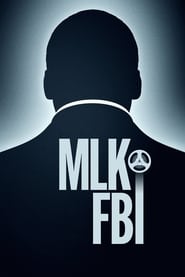
MLK/FBI
د English ژباړه ډاونلوډ کړئ
د خپرونې معلومات
تګونه
د English سرليکونو مخکتنه
لومړۍ 193 کرښې.
MLK.FBI.2020.1080p.BluRay.x265-RARBG English SRT Subtitles - UF (v1.07)
At this time I have the honour to present to you,
the moral leader of our nation.
From 1955 to 1968,
Martin Luther King led a peaceful 20th century American revolution.
In the short span of 13 years,
the non violent Civil Rights Movement
which he headed changed the face of American society.
You know, when you construct a man
as a great man, there's nothing almost more satisfying
than also seeing him represented as the opposite.
When the National Archives,
puts government documents
up on the web in public,
one has to confront them.
One cannot pretend they don't exist.
I think one of the difficulties
for historians in dealing with really the fruits
of all of this surveillance of King is whether or not
we then become complicit in what the FBI was doing.
You know this about humans, what we're best at is convincing ourselves
of our own righteousness.
And I think this entire episode represents the darkest part
of the bureau's history.
Tapes from the hotel rooms,
uh. the FBI reports of what was going on.
those are pieces of information that we shouldn't have.
Whatever comes out will certainly help us
understand him as a person and that's kind of our,
our duty is to understand.
Hello.
In the traditional motion picture story,
the villains are usually defeated,
the ending is a happy one.
I can make no such promise for the picture
you're about to watch.
The story isn't over.
They came from Los Angeles and San Francisco,
or about the distance from Moscow to Bombay.
We're almost there.
They came from Cleveland, from Chicago,
or about the distance from Buenos Aires to Rio de Janeiro.
They came from Jackson, Mississippi,
from Birmingham, Alabama,
or about the distance from Johannesburg to Darussalam.
Hi. Hello. Hi.
He had been insulted,
beaten, jailed, drenched with water, chased by dogs,
but he was coming to Washington,
he said, to swallow up hatred in love,
to overcome violence by peaceful protest.
We are not going to fight our white brethren with malice
nor are we going to fight them
with any falsified stories,
nor are we going to fight them with hatred,
but we're going to fight them with love.
When they hate us, we gonna solve their hatred in love.
When they speak against us,
we gonna speak things of love toward them.
We are not gonna let their hatred turn us around,
but we gonna love them on every side.
We had been through the battles in Birmingham.
We thought that was the movement.
And it was.
But after it was over, we realised
that what had happened was that the March on Washington
took a Black southern movement
and turned it into a national
and international movement for human rights.
One day right there in Alabama,
little Black boys and Black girls
will be able to join hands with little white boys
and white girls as sisters and brothers.
I have a dream today.
The FBI was most alarmed about King
because of his success.
And they were particularly concerned
that he was this powerful charismatic figure
who had the ability to mobilise people.
And if America is to be a great nation,
this must become true.
So let freedom ring.
When you look at the social movements
from the point of view of the FBI, it looks very different.
You know, J. Edgar Hoover is famous for saying
that he feared the rise of a Black messiah.
Free at last.
Free at last. Thank God Almighty,
we are free at last.
After Dr. King gave his famous March on Washington speech,
Wednesday, August 28th 1963...
in a memo dated the 30th of August, no later than that,
the second person in the FBI, it may have been Sullivan,
sends a urgent memo in which he says,
"After the March on Washington, it's clear
"that Martin Luther King Jr.
is the most dangerous Negro in America."
"And we have to use every resource
at our disposal to destroy him."
Let me hear you say,
- Freedom! - Let me hear you say,
Freedom!
1956, 20,000 Blacks
walked the streets of Montgomery, Alabama
to protest segregation on city buses.
The Montgomery bus boycott focuses
national attention on its leader,
a 27-year-old Baptist minister,
Martin Luther King Junior.
Is this just a test that you're getting ready for?
That's what we're doing. The next one will be for real.
I'm sure that I voice the sentiment
of the more than 40,000 Negro citizens of Montgomery.
We still have the attitude of love,
we still have the method of passive resistance
and we are still insisting,
emphatically that violence is self-defeating,
that he who live by the sword would perish by the sword.
He let us accept the fact, and made us accept the fact,
that what we were doing was insane.
He'd say, you've got to be certifiably insane
to think that a bunch of crazy young folks, like you all,
With no money, no guns, no political power,
are gonna change this nation.
We were trusting in the power of God,
and only kind of crazy people of faith
would be willing to put their lives on the line and,
and trust in God.
In an era of science and technology,
ambiguous spiritual phenomena like moral power...
you know, it didn't make sense.
This morning, the long-awaited mandate
from the United States Supreme Court
came to Montgomery.
Segregation in public transportation
is both legally and sociologically invalid.
In the light of this mandate,
the Negro citizens of Montgomery are urged
to return to the buses tomorrow morning
on a non-segregated basis.
As the boycott wins in the United States
Supreme Court come the end of 1956,
Civil Rights activists take a strong interest
in this unprecedented community action,
in the capital of the old confederacy.
Now, one of the most important of those long-time
civil rights activists who took a real interest
in Montgomery was Bayard Rustin,
and it's through Rustin that Stanley Levison meets Dr. King.
Stanley David Levison...
was white.
He was Jewish. He was a lawyer,
he was a certified public accountant,
an unsung hero in the civil rights movement
as related to Martin Luther King Jr.
And Dr. King adored him.
From 1955 forward, the FBI takes
some degree of interest in local Black protest movements in the south,
in Montgomery, in Birmingham,
in Nashville, Tennessee.
But it's standard FBI vacuum cleaner
information gathering.
They're not particularly focused on Martin Luther King, Jr.
in those middle and late 1950 years.
Even though Stanley Levison and King
have a very close personal relationship from 1957 forward,
only at the very beginning of 1962,
four, five years later,
does the FBI tardily realise
that Levison, has become
a very important advisor to King.
I always tell people I was strolling down
the student union one day, and the bureau had a table there
and they were recruiting,
so I filled out the application, and, lo and behold,
uh, a week later I get a phone call.
They told me that they will accept me if I pass the physical.
On my uh, gosh, 21st birthday,
I was driving my car to Washington D.C.,
took an oath of office and, uh,
almost quit that day because it was just,
very surreal.
They were talking about when the bomb goes off,
where to go, and stuff like that, I'm thinking,
"This is like out of a movie."
The new FBI will not be the product
of one individual.
No one man can build it, but one man can pull it down.
There were two big themes that came across
in the popular culture that was produced about the FBI.
One of those was crime,
and the other was the struggle against communism.
Uh-hmm.
MLK/FBI subtitles in other languages
More English subtitles for MLK/FBI
- MLK FBI 2020 720p BluRay x264-SCARE · 31 downloads · 2021-03-26
- MLK FBI 2020 720p BluRay x264-SCARE · 42 downloads · 2021-03-26
- MLK FBI 2020 1080p BluRay x264-SCARE · 29 downloads · 2021-02-27
- MLK FBI 2020 720p BluRay DD5 1 x264-SCARE · 21 downloads · 2021-02-27
- MLK FBI 2020 1080p WEBRip x264 AAC5 1-[YTS MX] · 36 downloads · 2021-01-20
تبصرې
No comments yet. Be the first to leave one.