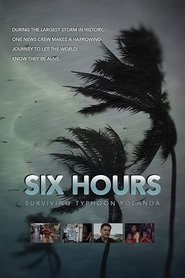
Six Hours: Surviving Typhoon Yolanda
د English ژباړه ډاونلوډ کړئ
د خپرونې معلومات
تګونه
د English سرليکونو مخکتنه
لومړۍ 200 کرښې.
Things are flying everywhere.
It sounded like howling dogs.
There's not even time to cry.
We hang on for our dear lives.
- Either they're dead or they're looking for their dead.
They too thought thought that they would die.
World just came crashing down.
- I'm Jiggy Manicad, I'm a senior news producer
and the anchor for GMA Network,
and I've been covering disasters and tragedies
in the Philippines and outside the country as well.
Good afternoon, sir.
- We only go to places for breaking news only.
- We were already in Tacloban to do coverage
of the preparations of the typhoon.
- When we heard about the gravity of the typhoon
the government officials, everybody was saying
that it was strong, really really strong,
but we didn't really mind it.
We were used to typhoons and storms
so it didn't really matter.
- Our country's visited by calamities most of the time.
In the Philippines you always get hit
by a bunch of tropical storms.
I mean, every time I've been there it's rained.
The situation was just normal
and the weather was just fine.
It's normal, sunny.
- There wasn't any strong winds at that time
so I wasn't expecting that much about Yolanda itself.
We weren't expecting anything.
- Though very few of us seemed to take it seriously,
Yolanda was already classified as a category five typhoon
even before it made landfall in the Philippines.
On November 7th, a day before,
my parents were kind of afraid.
So I looked for a hotel and then I checked them in Tacloban.
It was near Astrodome along Cancabato Bay at budget hotel.
The weather was okay, there was no wind, it was sunny.
I left the hotel and I said Mum, Dad,
I'll just fetch you tomorrow.
It was like a normal day, we were playing,
watching TV, eating, we had food.
I said okay, I have to go.
The storm might come 'round eight
so I think I'll just go and fetch you tomorrow.
So I arrived here, I fetched my girlfriend, she was with me.
We ate, then watched TV, watched a movie,
then, I mean, we felt that nothing was gonna happen.
We slept.
It's the usual news coverage now.
We will get up at 11 a.m.
and then call time is around 2 p.m.
The ordinary day to day news coverage.
It will be a super typhoon.
We finished at six p.m. and then we arrived
in our hotel at seven p.m.
We had dinner and then that's it, we rested.
Then around three a.m.
- I was awakened by the strong winds at around three a.m.
The wind was getting stronger.
Then we were looking around, looking out our window,
and then we saw some of the houses,
especially our neighbor here in front,
the house already had fell.
The storm hasn't started but most of the houses
were already falling apart,
so actually we were laughing.
Ah, look at that house, it fell down.
I was still on the radio.
I was live on radio and I was appealing to the people
to get out of the shorelines, get out of the coastal areas.
I alerted my team to start filming,
and also to record the sound of the winds.
- We were actually afraid, it was so strong.
It's really different, it's howling.
It sounded like howling dogs.
It was like how hell hounds sound like.
- While the storm was pounding on Tacloban city,
my air-conditioning unit was pushed inwards.
The ceiling on my room started to beat
as if it was like a heart.
The wall in my room cracked.
Things are flying everywhere,
be it pieces of wood, even trees.
I just stared at the street.
And then all of a sudden it's gone.
- And the wind direction is changing from time to time
so it was a very dangerous situation.
The only protection we had was the roof
and from time to time we would go inside our bathroom.
If my ceiling would collapse or be sucked out,
that would be it.
Around 6:30 in the morning I was able to do a live report
for the radio, the local radio,
and a program for GMA Network,
and by around 7:30 communications went down.
Jiggy?
Hello, Jiggy?
- After electricity was cut, everything was cut, just dark.
Dark but eerie white glow.
The floor was rumbling, the wall was rumbling,
everything was flying.
Little by little my house,
our house was being torn apart by the storm.
We looked around.
The house was totally destroyed.
But the first thing on my mind was how were my parents?
- We almost died, together with my wife and three children.
The storm surge for the first time,
the water from the sea, the water for the bay,
they met together, it was like this high already.
We were fortunate that we had a window
that we weren't escape through the window.
We hang on for our dear lives.
But fortunately the sea and the water subsided immediately.
If not for the window, the back of a room,
I think all of us would have perished.
- Myself, my family, people started getting worried.
You know, started calling home to call my grandmother,
my uncle, other family and friends out there
and the phone lines are shut down.
Not a single roof was in place.
All the trees were either broken, fallen,
or no leaves at all.
Everything was in a total destruction.
Thick glass, I mean that thick.
- We had to send a message, at least, that we were alive.
Not even the story, just the message that we were okay.
We lost the internet, we lost the mobile phone lines
so I told my team that the only thing
that would tell our relatives,
our boss that we're okay, we're alive,
to be able to deliver the news, is to go to Palo, Leyte,
which is about six hours away by walk.
By walk because most of the lampposts,
the trees have fallen on the roadside.
Even motorcycles can't pass through.
Our satellite is on another town.
It's around 15 miles away, so we had to walk
for about six hours just to get to that satellite setup.
That is the only chance that some of our story
will be able to come out.
Not to beat a deadline but to really send a message
across not only the Philippines but worldwide.
I did not expect that our communications team,
our satellite team, is still intact during that time
because I didn't have an idea.
I just have this theory that if we can go to Palo
and the satellite team is okay,
we might have a chance to communicate
whatever message that we have right now.
Of course we don't have communication.
That's the shortest place that we can go.
- I did not expect that even the basic mobility
that we have where the roads that we needed
would be blocked by all the debris, fallen trees,
fallen lampposts, just to be able to be mobile during that.
I did not expect that actually.
I expected a lot of damages on the roofs
or in the structures but not the roads
that we badly needed during that time.
So of course when I saw then
that we cannot even pass through
and we cannot even drive our service vehicle
going down the road, I mean,
I felt that this is going to be another problem for us.
It's going to be another challenge for us.
Problems piling up on each other.
You have a problem with communication,
you don't have communication, you don't have food, water,
now you don't have the basic mobility
that you need during that time,
so what you have is just yourself,
your clothing and the camera that we have during that time.
When I broached them the idea of walking,
going to Palo despite what we are seeing right now,
we were all convinced
that it was the best thing that we can do.
- We were shocked, we were in a state of shock.
I think there's no time for us, not even time to cry,
because people started coming in.
People who were wounded,
there were even those carrying their dead,
and we have to do something about them
so there was nothing we can do but just attend
to the people who came who were in need of help.
I converted the two big rooms there as a mini hospital.
We called for volunteers and a lot came,
but we had no doctors and then we had medicine
because we always had in our unit, in our HQ,
so we were able to treat a lot of people.
- At least about 100 meters away from our hotel room
which is still part of the property
of the owners of that hotel,
we immediately saw 12 dead bodies on the shoreline.
Children, women, men, and a lot of dead animals also.
A few persons we saw were volunteers
from the Philippine Red Cross which were doing the best
that they can to retrieve the bodies from the shoreline.
Six Hours: Surviving Typhoon Yolanda subtitles in other languages
More English subtitles for Six Hours: Surviving Typhoon Yolanda
- Six Hours Surviving Typhoon Yolanda 2014 1080p WEBRip x264 eng · 14 downloads · 2020-04-29
تبصرې
No comments yet. Be the first to leave one.