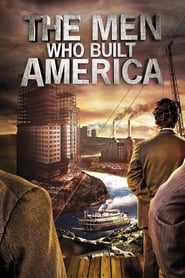
The Men Who Built America
د English ژباړه ډاونلوډ کړئ
د خپرونې معلومات
تګونه
Download English Subtitle Files for Mobile (8)
د English سرليکونو مخکتنه
لومړۍ 200 کرښې.
Just five days after the end of the Civil War,
President Abraham Lincoln is the final
of the six hundred thousand deaths
in America's bloodiest conflict.
The country is divided, and the world looks
at American democracy as a failed experiment.
But what most don't realize is that a new era has dawned.
The nation is entering an age of advancement,
and from the void left by the death of perhaps
the greatest statesman we will ever know,
a new breed of leader will emerge.
The Rockefellers, the Fords,
the Carnegies, were the first generation
of what we know as now the entrepreneurial rock stars,
or what are today are the Buffets,
and the Jobs, and the Gates.
They were the ones that set the standard for the American dream.
They owned a new frontier-- literally and figuratively--
of who we are as a culture.
Men of insight, innovation,
and ingenuity, the likes of which the world
has never seen, and over the next five decades,
this small group will change history,
propelling the United States ofAmerica to greatness.
These were great men
with a vision that nobody else had.
And that's why in the last century--
that fifty year period-- we built the world.
(Blues Saraceno playing "Save My Soul")
For the first time in the country's
short existence, the man most capable
of leading America is not a politician.
He's a self-made man, who, through sheer force of will,
turned a poor upbringing on the docks
of New York Harbor, into an empire.
At sixteen, Cornelius Vanderbilt buys
a small ferry boat with a one hundred dollar loan.
He quickly earns a reputation as a cutthroat businessman,
willing to use any means necessary to get ahead.
Back then, it was just pure competition.
My brain against your brain.
My effort against your effort.
You just competed.
That's the way they looked at business.
It was the Wild, Wild West,
and by hook or crook, it was just win or lose,
and the best win.
He was a tough guy.
Getting into scraps with other men,
beating the hell out of them and knocking them unconscious.
That competitive streak, and that toughness,
very much defined his character.
His single ferry soon becomes
a fleet of ships, transporting goods and passengers
to every corner of the growing country.
Vanderbilt will become so synonymous with shipping
that his nickname becomes "the Commodore".
I think Vanderbilt recognized
that what was going to be important is transporting goods
from one place to another.
And he had this idea that required infrastructure,
and not infrastructure the government was going to provide,
but that he was going to provide.
Over the next forty years,
Vanderbilt builds the largest shipping empire in the world.
Then, at the peak of his power,
just before the Civil War, he does the unthinkable.
Work is under way on the first Transcontinental Railroad,
and the Commodore realizes
that its completion will transform America,
slashing cross-country travel time by months.
Railroads were absolutely liberating,
because the railroads allowed cheap
and efficient transportation
from one corner ofAmerica to another.
Vanderbilt sees his future.
He sells all of his ships and invests
everything he has in railroads.
You talk about seeing around corners
as an element of success.
That's what differentiates a good leader.
Not many people have it.
Not many people can predict that corner.
That is a characteristic of great leaders.
His decision to invest heavily in rail pays off.
By the end of the war, Vanderbilt
is the richest man in America,
with a net worth of over sixty-eight million dollars,
the equivalent of seventy-five billion today.
But all that money can't buy his escape
from the war's devastation.
In the wake of the Civil War,
a country mourns publicly, while Vanderbilt does so privately.
The first card is the past,
the second, the present, and the third is the future.
There has been an unexpected loss.
Someone close to you.
My son. George.
He died in the war.
What about the future?
The chariot.
There will be a war.
The war's over.
No. Your war is about to begin.
Hey.
Watch it, man!
Tormented by the loss of his favorite son,
Vanderbilt's empire is more vulnerable than ever before.
For Vanderbilt, this is a great tragedy.
He had one son who had that same sense
of physical strength and ability,
and he had died when he was still quite young.
It was deeply troubling for the Commodore.
For years, Vanderbilt groomed George
to take over the family business.
Now, the Commodore is forced to rely
on his less accomplished son, William.
I'm making you operations director
of the Hudson Railroad.
Vanderbilt places William in the midst
of negotiations with the owners of a rival railroad.
So name your price.
If you give us your freight, year round,
we will give you the privilege of allowing your passengers
access into Manhattan for two hundred thousand.
That privilege is not worth two hundred thousand.
Then let us settle on one hundred thousand?
I believe that to be a fair and generous offer.
I'm not really interested in your generosity.
I'm only interested in getting the best deal
for my shareholders.
And that does not include handing
over one hundred thousand dollars, or even one dollar.
My father wants only what he believes is right.
The trouble is, your father doesn't know what is right.
The old man should be put out to pasture.
The message is clear.
The competition no longer sees Vanderbilt as a man to fear.
People are always rooting
for very successful people to fail.
The day people are not taking shots at you means
you're not on top anymore.
But where they see weakness,
the Commodore sees an opportunity
to assert his dominance,
and teach William what it means to be a Vanderbilt.
If they want a war,
I'll give them a war.
Vanderbilt owns the only rail bridge
into New York City.
It's the gateway to the country's largest port,
supplying the entire continent.
Vanderbilt knows this is the hammer he needs to beat
his rivals into submission.
Sit down.
I want you to close the Albany Bridge.
Without the bridge,
every other railroad is shut out of New York City.
Vanderbilt, in essence,
single-handedly erected a blockade
around the nation's largest city, cutting it off
from contact with the rest of the country.
He was now asserting his dominance.
Ladies and gentlemen,
this train will not be going any farther!
We're gonna watch them bleed.
The Civil War has left America in ruins.
For the first time in its history,
the nation must rebuild.
Over fifty-thousand miles of railroad track
have transformed the country.
"Commodore" Cornelius Vanderbilt grew up poor,
but has created a railroad empire,
making him the richest man in the country.
At 72, he's thirty years past the average life expectancy,
and his competitors see him as weak.
It's a mistake they'll come to regret.
Locked in a battle for control of the rail lines
east of the Mississippi,
the Commodore is holding nothing back.
I want you to close the Albany Bridge.
We're gonna watch them bleed.
Vanderbilt controls the only bridge
into New York City, America's busiest port.
Seizing an opportunity, he sets up a blockade.
This train will not be going any farther!
Shutting the bridge leaves millions of pounds
of cargo unable to reach the rest of the country,
and slowly bleeds his competitors dry.
Before their stock is worthless,
the presidents of the rival railroad
try to sell all their shares.
Word quickly reaches Wall Street,
triggering a massive sell-off.
Come on, put some money in that. Come on.
New York Central shares are dropping fast.
How low?
$20 a share.
Buy everything you can.
Vanderbilt was buying all of that stock
The Men Who Built America subtitles in other languages
More English subtitles for The Men Who Built America
- The Men Who Built America Frontiersmen S01 WEBRip x264-ION10 · 84 downloads · 2020-03-15
- The Men Who Built America Frontiersmen S01 WEBRip x264-ION10 · 56 downloads · 2020-03-15
- The Men Who Built America - S01E01 - A New War Begins eng · 66 downloads · 2017-06-24
- The Men Who Built America -Part1-A New War Begins 720p HDTV · 107 downloads · 2014-08-26
- The Men Who Built America 7of8 Taking the te House BDRip 720p x264 AAC MVGroup org-eng · 56 downloads · 2014-02-24
- The Men Who Built America 8of8 The New Mane BDRip 720p x264 AAC MVGroup org-eng · 57 downloads · 2014-02-24
- The Men Who Built America 6of8 Owning It All BDRip 720p x264 AAC MVGroup org · 57 downloads · 2014-02-24
- The Men Who Built America 5of8 A New Rival Emerges BDRip 720p x264 AAC MVGroup org · 53 downloads · 2014-02-24
تبصرې
No comments yet. Be the first to leave one.