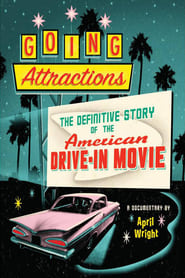
Going Attractions: The Definitive Story of the American Drive-in Movie
د English ژباړه ډاونلوډ کړئ
د خپرونې معلومات
تګونه
د English سرليکونو مخکتنه
لومړۍ 200 کرښې.
The show starts in two minutes.
The drive-in is a holy American icon.
It's actually a phenomenon.
My earliest memories of the drive-in
really had nothing to do with movies.
It really had to do with being at the drive-in.
They were heavily teenaged,
but there were also young families.
There wasn't internet, there wasn't computers,
and there wasn't the television.
The drive-in sort of came out of this car culture,
this time where we were trying to do everything in a car,
to be able to eat in your car,
and then to be able to watch a movie from your car.
And the drive-in kind of married Hollywood and cars,
that post-war euphoria of optimism.
There's something about going to the drive-in.
Being outside with a group of people
really makes a difference than just regular moviegoing.
By 1958, there was almost 5,000 drive-ins in the country.
They are becoming harder and harder to find.
You know, what happened to all the drive-ins?
They get plowed under. Something gets built over it.
And after five years,
people have forgotten what was there before.
Walmarts were buying the properties and whatnot.
Developers would come in,
and they'd say to a drive-in owner,
"I'll give you $500,000 for your property."
If you go by there, you'll see the ghosts of the place,
the way it was,
and I don't even need to see a picture of it.
The memories of the place are still there.
Maybe some of this really could make a difference
if people looked at this
and said, "Hey, what did happen?"
More than 70 million people in the United States
go to the movies each week to get away from their cares
and to find entertainment and thrills on the magic screen.
In the '30s,
which was the height of the big studio system,
the moviegoing experience was like a night in the theater.
Really gave the ordinary citizen the feeling
that they were in a palace.
Beautiful seats and a large stage
that could be used
for musical productions before or after the film.
All through the 1930s and into the '50s,
when people went out to the movies,
American society was a little bit more formal,
so people would dress up.
When you see pictures
of audiences in those earlier decades,
they are very formally dressed.
Take me to the drive-in picture show
When I'm with you, that's where I want to go
With the stars above, we fell in love
At the...
Richard Hollingshead Jr. decided
to put a sheet up between some trees
and bring the projector outside and screen some movies.
My dad -- he put a Model "A" Ford on our driveway,
put a projector on the hood, and put a screen on the tree.
He decided to start tinkering around
with different ways of placing cars
and eventually became
what we consider the ramp car system now,
where cars would pull up on a ramp.
He placed several cars on blocks to raise them --
the front of the car, up and down.
When they first built them,
they had a fixed ramp in front of a bulkhead.
You couldn't drive over it.
I believe he originally did it for his mother.
My grandmother Donna is the one that started it.
She was a big woman -- 6 foot tall.
She couldn't fit in the seat.
It grew and started charging admission
and eventually had to move out of the yard
and to a separate location.
The first drive-in theater opened
in Camden, New Jersey, on June 6, 1933.
And at that time,
they were charging 25 cents a carload.
The idea went over quite well.
They started springing up around the country.
The drive-ins were supposed to be paying royalty fees
to what was then known as Park-in Theatres Corporation,
though a lot of drive-ins didn't.
Wilson Shankweiler took four acres of land
and made Shankweiler's Auto Park,
which opened in 1934.
He actually paid Hollingshead 2 cents per patron.
And he had two very loud speakers.
You could wake up the neighborhood.
I'm sure that ultimately became a problem
with people hearing the movie who weren't watching the movie.
The Pico drive-in --
they had speakers mounted
in front of where you would pull your car up to.
Back when drive-ins first started,
they didn't have names.
Back then, they were just "drive-in."
By 1942, around the start of World War II,
there were about 100 drive-in theaters in the country,
and that stayed that way pretty much throughout the war.
Fire.
After World War II, the troops were coming home.
The economy's up.
People were buying cars again.
Got me a new car
It's a Cadillac Coupe de Ville
World War II --
a lot of shortages of rubber and fuel.
So families didn't have the resources,
if they had a car, to keep it running.
After World War II, all of that changed.
The car became kind of a symbol of post-war freedom.
It takes more than money
More than money
Keep a man warm at night
Takes more than money
More than money
After World War II, after the belt tightening,
families can be on the move much more easily.
First of all, they were moving into newly developed suburbs.
Like so many people these days, we live in the suburbs.
The suburbs.
1/5 of America, over 32 million people,
now live in the suburbs,
and 1.25 million more are moving in each year.
Before the expansion of the suburbs,
with all of the government funding from the G.I. Bill,
people tended to live in cities that were often very cramped.
So a lot of public investment
went into the development of suburban life.
Now they lived in neighborhoods
where kids walked to school or they went to the P.T.A.
You know, very homogeneous, suburban kind of situations.
Goin' to the drive-in
The drive-in was really a family event.
Ooh, ah
Goin' to the drive-in
We'd get in the back of the car or the back of a pickup truck.
I got to sit in the back
in the seats that fold down into the floor.
I thought that was cool.
I think a lot of it was convenience.
You could take your kids.
You can put them in their jammies.
You didn't need to get a babysitter.
My mom and dad did what I do with my girls right now.
They'd throw us in our pajamas.
Wearing pajamas to see the movie.
You can throw some pillows or a sleeping bag in the car.
You could all be together.
They fall asleep, usually before the second movie even starts.
Of course, we saw the Disney movies as little kids.
A lot of times,
it wouldn't be a movie that we'd be interested in,
but it was still, "Ooh, the drive-in!"
As a little kid, you'd look up at the huge movie screen,
and it's bigger than life itself.
It was a big event to go to the drive-in.
It was an important night.
Anything that catered to families
was a very, very big component of the drive-in.
The playground was, like,
the most important part of the drive-in experience
when I was a kid.
They wanted families to come in early
and to have something for the kids to do.
It would have been considered much more safe
to just send kids to the playground nearby
and watch the movie.
It was a family thing.
They let the kids run around and play on the playground
and the train rides and everything.
It was fun. It was fun.
They could get anything
from being, like, a park playground,
which would be a simpler playground.
Merry-go-rounds, clowns,
eventually go-kart tracks, bumper boats.
How we ever did it then, I'd never know,
because the liability today would kill you.
The drive-ins that had miniature golf courses.
There are some that had train rides
and other things for kids.
It makes the drive-in
a whole entertainment experience.
The Algiers had a fire engine.
I think the Wayne had boats.
All of the drive-ins had something.
It was a circus-like atmosphere
that you just didn't get at an indoor theater.
Every drive-in was, at one point,
out on the outskirts.
They were out in country pastures,
several miles outside of town.
More English subtitles for Going Attractions: The Definitive Story of the American Drive-in Movie
- Going Attractions The Definitive Story of the American Drive-in Movie 2013 WEBRip x264-RARBG · 39 downloads · 2017-06-06
تبصرې
No comments yet. Be the first to leave one.