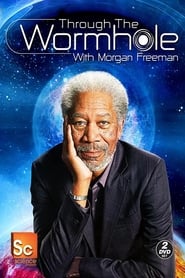
Through the Wormhole
د English ژباړه ډاونلوډ کړئ
د خپرونې معلومات
تګونه
د English سرليکونو مخکتنه
لومړۍ 200 کرښې.
Space... A vast empty ocean where a planet
like ours is a remote island...
Alone in the void.
Or is it?
New research is beginning to unveil a hidden force,
one that shakes the entire universe
and penetrates space
with trillions of invisible connections...
Instantly linking every place in our world
and joining our future with our past.
Now we're beginning to grasp these mystical powers.
Is the force... With us?
Space, time, life itself.
The secrets of the cosmos lie through the wormhole.
captions paid for by discovery communications
you know the story.
A long time ago in a galaxy far, far away,
there was a mysterious force,
surrounding us, penetrating us,
binding the galaxy together.
If you could wield this force...
You could do astonishing things.
Seem like a Hollywood fantasy?
Well, scientists now wonder
whether something like the force could be real.
Could there actually be a mystical power
that spans the universe,
connecting and binding all things?
Astrophysicist Jamie Rollins has spent his career
listening to the universe,
trying to detect a mysterious force...
one we've never been able to see.
Over the course of the history of astronomy,
light has essentially been
our only way of learning about the universe.
What we see out there is influenced by forces
coming from things
that we don't actually directly observe.
It's like walking around without being able to hear.
We know that there are sounds,
and we know that we could learn a lot from them
if we could hear them.
There is no sound in the vacuum of space.
But according to Albert Einstein,
gravity affects space in a very similar way to sound.
We've been able to demonstrate many of the predictions
of Einstein's general theory of gravity.
The one big one that we haven't is the fact
that there should be waves of gravity.
Gravitational waves are one of Einstein's
most elusive predictions.
He believed that space is not truly empty,
but acts like a kind of substance
that can be warped by masses
like stars and galaxies.
And when massive objects move suddenly,
they send ripples across space,
squeezing and stretching everything they encounter...
from planets to the people living on them.
Detecting these gravitational waves
would prove that we are physically joined to the cosmos
by a fabric of space,
and that events across the universe exert
a tangible force on us.
But detecting this force is no easy task.
The waves that pass through the Earth
are essentially unfathomably small.
We have to make incredibly sensitive detectors to be able
to experience this effect.
LIGO...
the laser interferometer gravitational-wave observatory...
is one of the world's biggest scientific experiments.
Each of its arms
is four full kilometers long.
To rule out Earthquakes and other forces,
LIGO has two separate detectors...
one in Louisiana, one in Washington state.
LIGO compares the way two high-powered laser beams
move up and down each of its long arms.
Mirrors at the end of each one bounce
the laser beams back to the center,
where they're compared by computers.
As long as the length of the two arms are exactly the same,
then the light going into the two arms
will come back and be exactly in synch.
If a gravitational wave passes through the Earth,
it would cause the arms to squeeze and stretch,
throwing the lasers out of phase with each other.
Jamie is one of LIGO's more than 1,000 scientists.
And, for him, the principle
by which the detector works is very familiar.
As a former DJ, he's used to listening
to tiny discrepancies in sounds.
Let's say I've got two identical records
that I've started at the exact same time
such that the songs are exactly synchronized together.
If we were to disturb one by,
say, dragging my finger along the side,
then this record would fall out of phase with the other one,
which would produce a shift in the sound that we can hear.
If you're listening to one record,
you might not notice that effect.
Now if we were to speed up on record
and slow down the other, the songs come in
and out of phase with each other.
This is very similar to what happens to the light
in the arms of the interferometer.
The changes in length
that we're looking for are so miniscule.
They're smaller than the nucleus of a single atom.
It's completely imperceptible to the normal physical world
that we experience.
But in September 2015,
after more than two decades of development
and more than a billion dollars,
LIGO finally detected a ripple in space.
It sensed a staggeringly violent event,
one that took place a long time ago
in a galaxy a billion light years away.
What we detected was a binary black hole system
which is two black holes that are in a tight orbit
around each other...
in fact, at the very end of their lifetime
as a binary system.
As the two black holes spiraled together and collided,
the fabric of space shuddered and a billion years later,
LIGO felt it.
To Jamie, that ripple in space
is proof that gravity
connects everything in the universe.
It was incredibly gratifying.
But it's also the excitement
to know that there's so much to be learned
by having this new sensory perception in the universe.
It's really as if we're connected
to the rest of the universe in a totally different way.
One omnipresent force, the force of gravity,
binds the universe together.
But how does gravity actually connect planets,
stars, and people?
Cosmologist Claudia De Rham is taking aim
at the elusive substance of gravity itself.
For all the forces that we know,
there's a particle associated with that force,
which is responsible for carrying the force
through empty space.
When I bring that magnet close to the horseshoe,
I can feel the magnetic force.
And for the magnetic force, the electric force,
the particle is the photon.
It's not visible light, but it's there nonetheless.
And one of the great mysteries of physics today
is whether there's a particle associated
with the gravitational force.
Claudia is obsessed
with finding gravity's hidden mechanism.
How does this mysterious force stretch across the cosmos,
silently tugging on everything?
But gravity is not easy to study.
Because of all the forces we know,
gravity is the weakest.
We think of gravity as this huge,
powerful force that keeps us glued
to the surface of the Earth.
But, actually, it's remarkably easy to overcome.
All it takes is a few fans.
Right now, a powerful
wind is pushing Claudia away from the Earth.
Molecules of air are hitting her body
and forcing it upward.
But something else is forcing her down.
You could almost picture a tractor beam pulling me down.
And if anything is, in physics,
we're having a huge debate on
whether gravity is a force or not.
According to Einstein,
there is no force of gravity
pulling on these skydivers.
The huge mass of the Earth
simply distorts the shape of space near it,
and they follow the contours of that shape.
But quantum mechanics has a different approach.
According to this theory of the most fundamental particles,
something really is passing
between the skydivers and the Earth...
identical little chunks of gravity called gravitons.
Right now, I'm exchanging gravitons with the Earth.
They are traveling between the Earth and me.
If we could see gravitons,
we'd see tractor beams everywhere,
making hidden connections
between everything that has mass.
Claudia believes these graviton tractor beams
keep us all stuck to the Earth...
at least, when we're not in a wind tunnel.
But they have never been detected
in any scientific experiment.
It's extremely hard to catch a graviton.
When a graviton comes,
it just goes straight through me.
Through the Wormhole subtitles in other languages
More English subtitles for Through the Wormhole
- Through the Wormhole S02E06 Are there parallel universes · 51 downloads · 2018-02-08
- through the wormhole s08e04 is gun crime a virus internal 720p HDTV x264-DHD · 67 downloads · 2017-05-17
- through the wormhole s08e03 can we hack the planet internal 720p HDTV x264-DHD · 56 downloads · 2017-05-10
- through the wormhole s08e02 can we cheat death internal 720p HDTV x264-DHD · 64 downloads · 2017-05-04
- Through the Wormhole S07E04 Can We All Become Geniuses 720p WEB-DL x264-Sleepless · 72 downloads · 2016-10-10
- Through the Wormhole S07E04 Can We All Become Geniuses 720p HDTV x264-DHD · 50 downloads · 2016-09-22
- Through the Wormhole S07E04 720p HDTV x264-DHD Can We All Become Geniuses? · 54 downloads · 2016-09-21
- Through the Wormhole S07E03 Are There More Than Two Sexes 720p HDTV x264-DHD · 59 downloads · 2016-09-14
تبصرې
No comments yet. Be the first to leave one.