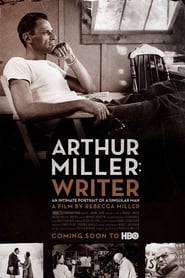
Arthur Miller: Writer
د English ژباړه ډاونلوډ کړئ
د خپرونې معلومات
تګونه
د English سرليکونو مخکتنه
لومړۍ 200 کرښې.
What a real playwright has to do
is to say to the audience, in effect,
"This is what you think...
you're seeing in life every day,"
and then to turn it around and say,
"This is what it really is."
Imagine if we knew the truth.
Man: That's a very lovely thought, all right.
That would be great thing.
And once, sometimes, in a lifetime,
a playwright can get at it, really.
Man: Playwright Arthur Miller has received
virtually every artistic award which denotes
distinction, creativity, and acclaim.
Man 2: A great deal of publicity attended Arthur Miller.
Dick Cavett: ...with a giant of the American theater--
Arthur Miller.
Rebecca Miller: My father had become
a national icon of the theater decades before I was born.
He had lived through so many different eras,
almost like different lifetimes.
Man 4: Why did you refuse the invitation
of President Johnson?
Man 5: Are you a member of the Communist Party
or have you ever been
a member of the Communist Party?
Rebecca: Early on, I recognized
that his public persona was so different
from the man I knew,
and I felt I was the only filmmaker
that he would let close enough
to really see what he was like.
So I started doing interviews with him
and his siblings, friends,
taking a lot of home footage
and gathering old movies and photos,
over a period of about 20 years.
And all that footage sat in storage
for quite a long time, until I decided
it should be shut away no longer.
Rebecca: Have you decided on what to wear?
Arthur Miller: Well, you sort of decided for me.
It's what I wore all week.
I got up and I sat down, and I'm just breathless.
Rebecca: OK, Pop!
Miller: All those goddamn angles drive you crazy.
Rebecca: Dad, do you think there are any similarities
between building furniture and writing plays?
The way I look at it, it's...
there are forces that want to break out,
and forces that want to contract.
And if you've got a sense of form,
you can make that projectile on stage...
move like a living...thing.
And move people with it.
If it just lies there... motionless,
it means that some of the forces in it
haven't been captured.
Or you haven't evoked them.
Did your father like to eat as much as you do?
Some restaurants, they loved him,
so they'd never let him pay.
I went into one restaurant in those years,
twenty-five years ago,
sat down, had a little lunch,
waiter came over to me and said--
leaned over the table and said,
"Your father was a better dresser."
Miller: My father had arrived in New York all alone,
from the middle of Poland,
before his seventh birthday.
Came here alone
with a tag on his...coat.
And his family was here.
But why--I never understood why,
how they could have done that.
I think they must have thought there was something wrong with him.
Miller: He used to say that
he would always be sleeping with idiots.
And I have the feeling that he may have been
in some kind of an institution.
Rebecca: You think that they thought there was something--
Yeah.
I can't imagine them leaving him here otherwise.
Rebecca: You mean in Poland?
Miller: Yeah, I think he's right.
Miller: He arrived in New York.
His parents were too busy to pick him up
at Castle Garden,
and sent his next-eldest brother Abe,
going on 10, to find him,
get him through Immigration,
and bring him home to Stanton Street
and a tenement where, in two rooms,
the eight of them lived and worked,
sewing the great, long, many-buttoned cloaks
that were the fashion then.
They sent him to school for about six months.
Figured he had enough.
He never learned how to spell, he never learned how to figure,
then he went right back into the shop.
By the time he was twelve,
he himself was employing two other boys
to sew sleeves on coats alongside him
in some basement workshop.
Kermit: He went on the road,
when he was about 16, as a--
selling at a wholesale level.
He ended up being the support of the entire family,
because he started a business in 1921 or something,
the Miltex Coat Company, which turned out to be
one of the largest manufacturers in this country.
See, we lived in Manhattan then...
on 110th Street, facing the park.
It was a beautiful apartment up on the sixth floor.
We had a chauffeur-driven car; the family was well fixed.
It was the '20s,
and I remember our mother and father
going to a show every weekend
and coming back Sunday morning.
She would be playing the sheet music
of the musicals.
And we would fight about who was going to sing with her.
Or who wasn't going to sing with her.
And who wasn't going to sing with her.
Generally, he wasn't going to sing.
Rebecca: That's nice.
Dad, what does this remind you of?
It reminds me of...
Miller: You know, she could read a novel
in an afternoon.
She was the fastest reader
I have ever met in my life.
Not only that, but she'd remember it
for the rest of her life.
Well, she was a very complicated woman, very complex.
She had the energy of a dynamo.
She could sing, she could play the piano...
She could be quite flamboyant.
She used to dance on the table New Year's Eve.
She could draw, she could-- she was a helluva bridge player.
- She was funny. - Very bitchy.
She had an attitude about most things.
Rebecca: But you kept kosher when you cooked?
Well, yeah. Till she started making bacon.
She loved bacon.
I think she tried to rule and divide the kids.
See, I always considered myself the favorite.
Rebecca: Who was your mother's favorite?
Miller: Yeah, I think I was.
I would, for example, if I didn't want to go to school,
I'd start limping around.
My mother immediately caught on, and she said,
"You don't have to go school today,
you're limping."
And we'd both go to some place and have oysters.
Rebecca: But your mother,
you said that she saw portents in a lot of things, right?
She saw signs.
She saw...mysterious things in the air from time to time.
She'd have feelings from people.
She once sat up in bed in the middle of the night,
she suddenly said, "My mother died."
And indeed, at that moment, her mother had died.
It was spooky.
How you you think that it translated into you, though?
Well, I used to think that the way that a play
was not about what was spoken,
but was between the spoken lines.
That the world, essentially, is not what we call "real."
And these arts are attempting to approach that world.
And it all comes from my mother.
You know, in my case, it's always coming from somewhere.
She was that way.
She idolized artists,
pianists, writers, and so on.
My father had no knowledge of any of that.
Fran: And it was an arranged marriage.
For a woman of her ability to be married off
to a man who couldn't read or write--
I think Gussie taught him now to read,
and then to sign his name.
Miller: She knew she was being wasted, I think.
But she respected him a lot,
and that made up for a lot.
Until he really crashed economically--
she got angry then.
Newsman: These tremendous crowds
which you see gathered outside the Stock Exchange,
are due to the greatest crash
in the history of the New York Stock Exchange.
Miller: First, the chauffer was let go
and the summer bungalow was discarded,
the last of her jewelry had been pawned or sold--
and then another step down: the move to Brooklyn.
Not just the case of my father,
but every boy I knew.
I used to pal around with half a dozen guys,
and all their fathers were simply blown out of the water.
The whole family orbit changed.
Arthur Miller: Writer subtitles in other languages
More English subtitles for Arthur Miller: Writer
- Arthur Miller Writer 2017 1080p AMZN WEB-DL ENG HI · 16 downloads · 2019-12-18
تبصرې
No comments yet. Be the first to leave one.