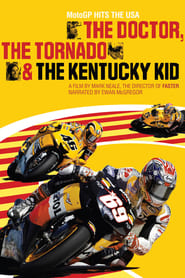
The Doctor, The Tornado & The Kentucky Kid
Скачать English субтитры
Информация о релизе
Теги
Предпросмотр субтитров (English)
Первые 200 строк.
A Grand Prix is like a heist.
Beating the best riders on the fastest bikes in the world
is more than a matter of racing ability.
It requires expert teamwork,
elaborate preparation and faultless execution under massive pressure,
with no margin for error.
The race is on Sunday at 2:00 p.m.
The teams arrive on Wednesday.
They have four days to crack the code of the racetrack
and set up the bike for this particular collection
of twists, turns and elevation changes.
The riders practice on Friday and Saturday.
Two days to master the track and prepare themselves
for racing combat
at speeds of over 200 miles per hour on the fastest tracks.
There are 17 races on the MotoGP calendar.
Each at a different circuit,
presenting different challenges.
The Red Bull US Grand Prix at Laguna Seca
is a particularly difficult proposition.
Laguna is one of the most technically demanding
and physically intimidating circuits on the planet.
More than that,
this is the first Grand Prix on US soil since 1994.
Most of the riders have never been here before.
- (crowd cheering) - (air horns blowing)
Among the Laguna rookies is one very special Italian.
World champion Valentino Rossi.
The Doctor, as he is known to millions of fans around the world.
As of July 2005,
the 26-year-old has won 48 Grand Prix
and four straight world titles in the premier class.
After winning five of the season's six races so far,
he's well on his way to his fifth MotoGP championship,
and well on the way to sporting immortality.
Among those who have raced at Laguna before
are three Americans looking for their first MotoGP victory.
Colin Edwards and Nicky Hayden moved into MotoGP in 2003.
John Hopkins, the year before.
If ever there was a race they wanted to win, this is it.
Improved Subtitle by Sailor420
!!! Hope you enjoy the show !!!
The race before Laguna was at Assen,
a classic fast flowing European track,
almost three miles long, and this being Holland,
as flat as a pancake.
It's a place Rossi likes.
He's won three MotoGP races there,
including this one, ahead of rising Italian star Marco Melandri.
Third place at Assen was Colin Edwards' second podium of the season.
Hayden finished fourth,
Hopkins a distant 13th, his Suzuki down on power.
Hayden's Honda is widely regarded as the best bike out there,
but he hasn't made it onto the podium in any of the first six races.
This is his third season in MotoGP.
If he wants to hang onto the top spot at Honda,
he needs to start winning.
Laguna Seca is the complete opposite of Assen.
This is Californian earthquake country.
The only flat part of the 2.3 mile circuit is the dry lake bed,
which gives the place its name.
And which contains turns three, four and 11.
The other eight corners follow the contours of the hills
around the lake and range from
steeply-banked fast sweepers to hair-raising blind descents.
After Assen, the riders' thoughts turned to the American race.
Edwards, Hayden and Hopkins know Laguna well
and have won races here in other championships.
At this point, the closest Valentino Rossi has come to it
is on a video game at home.
This one is one of the hardest races for me.
It's a different type of track
compared to all the other tracks.
A lot of strange points like the Corkscrew.
As you climb the Corkscrew,
it's blind, all you see is the sky.
The Corkscrew awaits you at the top of the hill
on the south side of the circuit.
The corner's blind entry
drops into a steep left-right chicane,
which looks more suited to downhill skiing than motorcycle racing.
The big drop-off is like a roller-coaster.
Once you turn in, you gotta have the confidence
just to flick it right, and wait for the suspension to load up,
to open the throttle.
That's my favorite part of the track.
So much G-force right when you get to the bottom of the Corkscrew.
And then you just throw it into the left-hander.
The corner's so banked that you can just throw it in there completely hard.
You want to stay mid-track there, as tight as possible coming out of that corner
and then you drop down into the right-hander, that corner as well.
From the Corkscrew to turn 11, it's just an unbelievable sensation.
It's all about momentum from the top of the Corkscrew
till you put the brakes on for turn 11, keeping your speed up.
If you mess up one corner, it throws that whole section off.
The last corner, turn 11, it's pretty simple once you come out,
they really gonna wanna wheel it. I'm sure we'll be standing on the rear brake,
trying to keep the front wheel down so we can open the throttle.
Everybody talks about the Corkscrew
and how it's the masterpiece of Laguna.
Honestly, turn one is a hell of a lot more scarier than the Corkscrew.
Turn one doesn't look like much of a corner.
At over 150 miles an hour, it is.
Corkscrew, you're only in second gear.
Except at turn one, your shift's tapped.
You want to touch the rear brake,
It keeps the g-force under the front end,
keeps the front wheel down.
Coming up over the hill,
you're gonna want to pick it up and let it run all the way out
to the white line at the edge of the track while braking.
And it takes years of experience to get to the level
where you can actually feel the front end
and know exactly the fine line between keeping it upright
and sliding the front end.
Turn three catches a lot of guys off.
I'm no different.
It's just so flat.
You really have to rely on your front end.
That's gonna be where you want the best setup possible for the front end
and have as much feedback from it as soon as it slides out.
It's pretty open on the way in,
then gets tight as you exit, so that's what makes the trick.
Turn four is really fast.
That's where you make your time, in the fast corners.
Turn five is a good one.
There's a couple of different lines in there.
A lot of guys brake a little bit early,
and try to set themselves up for a good drive up the hill,
and it's really just like the pass. Turn six,
that's when it starts happening.
I've crashed there a couple of times while testing.
It's a very difficult corner.
You know, you think it's a lot more banked than it actually is.
You're carrying a lot of speed into that corner
from that little short straight you have.
It's very important to get the best drive possible
coming out of that corner, so you want to have the thing upright as soon as possible,
driving up the hill.
When you get to the bottom of the dip,
it fully loads your suspension and then it unloads
right as you're trying to accelerate, so,
there's no weight on the rear wheel.
Turn seven going up over the hill into the short left-hand kink,
you've got to know exactly where you are on the track.
It's very easy to just run wide and run straight off the track.
Laguna is everything from
fourth gear corners, to first gear corners,
uphill, downhill, off-camber, camber.
It doesn't really have a straightaway that you can relax,
and even on a normal track, it might only be two seconds,
three seconds on a straightaway,
that you get to kind of loosen the grip.
You miss that when you're at Laguna
'cause you don't have two or three seconds to loosen your grip anywhere.
Laguna's different than any other track.
Some of the new tracks now, they're all the same.
They make 'em on a computer,
and they're designed for Formula 1,
but I can tell you, this track, it definitely
wasn't designed on any computer.
It wasn't designed by a guy sitting in an office, in a chair.
It's a real racetrack with real character.
We live with these people. I see these people more than I see my family.
Big Jeffrey.
Tremblay.
Howard.
- Okay? - Doing good.
You all right? Tom?
- All right? - Yeah, not bad.
Wednesday, we spend all the morning to set up the garages.
And in the afternoon, we start to do a little bit of work on the bikes.
The crew chief, with the engineers,
they started to make a technical plan.
Each MotoGP team consists of a group of highly-skilled specialists
with clearly-defined roles.
They figure out the track together, set up the bike together,
work hand in glove for four days
until 2:00 on Sunday.
Then it's all down to the guy on the bike.
We have a couple of rocket scientists on our team.
They process the information.
It's up to the rider, really, to kind of ask what he wants with the bike.
But at the same time, if your data guy sees anything
or your crew chief sees anything
funny on the day, he can ask you, "Hey, you know,
"you can't quite get it to full throttle in second gear.
"Does it have too much power? Too little power?
"We can do this. We can do that."
And it's definitely a team effort.
Like a pyramid, you've got the rider on the top
and a lot of slaves underneath, doing a lot of work.
And they have their individual goal of winning the championship,
or winning the race, and they get the full support of the immediate team
and the engineering group, all the way back to Yamaha in Japan.
We got some old data from Noriyuki Haga, on the Yamaha,
and some of what I remember
back in the superbike days, and we kind of put all that together.
At least it'll give us a ballpark to start from.
When we are in a new circuit,
Комментарии
No comments yet. Be the first to leave one.